










Indian Equity Markets Face Sideways Consolidation After Rally
Key highlights
- Nifty faces a broader resistance zone between 25,000 and 25,200.
- Sensex and Nifty fell by as much as 0.6% on November 13 after the recent rally.
- Nifty was cited near 23,000, around 12% below its January peak, in a separate market assessment.
- Analysts expect a range-bound phase for the next three to six months.
powered by IRIS
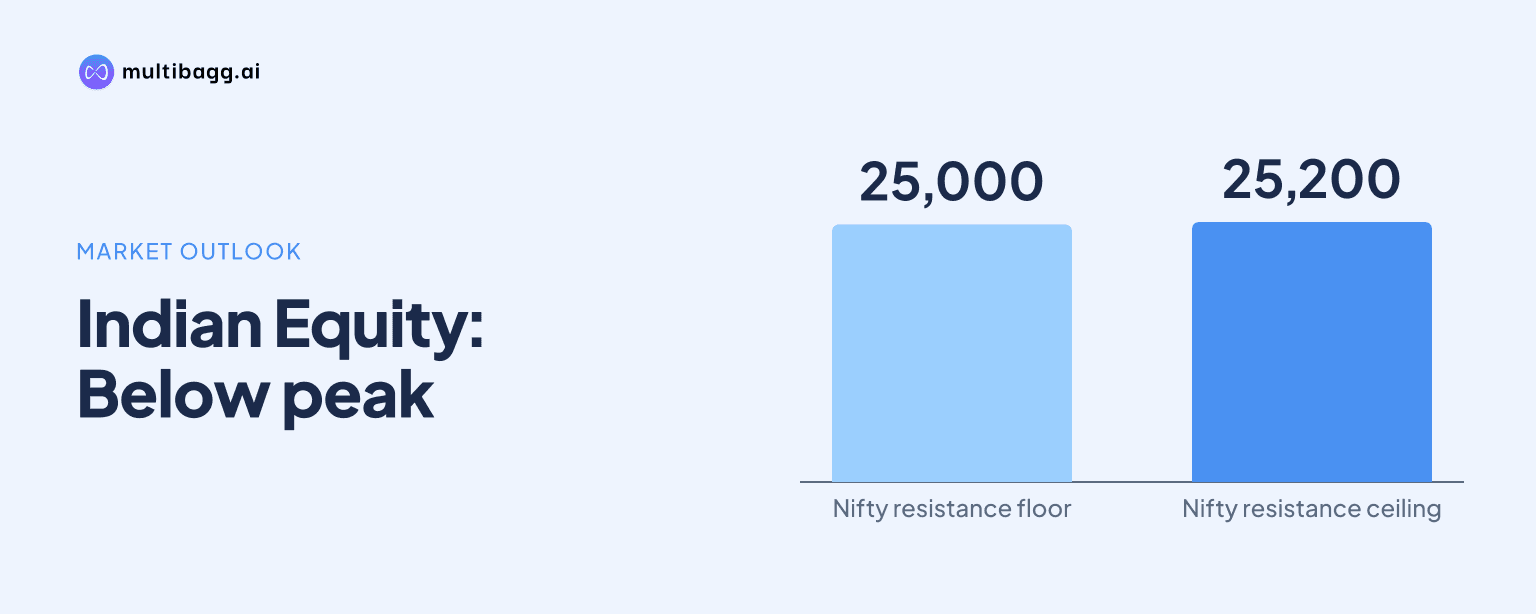
Indian equity markets are expected to move sideways after a strong run, with analysts identifying Nifty resistance between 25,000 and 25,200 and warning that higher crude oil prices, profit booking and foreign flows could determine the next move. The recent rally has improved sentiment, but it has also brought the market close to broader resistance levels.
Why are Indian equities expected to consolidate?
Indian equities are expected to consolidate because the market has shifted from a one-way rally to a phase where investors assess valuations, earnings and global risks. Vikas Khemani said a consolidation after a strong run is natural and potentially healthy. His view is that the market may not correct sharply, but could spend the next couple of months moving sideways in a time correction.
Recent trading supports that assessment. The benchmark indices saw their rally slow as profit booking and temporary spikes in oil prices checked bullish sentiment. Sensex and Nifty fell by as much as 0.6% on November 13 after a strong run, while a holiday-shortened week saw narrow-range trading with a positive bias. Despite the pauses, steady foreign inflows and resilient quarterly earnings helped the benchmarks finish marginally higher for the week.
What Nifty levels and signals are shaping sentiment?
Nifty resistance at 25,000-25,200 is a key marker for the current consolidation discussion, while crude oil, the rupee, foreign investor activity and earnings momentum remain the main signals for direction. Analysts have also pointed to the 22,800-23,100 range in a separate assessment, when Nifty was near 23,000 and about 12% below its January peak.
The differing levels reflect market commentary from different points in the consolidation cycle, but the underlying message is similar: a sustained move requires supportive macro conditions and continued corporate earnings delivery. Investors are watching whether foreign buying can persist after earlier outflows and whether energy costs ease enough to reduce pressure on inflation and sentiment.
Got a follow-up? Ask IRIS
Can consolidation shake retail investor confidence?
Consolidation could test retail investor confidence if returns remain low or markets decline while fixed deposit rates become relatively more attractive. Sanjeev Prasad of Kotak Institutional Equities said that combination could shake retail faith in equities over the next few months.
Retail participation has been an important support for Indian equities in recent years, through both mutual funds and direct investment. Other market participants take a different view, arguing that investors should use the consolidation period to add to equity positions rather than try to time the market. The contrast shows that retail behaviour may depend less on one volatile session and more on how long the market remains range-bound.
Which parts of the market carry greater correction risk?
Stocks with frothy or excessive valuations could face a sharper correction even if the broader market remains broadly sideways. Khemani flagged the possibility that pockets of the market where valuations have run ahead could see selling during this phase.
The preference expressed by Geojit Investments is for selectivity, particularly large-cap stocks with earnings visibility. That stance reflects a market where headline indices may be supported by foreign inflows and better earnings, while individual stocks can react differently to valuation concerns. A consolidation therefore need not mean a uniform fall across Indian equities, but it can widen the gap between companies with visible earnings support and those exposed to elevated expectations.
What could end the range-bound phase for Indian equities?
A durable move out of consolidation would depend on easing crude oil prices, a stable rupee, sustained foreign buying and continued earnings momentum. Nikunj Saraf of Choice Wealth described the next three to six months as a likely range-bound period rather than one with a clear directional trend, unless those variables align.
Fund managers have also cited improving large-cap earnings, lower crude oil prices and a turn in foreign investor flows as potential signs that peak pessimism has passed. One market view expects a gradual recovery after a 24-month consolidation if crude oil falls below $90 a barrel. Conversely, another oil spike, geopolitical uncertainty or continued foreign outflows could renew pressure and push markets towards lower support levels.
Conclusion
Indian equities are entering a phase in which consolidation appears more likely than a straight continuation of the recent rally. Resistance near 25,000-25,200, profit booking and inflation concerns argue for caution, while foreign buying and better-than-expected quarterly earnings have so far helped contain downside pressure.
The next three to six months will be shaped by crude oil prices, the rupee, US monetary-policy signals, foreign investor flows and earnings momentum. Retail investors will also be watched closely: a prolonged period of flat returns alongside higher fixed deposit rates could challenge participation, while stable macro conditions could support gradual recovery.