










Nifty 50 Faces Prolonged Volatility as Foreign Selling Persists
Key highlights
- The Nifty 200 fell nearly 16% over 165 days during the reported correction.
- FIIs reportedly sold more than Rs 2 lakh crore of Indian stocks since October 2024.
- Nifty was reported to be at risk of its first five-month losing streak since 1996.
- One report said Nifty declined nearly 6% in September and logged eight consecutive weekly losses.
powered by IRIS
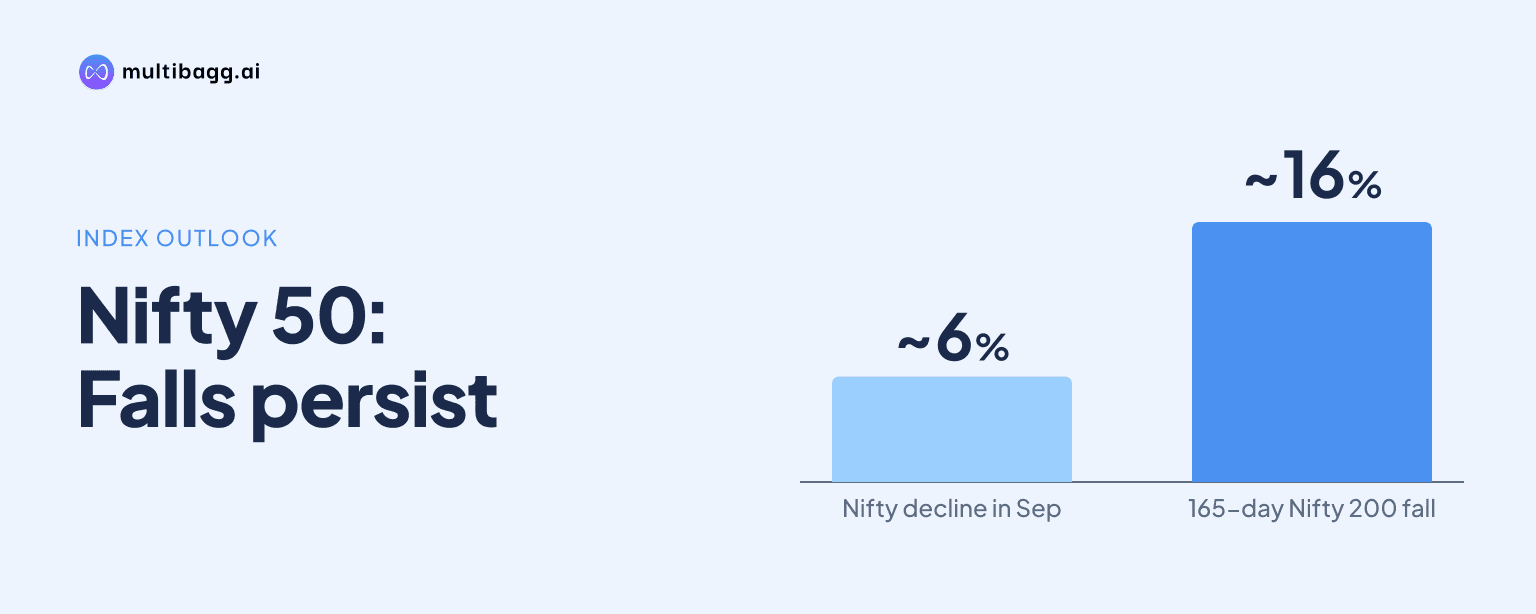
Nifty 50 is facing a prolonged period of volatility as foreign institutional investor selling, elevated global risks and concerns over earnings and valuations weigh on Indian equities, while the broader Nifty 200 has fallen nearly 16% over 165 days. The trend has tested investor confidence more than a short, sharp market correction.
Why is Nifty 50 facing sustained selling pressure?
Nifty 50 is under pressure because foreign institutional investors have continued to reduce exposure to Indian equities amid a stronger dollar, higher US yields, rupee weakness and concerns around crude oil. One report said FIIs had offloaded more than Rs 2 lakh crore of stocks since October 2024, while another cited weekly sales of Rs 34,970 crore during a period of market weakness.
The social-media discussion also points to capital shifting towards recovering Chinese markets. That flow matters because overseas investors can influence liquidity and sentiment, particularly when global investors are moving away from emerging-market risk. Analysts cited in the context said domestic liquidity can cushion declines, but it may not deliver a sustained recovery if foreign selling continues.
How do global factors affect the Indian market?
Global factors affect Nifty 50 through risk appetite, capital flows and the cost of money. The discussion identifies higher US bond yields, a firm dollar, elevated crude prices and a weaker rupee as major headwinds. Oil prices were also reported at $114 a barrel during a separate spell of market pressure tied to geopolitical tensions in the Middle East.
A potential US recession is another risk cited by market participants because it can trigger a global sell-off and lead overseas investors to pull money from emerging markets. India’s domestic focus may offer relative support, but it does not eliminate external exposure. The context specifically notes that the IT sector could be more vulnerable if the US economy slows, given its links to overseas demand.
Got a follow-up? Ask IRIS
Is this correction different from a sudden market crash?
This correction is described as different from a sudden crash because its length, rather than only its daily price move, has become the central concern. The Nifty 200 decline of nearly 16% across 165 days was attributed to weak corporate earnings, expensive valuations and persistent FII outflows, rather than a single major external shock.
A prolonged decline can be difficult for investors because it erodes patience and confidence over time. Market commentary in the provided discussion warns that investors may be better prepared for abrupt volatility than for a market that remains weak or rangebound for months. India VIX has also been discussed as a sentiment signal, as volatility usually makes investors more cautious and its relationship with Nifty 50 is typically negative.
What could stabilise Indian equities?
Indian equities could stabilise if foreign selling eases, crude prices and US yields become less disruptive, and corporate earnings offer clearer support for valuations. Analysts quoted in the discussion said the next leg of recovery depends on second-quarter earnings, particularly top-line growth, margins and management commentary.
There are also constructive views in the material. India’s projected FY26 growth was cited at 6%, and some analysts described the economy as relatively domestic-focused and better positioned than some peers. One market view expects Nifty 50 to remain in a 22,000 to 25,000 range over the next 10 to 12 months, while others see large-cap stocks as potential leaders if a recovery emerges. These remain forecasts, not confirmed outcomes.
Conclusion
The combined picture is of a market dealing with both external and domestic pressures. Foreign investor outflows, high global yields, oil and currency risks have hurt sentiment, while questions around earnings and valuation have made the correction longer and more difficult for investors to assess. At the same time, the discussion does not portray the downturn as evidence of a broad collapse in India’s domestic economy.
The next signals to watch are the pace of FII selling, crude oil prices, US bond yields, rupee movement and quarterly corporate commentary on revenue and margins. A durable rebound will depend less on a brief technical bounce and more on whether those pressures ease while earnings regain momentum.