










Securities Transaction Tax Hike Raises Market Volume Concerns
Key highlights
- STT on equity futures was raised to 0.05% from 0.02% in the Union Budget 2026.
- STT on options premium and option exercise was raised to 0.15%.
- Nearly 88% of individual equity derivatives traders lost money through March 2026, with losses of about Rs 91,700 crore.
- The Nifty 50 fell 1.96% to 24,825.45 in the special trading session after the announcement.
powered by IRIS
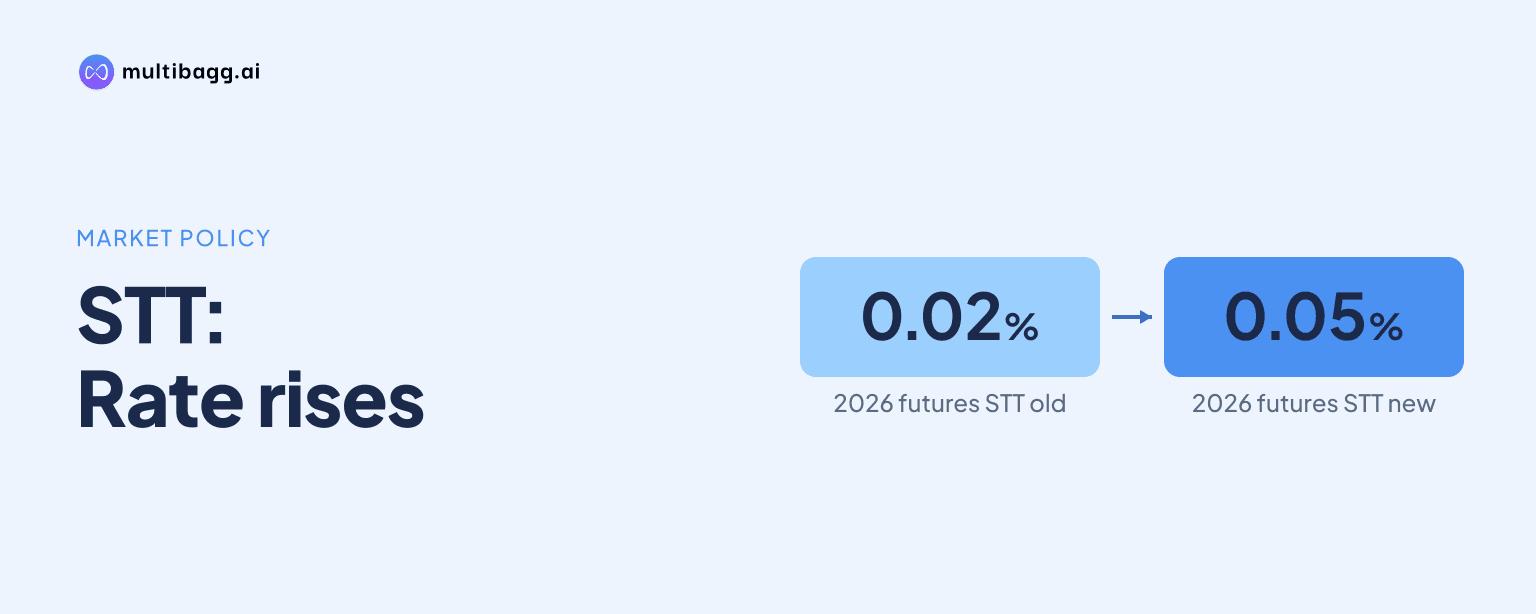
India's Securities Transaction Tax (STT) hike raised the levy on equity futures to 0.05% from 0.02%, adding to concerns over trading volumes after 88% of individual equity derivatives traders lost money in the year through March 2026. The policy debate now centres on curbing speculative activity while supporting participation in the cash equity market.
What changed in the 2026 STT rates?
The Union Budget 2026 increased STT on equity futures and options, materially raising transaction costs in the derivatives market. Finance Minister Nirmala Sitharaman said the futures rate would rise to 0.05% from 0.02%, while the tax on options premium and the exercise of options would each rise to 0.15%.
The changes affect a market where frequent trading can make transaction charges significant. One estimate cited in the discussion said traders selling Rs 1 lakh of futures would pay Rs 20 in STT, compared with Rs 12.50 earlier. The following table sets out the announced rate changes.
Why are officials reviewing further tax changes?
Revenue officials are reviewing proposals to raise taxes on stock derivatives while lowering levies on share trading, according to people with knowledge of the discussions. The stated aim is to reduce speculative bets in derivatives and encourage broader participation in the equity market.
One proposal under review is a 50% reduction in STT on buying and selling shares. The people said a shortlist of recommendations would be presented to Finance Minister Nirmala Sitharaman for final consideration closer to a budget announcement due in February. These deliberations are private, and the reported proposals do not amount to a confirmed policy decision.
The review reflects a concern that derivatives have received more favourable tax treatment than cash shares, contributing to rapid growth in options activity while cash trading lagged. Any eventual change would therefore matter not only for active traders but also for exchanges, brokerages and investors using the cash market.
How did the STT announcement affect Indian shares?
The STT announcement prompted a sharp sell-off during the special weekend trading session, with investors focusing on the risk of lower derivatives volumes and pressure on earnings at exchanges and retail brokerages. The BSE Sensex fell 1,546.84 points, or 1.88%, to 80,722.94, while the Nifty 50 declined 495.20 points, or 1.96%, to 24,825.45.
Shares of market-linked businesses also came under pressure. BSE, Groww, also known as Billionbrains Garage Ventures, and Angel One fell by as much as 13.5% in the reported session. Other commentary cited declines of up to 9% among brokerages, exchanges and capital-market firms as the market assessed the possible effect on trading activity and margins.
The reaction came as Indian shares were heading for their first annual decline in 11 years, though they had rebounded in recent weeks after a global sell-off in chip stocks encouraged diversification into other markets. The context also points to a risk of reversal, making policy-sensitive sectors particularly important for investors to monitor.
Got a follow-up? Ask IRIS
Why do retail derivatives losses matter for policy?
Retail losses matter because the Securities and Exchange Board of India reported that nearly 88% of individual traders in equity derivatives lost money in the year through March 2026. Their combined net losses were about Rs 91,700 crore, or roughly $10 billion.
Those figures have strengthened the case for measures intended to discourage risky options and futures wagers. Supporters of the tax increase argue that higher trading costs can temper excessive speculation. Investor Shankar Sharma, for example, supported the Budget move and described futures and options as harmful for investors.
Critics focus on market functioning rather than the need to address losses. Aakash Shah of Choice Equity Broking said the increase could dampen futures and options volumes, particularly for high-frequency traders, proprietary desks and cost-sensitive strategies. He also warned of possible effects on liquidity, market depth and India's competitiveness as a trading market.
What could higher derivatives costs mean for market participants?
Higher derivatives costs could reduce the appeal of strategies that depend on frequent or large-volume trades, while the reported cash-market STT cut proposal could shift attention toward share transactions if it is adopted. The ultimate effect on volumes cannot yet be known because further tax changes remain under review rather than final.
For exchanges and brokerages, the key issue is whether reduced derivatives activity affects revenue and operating assumptions. Market participants have also argued that lower derivatives volumes can weigh on cash-market volumes, although the reported policy objective is to promote broader cash equity participation. The balance between speculation control, liquidity and transaction costs remains unresolved.
Conclusion
The Securities Transaction Tax increase has put derivatives costs at the centre of the market debate, following steep retail losses and an immediate sell-off in market-linked stocks. The 0.05% futures rate and 0.15% options rates signal a clear effort to make frequent derivatives trading more expensive, even as investors question the potential effect on liquidity and volumes.
Investors will watch whether revenue officials' reported recommendations, including a possible 50% reduction in STT on share transactions, are taken forward for final consideration. They will also watch derivatives volumes and the performance of exchanges and brokerages as the market absorbs the Budget 2026 tax changes.