










National Stock Exchange Breadth Recovery Reverses in November
Key highlights
- Only 1,099 of 2,821 NSE stocks, or about 39%, were above their December 2025 closing levels as of November 16.
- NSE recorded 1,937 declines versus 792 advances in one weak session, or about 2.45 declines per advance.
- On November 12, 53.5% of 1,514 liquid NSE stocks were above their 200-day averages.
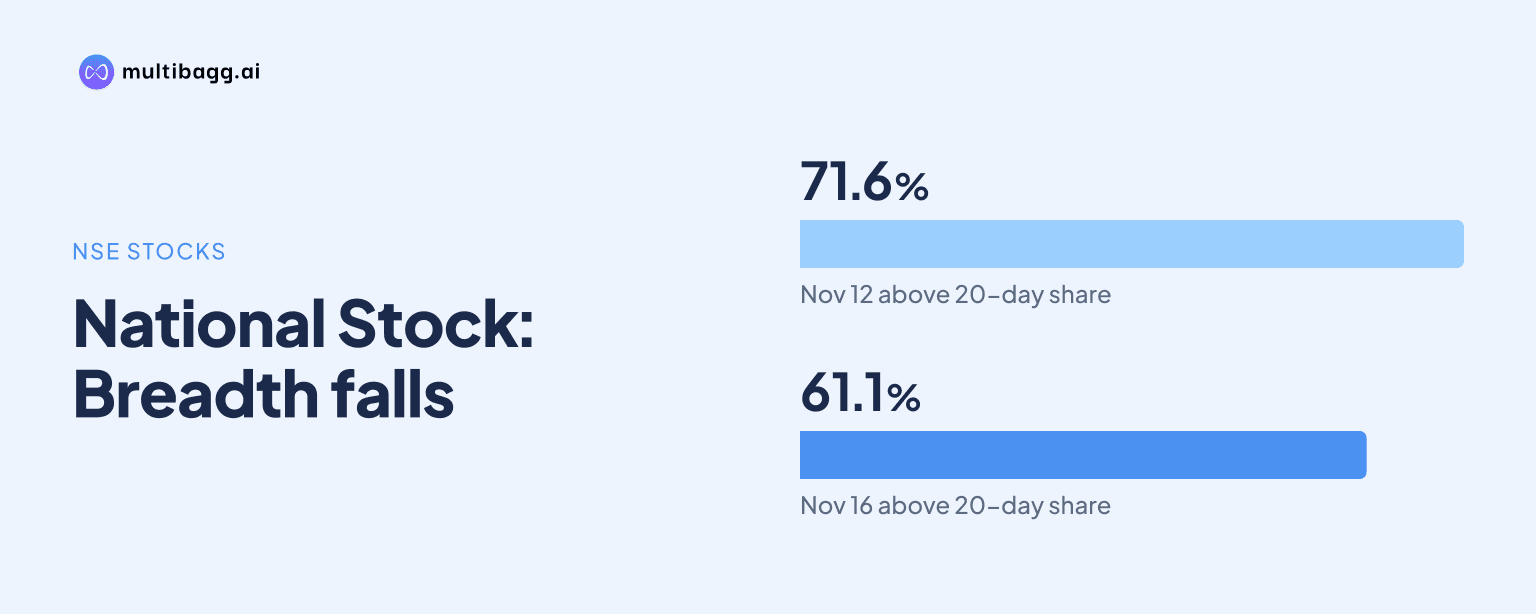
- The share of NSE stocks above their 20-day average fell to 61.1% from 71.6%.
powered by IRIS
National Stock Exchange breadth showed a renewed loss of participation in November 2026, with 61% of 2,821 traded stocks below their December 2025 closing levels and declining shares outnumbering advancing shares for three consecutive sessions. The data temper an earlier recovery in the share of stocks trading above long-term averages.
Why has NSE market breadth weakened again?
NSE market breadth has weakened because benchmark gains have not been matched by sufficiently broad participation across listed stocks. According to ACE Equity data for November 16, only 1,099 of 2,821 traded stocks, or about 39%, were above their December 31, 2025 closing levels. The other 61% remained below those levels, despite several stocks reaching fresh highs during 2026.
The latest trading pattern also pointed to pressure below the headline indices. In one session, 1,937 NSE stocks declined against 792 advances, with 31 unchanged. That equates to roughly 2.45 declining shares for every advancing share. The Nifty 50 and Sensex both closed lower on November 18 amid broad-based selling, reinforcing concerns that index performance and the wider market are diverging.
Large-cap banking and financial shares, along with select technology names, had led the recent rally. Mid-cap and small-cap stocks, meanwhile, were described as being in recovery mode after steep falls in September and October. That split has left the market vulnerable to a reversal in sentiment when heavyweight buying slows.
What do the latest NSE breadth indicators show?
The latest NSE breadth indicators show that the earlier repair in long-term participation has become uneven. On November 12, 53.5% of 1,514 liquid NSE stocks closed above their 200-day averages, a reading that suggested improving internal conditions. However, other readings later showed the share above the 200-day average falling to 39.2%, while yearly highs exceeded yearly lows by only two.
Short-term participation has been stronger than long-term participation, but it too has softened. The share of stocks above their 20-day average fell to 61.1% from 71.6% on the preceding Friday. A separate weekly measure showed long-term breadth rising from 37.3% to 41.8%, after reaching 43.2% on Thursday, before Friday gave back part of that improvement.
The mixed readings matter because a higher share of stocks above a long-term average can signal improving participation, but it does not by itself establish a broad advancing market. The reported decline in the Stage 2 cohort by 50 stocks to 541 shows that the number of advancing names was still shrinking.
Got a follow-up? Ask IRIS
Can the Nifty 50 sustain a move above 25,500?
The Nifty 50 may struggle to sustain a move above 25,500 unless market participation improves, according to the technical view cited in the discussion. Dharmesh Bhatt of Systematix Institutional Research said the upside appeared capped around 25,500 after three consecutive sessions of negative breadth. The concern is that a narrow group of heavyweight stocks may be carrying the index while a larger share of the market loses ground.
Bhatt identified a close below 25,050 as confirmation of a pullback, which could open the way towards 24,700. The Nifty 50 had declined 155 points, or 0.61%, to 25,144 during the holiday-shortened week cited in the social-media discussion. Those levels frame the near-term technical debate, but the breadth data provide the broader test of whether the recovery can extend beyond index leaders.
Fund flows and macro concerns add to the uncertainty. Foreign institutional investors were reported to have invested Rs 84,291 crore in Indian equities in the first two weeks of November, while domestic institutional investors booked profits with net sales of Rs 24,190 crore during the referenced week. October retail inflation was reported at 6.09%, above the Reserve Bank of India's upper tolerance limit, adding rate expectations to the list of near-term market variables.
Conclusion
The combined evidence shows that NSE breadth has improved from earlier lows but has not developed into a consistent, market-wide recovery. The 53.5% reading above the 200-day average on November 12 was constructive, yet negative breadth, a falling short-term participation measure and the fact that 61% of traded shares remained below December 2025 levels show that leadership remains narrow.
Investors will watch whether advances begin to outnumber declines consistently and whether the share of stocks above long-term averages can recover and hold above recent levels. The immediate technical levels disclosed are 25,500 on the upside for the Nifty 50, with 25,050 and then 24,700 identified as levels that could matter if the pullback deepens.