










Jio Platforms Ltd IPO valuation tracks peers at 15.6x
Key highlights
- Jio Platforms is valued at 15.6x FY2026 EV/EBITDA, versus 15.7x for Bharti’s India business in one comparison.
- The IPO price band of ₹1,065 to ₹1,119 could raise up to ₹30,213 crore through a fresh issue of 270 million shares.
- Jio Platforms had 533.3 million customers and about 49.8% of the wireless broadband market.
- Revenue from operations rose from ₹1,09,558 crore in FY2024 to ₹1,46,885 crore in FY2026.
powered by IRIS
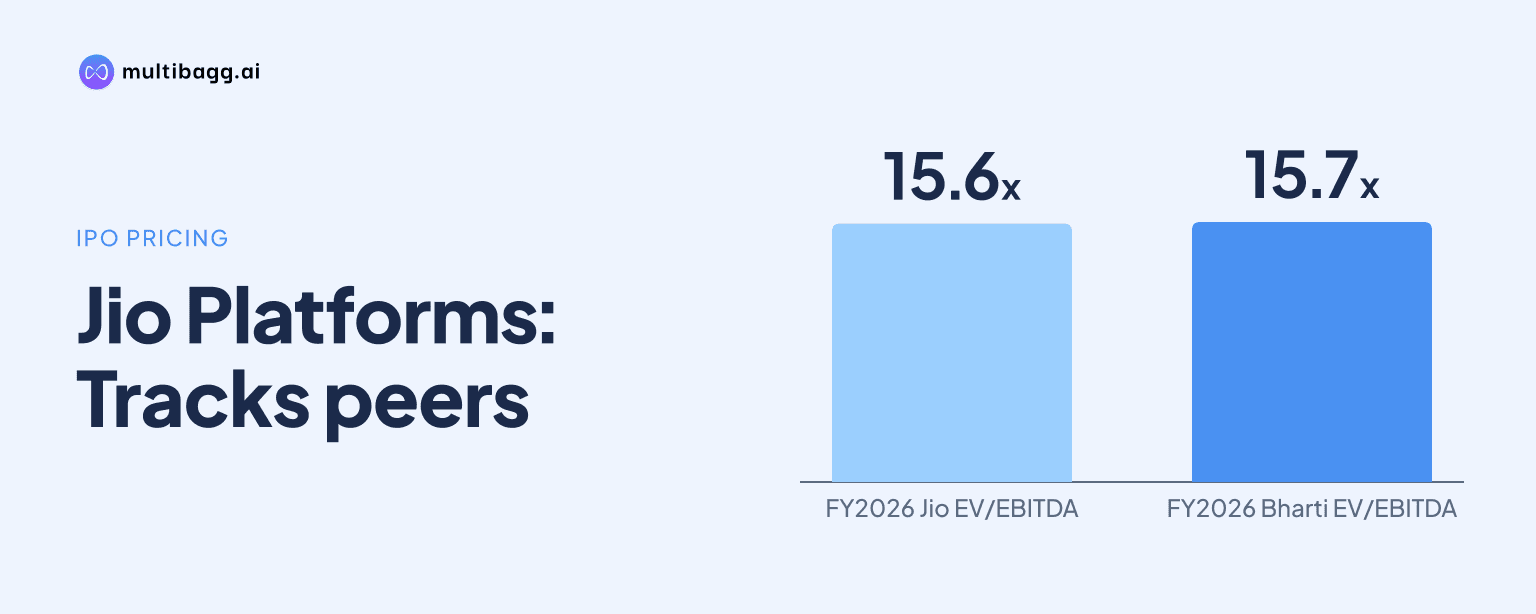
Jio Platforms Ltd is valued at 15.6 times FY2026 EV/EBITDA at the IPO’s upper price band, broadly in line with Bharti’s India business at 15.7 times, while its investment case rests on converting its 533.3 million customer base into higher ARPU, cash flow and digital-services growth.
How is Jio Platforms valued at the IPO?
Jio Platforms is being offered at a valuation that several market participants see as comparable with, or below, major listed telecom peers on selected measures. The price band is ₹1,065 to ₹1,119 a share, and the issue is entirely a fresh issue of 270 million shares. At the upper end, the IPO could raise up to ₹30,213 crore and imply a market capitalisation of about ₹10.3 lakh crore.
Valuation comparisons differ by broker methodology and forecast period. Emkay Research calculated a valuation of 33.3 times FY2026 earnings and 15.6 times EBITDA at the upper band. Another assessment cited 34.3 times FY2026 price-to-earnings and 14.8 times FY2026 EV/EBITDA. A separate comparison placed Jio Platforms at 15.6 times EV/EBITDA, close to Bharti’s India business at 15.7 times and below Hexacom’s 17.7 times.
Why are investors focused on Jio Platforms’ growth drivers?
Jio Platforms’ growth case is centred on rising data use, 5G adoption, fixed broadband, enterprise offerings and digital services. Centrum Broking identified these as key supports for the outlook, while other market commentary pointed to tariff increases, higher per-capita data consumption and expansion of JioFiber and JioAirFiber as potential revenue drivers.
The company’s scale is central to that argument. Jio Platforms has 533.3 million customers and about 49.8% of the wireless broadband market, according to the context provided. Analysts expect the next phase to depend less on network build-out and more on monetising the installed customer base through higher average revenue per user, home broadband and services for enterprises.
Revenue and profitability have also increased over the stated period. Revenue from operations rose from ₹1,09,558 crore in FY2024 to ₹1,46,885 crore in FY2026. EBITDA increased from ₹54,959 crore to ₹76,255 crore, while profit after tax rose from ₹21,423 crore to ₹30,049 crore.
Got a follow-up? Ask IRIS
What supports the long-term case for Jio Platforms?
The long-term case for Jio Platforms rests on its telecom leadership, profitability and potential to build additional revenue streams around connectivity. Analysts cited opportunities in artificial intelligence, enterprise digital services, cloud, digital entertainment and fixed broadband, alongside the company’s scalable technology platform.
Some brokerages assigned a Subscribe - Long Term view, citing market leadership, cash generation and 5G and digital-service opportunities. Religare Broking’s assessment used an estimated FY2028 EV/EBITDA multiple of 11.6 times. Other commentary described the upper-band valuation as a discount to Bharti Airtel on selected earnings comparisons, although the precise valuation gap depends on the measure and period used.
Capital allocation is another closely watched factor. One analyst said net leverage had declined to 0.36 times in FY2026, signalling a movement away from heavy infrastructure spending towards stronger free-cash-flow generation. Commentary also indicated that 5G rollout was largely complete, capex could remain around FY2026 levels, and IPO proceeds were earmarked to repay most foreign-currency loans.
What risks could affect Jio Platforms after listing?
Jio Platforms faces risks from competition, regulation, execution in new services and the challenge of delivering growth already reflected in its valuation. At roughly ₹10.3 lakh crore at the upper price band, the company is in the same broad market-capitalisation range as Bharti Airtel, which was cited at around ₹11.2 lakh crore.
The more durable investment outcome will depend on whether Jio Platforms can lift ARPU, sustain earnings growth and generate cash while becoming more asset-light and improving return on equity. Commentary also flagged related-party dependence and financial obligations as factors investors should assess. A potential 12% to 15% tariff hike was cited as a possible earnings driver, but its timing and impact remain uncertain.
Competitive threats extend beyond established telecom operators. Satellite-based connectivity was identified as a risk, with Starlink waiting since 2022 for permission to operate commercially in India. There is also a possible supply overhang because global investors that invested in Jio Platforms six years earlier may seek exits after a six-month lock-up period expires.
Conclusion
Jio Platforms enters the market with a valuation that is broadly comparable with selected telecom-peer benchmarks, a large wireless broadband base and a record of revenue, EBITDA and profit growth through FY2026. The positive view expressed by several brokerages is based on the prospect of higher ARPU, fixed-broadband growth, digital services and lower leverage rather than solely on a listing-day move.
Investors should watch the pace of tariff action, JioFiber and JioAirFiber expansion, enterprise and digital-services execution, and the company’s conversion of lower capex into cash flow. The six-month lock-up expiry for earlier global investors, regulatory developments affecting satellite connectivity and the stated plan to repay foreign-currency loans are further events that could shape the post-listing outlook.