










India Personal Income Tax Takes Direct Tax Lead in FY24
Key highlights
- PIT collections reached ₹10.44 lakh crore in FY2023-24, versus ₹9.11 lakh crore for corporate tax.
- PIT's direct-tax share rose from 38.1% in FY2014 to 53.4% in FY2024.
- Corporate tax's share fell from 61.9% in FY2014 to 46.6% in FY2024.
- TDS collections rose from ₹2.5 trillion in FY2014 to ₹6.5 trillion in FY2023-24.
powered by IRIS
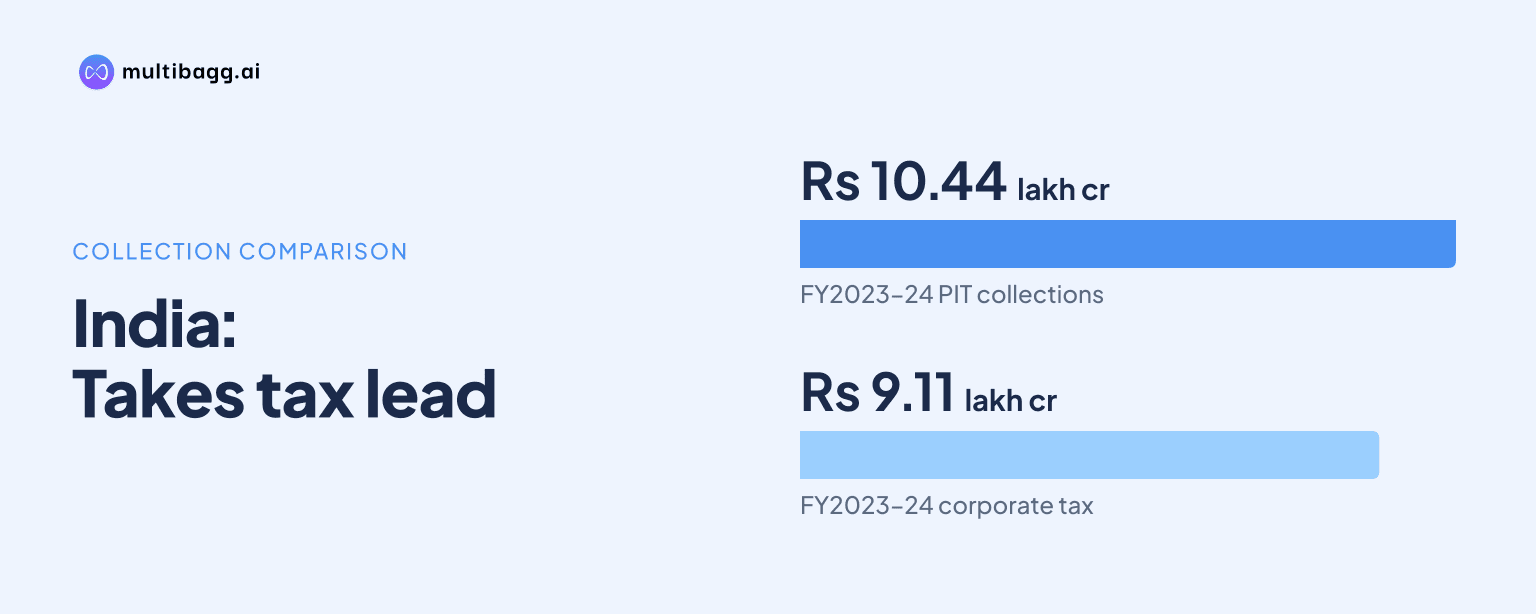
India personal income tax collections exceeded corporate tax collections for the first time in FY2023-24, reaching ₹10.44 lakh crore against ₹9.11 lakh crore for corporate tax. The crossover lifted personal income tax's share of total direct taxes to 53.4%, compared with 46.6% for corporate tax, according to a JM Financial Institutional Securities report cited in the discussion.
When did personal income tax overtake corporate tax?
Personal income tax, or PIT, moved ahead of corporate tax in FY2023-24, based on the figures widely cited in social-media and news-linked discussions. PIT collections were reported at ₹10.44 lakh crore, while corporate tax collections were ₹9.11 lakh crore. Posts consistently identify FY2023-24 as the crossover year rather than 2025 or 2026.
The shift followed years in which companies remained the larger direct-tax contributor. In FY2018-19, corporate tax collection stood at ₹6.64 lakh crore, compared with ₹5.27 lakh crore for PIT. A 2022 comparison also showed corporate tax marginally ahead at ₹7.12 lakh crore versus ₹6.7 lakh crore for PIT, indicating that the gap had narrowed before the FY2023-24 reversal.
How did India's direct tax mix change over ten years?
PIT's share of total direct taxes increased from 38.1% in FY2014 to 53.4% in FY2024, a gain of 15.3 percentage points. Over the same period, the corporate tax share fell from 61.9% to 46.6%, a decline of 15.3 percentage points, according to the JM Financial Institutional Securities report.
The change is notable because it describes the composition of direct-tax collections, not merely the increase in tax receipts. Both categories rose in absolute terms between FY2018-19 and FY2023-24, but PIT grew sufficiently to become the larger category. PRS Legislative Research was also cited as noting that income tax accounted for 53% of total direct taxes by 2023-24, up from 47% in 2000-01.
What is driving the rise in PIT collections?
The reported rise in PIT collections has been linked in the discussion to a broader tax base, increased formalisation and stronger collection through tax deducted at source, or TDS. Finance Minister Nirmala Sitharaman said during the Rajya Sabha debate on the Union Budget 2026-27 that higher personal tax collection reflected a widening tax base and greater formalisation, rather than financial distress among the middle class.
The figures cited alongside that explanation show a substantial expansion in collection mechanisms. TDS collections rose to ₹6.5 trillion in FY2023-24 from ₹2.5 trillion in FY2014. Advance-tax payments were reported at ₹12.8 trillion in FY2024, up from ₹2.9 trillion in FY2014. The JM Financial report also cited declared salaries rising to ₹35.2 trillion in FY2023 from ₹9.8 trillion in FY2014, while personal tax collections increased to ₹8.3 trillion from ₹2.4 trillion over those years.
Got a follow-up? Ask IRIS
Does a higher PIT share mean salaried taxpayers bear more tax?
A higher PIT share shows that individuals are contributing a larger portion of direct taxes, but the available discussion does not establish that salaried taxpayers alone account for the entire increase. Some posts frame the change as a larger burden on salaried and middle-class taxpayers, while the finance minister rejected the conclusion that higher collections amount to their suppression.
The distinction matters because personal and non-corporate tax references are sometimes combined in the discussion. Advance tax can include professionals, freelancers and businesses, while TDS can apply to salary and eligible interest payments. Readers should therefore distinguish between standalone PIT figures, broader non-corporate tax figures and gross or net collection figures before comparing numbers across posts.
What do the latest cited figures indicate?
The latest cited figures indicate that PIT's lead has continued in subsequent reported periods, although the posts use different measures and time frames. One cited estimate put FY2024-25 PIT collections at about ₹11.82 lakh crore and corporate tax at about ₹9.86 lakh crore. Other posts refer to PIT above ₹12 lakh crore and corporate tax of ₹9.8 lakh crore.
These references should not be treated as directly interchangeable without checking their classification and whether they refer to gross or net collections. A separate cited data point put corporate tax at ₹8.89 lakh crore and personal and non-corporate tax at ₹10.03 lakh crore, illustrating why category labels can change the comparison. The central, consistently reported finding remains the FY2023-24 crossover.
Conclusion
The FY2023-24 data marks a clear shift in India's direct-tax structure: PIT collected ₹10.44 lakh crore, ahead of ₹9.11 lakh crore from corporate tax, and represented 53.4% of direct taxes. The move followed a decade in which PIT's share rose while the corporate share declined, alongside higher reported TDS, advance-tax payments and declared salaries.
What to watch next is whether official releases continue to show a widening PIT lead and how they classify personal, non-corporate and corporate tax receipts. The Union Budget 2026-27 debate has already made the issue a policy discussion, with contrasting views on whether the trend mainly reflects formalisation and a wider tax base or a changing burden within direct taxes.