










Atharva Polyplast EBITDA margin reaches 20.7% on mix shift
Key highlights
- Premium furniture increased from 28% of revenue in FY23 to 53% in H1 FY27.
- EBITDA margin increased from 10.5% in FY23 to 20.7% in FY26.
- FY26 revenue from operations was Rs 54.39 crore, compared with Rs 45.30 crore in FY23.
- H1 FY27 revenue from operations rose 77.5% year on year to Rs 36.69 crore.
powered by IRIS
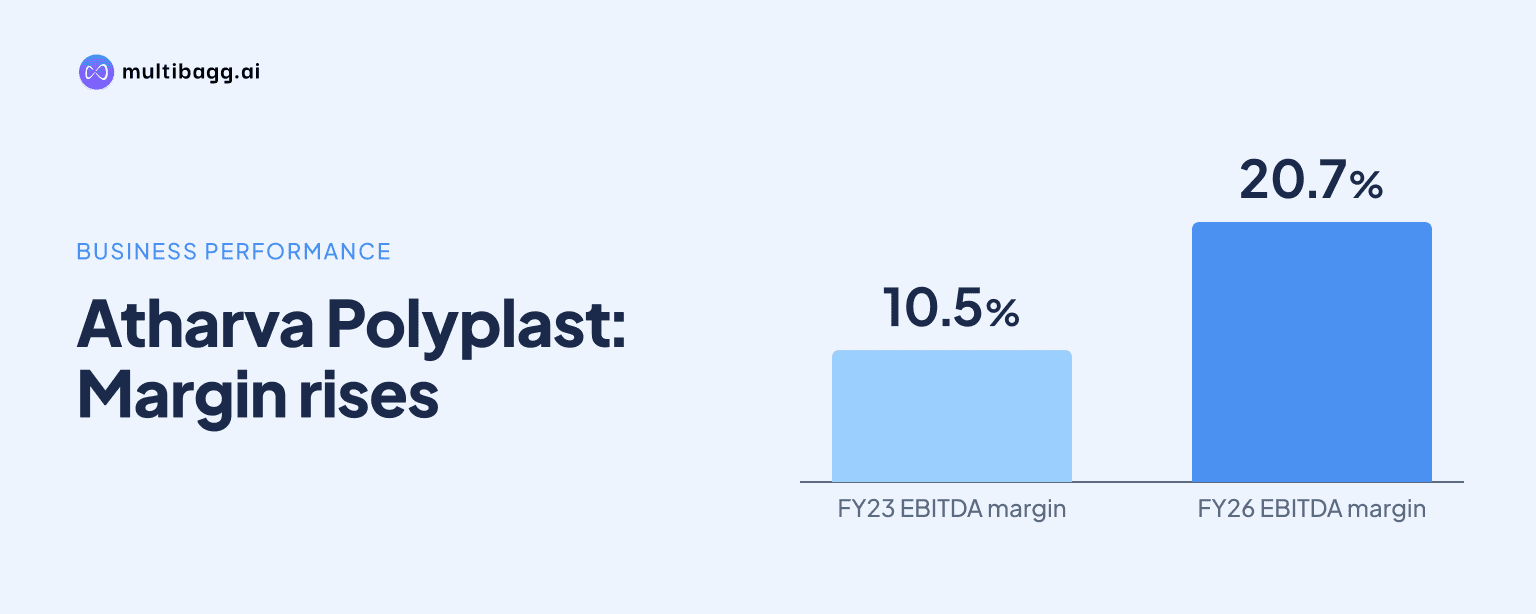
Atharva Polyplast Limited increased its EBITDA margin to 20.7% in FY26 from 10.5% in FY23 as premium furniture rose from 28% to 53% of revenue by H1 FY27. The company’s presentation attributes this margin transformation to a shift from appliance moulding toward higher-value furniture, engineering, design, tooling and assembly work.
Know Atharva Poly-Plast inside out
Results, valuation, peers and who's buying, in one view.
How did Atharva Polyplast change its revenue mix?
Atharva Polyplast made premium furniture its largest reported business vertical, increasing its revenue share from 28% in FY23 to 53% in H1 FY27. Over the same period, home appliances declined from 59% to 27%, while engineering, automotive and other categories increased from 13% to 20%.
Premium furniture therefore gained 25 percentage points between FY23 and H1 FY27, while appliances lost 32 percentage points. Atharva Polyplast still describes appliances as its volume and cash-flow anchor, supplying air-flow ducts, door racks, crispers, chiller trays and freezer-door parts to customers including Godrej, Versuni and BSH.
The mix shift follows a change from Atharva Polyplast’s 2015 contract-manufacturing model, in which customers supplied the moulds and designs. By 2026, the company says it participated in product concept development, design, tooling, validation, precision moulding, assembly and delivery, including for furniture components such as back frames, seat bases, arm assemblies, headrests and star bases.
What happened to Atharva Polyplast margins and profit?
Atharva Polyplast’s EBITDA margin increased by 10.2 percentage points from 10.5% in FY23 to 20.7% in FY26, while revenue from operations increased from Rs 45.30 crore to Rs 54.39 crore. EBITDA, including other income as defined in the presentation, rose from Rs 4.77 crore to Rs 11.25 crore.
Profit after tax increased from Rs 0.71 crore in FY23 to Rs 6.47 crore in FY26, and its margin rose from 1.6% to 11.9%. Revenue fell to Rs 41.49 crore in FY24 before recovering to Rs 47.54 crore in FY25 and Rs 54.39 crore in FY26, while EBITDA margin increased in each of the four reported financial years.
Atharva Polyplast characterises the result as mix-led, linking margin expansion to higher premium-furniture and engineering content. The presentation identifies greater engineering input, fee-based design work, in-house tool development and sub-assembly as mechanisms that can increase value per part beyond simple contract moulding.
Got a follow-up? Ask IRIS
Why does premium furniture carry more value for Atharva Polyplast?
Premium furniture carries more value for Atharva Polyplast because it involves structural, load-bearing and aesthetic polymer parts as well as engineering and tool-development work before recurring production begins. Its products include glass-filled polymer seat bases, headrests, multi-direction arm assemblies, foam assemblies and five-star bases for office chairs.
The presentation compares an average branded Indian chair priced at Rs 10,000 with an average global premium chair priced at Rs 1,50,000, a 15 times price difference. This is a comparison of chair prices rather than Atharva Polyplast’s component revenue, but management uses it to illustrate the higher value pool in global-premium seating.
Atharva Polyplast names MillerKnoll, Steelcase, HNI, Haworth and Kokuyo among its premium-furniture customers. It says customer qualification can take up to three years from design through testing and approval, while customers may provide product warranties of up to 14 years, supporting the company’s focus on repeat programmes after qualification.
The company also identifies tilt-and-recline mechanisms as a planned expansion in chair content. Management estimates a Rs 670 crore annual market from 6.7 million units at Rs 1,000 each and has set a 30% share target, equivalent to a Rs 201 crore opportunity; this is a target rather than reported revenue.
What do H1 FY27 results show about the mix transition?
Atharva Polyplast reported H1 FY27 revenue from operations of Rs 36.69 crore, up 77.5% from Rs 20.67 crore in H1 FY26, while premium furniture retained a 53% revenue share. EBITDA was Rs 7.45 crore, 1.0% above Rs 7.37 crore a year earlier, and EBITDA margin was 20.3% compared with 35.7% in H1 FY26.
Management says raw-material intensity increased to about 75% of revenue in H1 FY27 from about 54% in H1 FY26, compressing the year-on-year margin. The H1 FY27 EBITDA margin was close to FY26’s 20.7% full-year level, while revenue increased from Rs 33.72 crore in H2 FY26 to Rs 36.69 crore in H1 FY27 and EBITDA rose from Rs 3.88 crore to Rs 7.45 crore.
H1 FY27 profit after tax was Rs 4.38 crore, down 7.1% from Rs 4.72 crore in H1 FY26 but above Rs 1.75 crore in H2 FY26. The half-year figures are unaudited and limited-reviewed, while FY26 results are audited, making the comparison relevant to shorter-term changes in material intensity and profitability.
Atharva Polyplast reported 67% capacity utilisation in H1 FY27 on installed capacity of 1,800 tonnes a year and stated annualised production of 1,206 tonnes. It owns 2,34,614 square feet of land, of which 40,000 square feet is built, and describes the remaining land as 5.8 times brownfield expansion runway.
Conclusion
Atharva Polyplast’s reported margin improvement coincided with a material reweighting of its sales mix. Premium furniture increased from 28% of revenue in FY23 to 53% in H1 FY27, while home appliances fell from 59% to 27%; over FY23 to FY26, EBITDA margin rose from 10.5% to 20.7% and profit after tax increased from Rs 0.71 crore to Rs 6.47 crore.
The next disclosures to watch are whether premium furniture sustains its stated 19% year-on-year vertical growth, whether co-developed engineering categories approach management’s target of about 20% of revenue, and whether the planned mechanism programme progresses toward its stated Rs 201 crore opportunity. Raw-material intensity, at about 75% of H1 FY27 revenue, also remains relevant to future margins.