










Atharva Polyplast identifies Rs 756 crore plastics pool
Key highlights
- Atharva Polyplast estimates a Rs 756 crore annual plastic-components pool within India’s premium-chair segment.
- India’s global-premium chair category represents 7% of units but about 47% of value, according to company estimates.
- Management targets 75% localisation within five years, compared with 8–10% currently.
- Atharva Polyplast estimates a Rs 670 crore tilt-and-recline mechanism market at 6.7 million annual units.
powered by IRIS
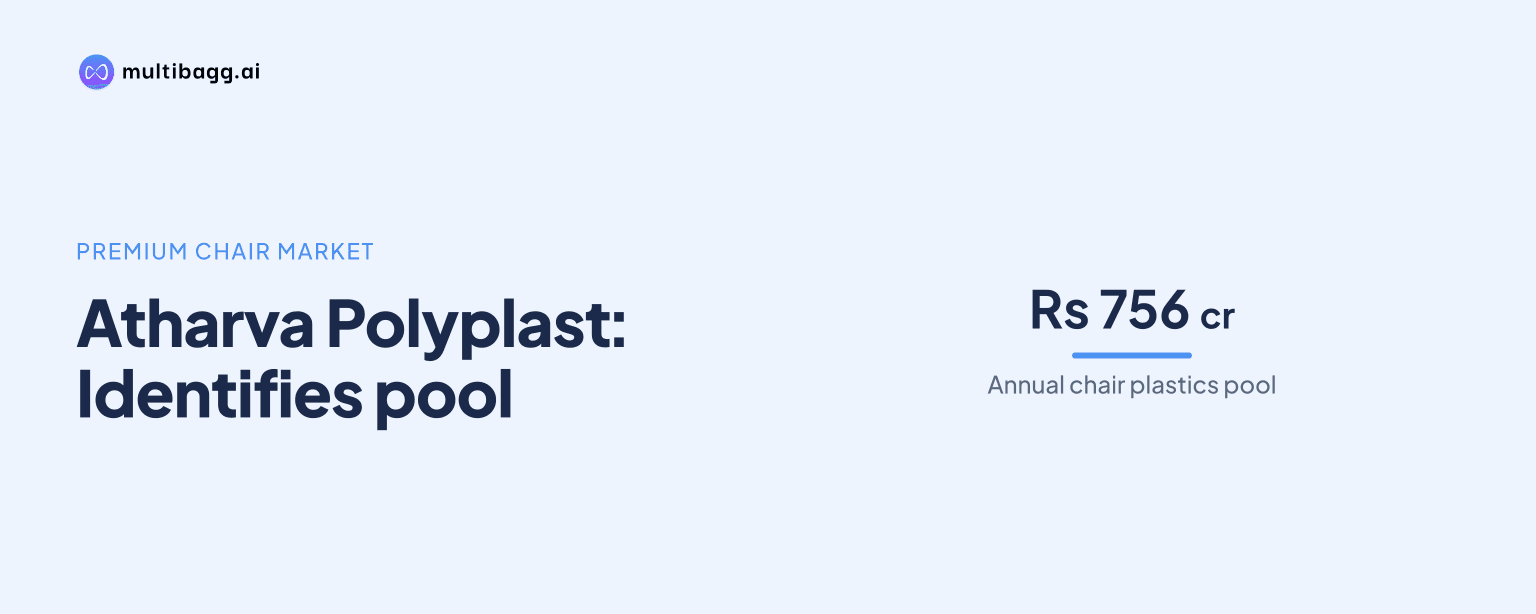
Atharva Polyplast Limited estimates that plastic components for 840,000 premium chairs sold annually in India represent a Rs 756 crore addressable pool, within Rs 1,890 crore of cost of goods sold in a Rs 6,300 crore market. Management targets 75% localisation within five years, from 8–10% today.
Know Atharva Poly-Plast inside out
Results, valuation, peers and who's buying, in one view.
How large is Atharva Polyplast’s premium-chair plastics opportunity?
Atharva Polyplast puts the annual value of plastic components in India’s global-premium chair segment at Rs 756 crore. Its estimate starts with 840,000 premium chairs sold annually, generating Rs 6,300 crore of business value and Rs 1,890 crore of cost of goods sold, or COGS.
The opportunity concerns a defined premium seating category rather than the entire Indian chair market. Atharva Polyplast describes this tier as imported and global original equipment manufacturer, or OEM, brands, and identifies the Rs 756 crore pool as the plastic-component value within that supply chain.
Management’s stated localisation target is 75% within five years, compared with 8–10% currently. The presentation does not disclose the revenue Atharva Polyplast currently earns from this pool or the share it expects to secure.
Why does Atharva Polyplast target global-premium chairs?
Atharva Polyplast targets global-premium chairs because the segment represents 7% of Indian office-chair units but about 47% of market value, according to company estimates. At Rs 6,300 crore, the segment exceeds the Rs 4,560 crore organised domestic category despite its smaller stated unit share.
The presentation compares an average branded Indian chair costing Rs 10,000 with an average global premium chair costing Rs 1.50 lakh. The stated 15-times price gap is linked to design-oriented products, tight dimensional tolerances, class-A surface finishes and advanced engineering polymers.
India sells an estimated 12–15 million office chairs each year. Office and institutional use accounts for about 45% of end markets, home use for about 35%, and other applications for about 20%; Atharva Polyplast cites modern workplaces, premiumisation, local manufacturing and government initiatives as demand drivers.
Which premium-chair components can Atharva Polyplast supply?
Atharva Polyplast says it engineers, tools and moulds structural and aesthetic polymer parts for premium task chairs. Its listed component scope includes headrests, back frames, arm assemblies, seat bases, seat foam assemblies and five-star bases.
The back frame is a load-bearing structural polymer part, the seat base uses glass-filled engineering polymer, and the five-star base carries the chair’s full load. Arm assemblies include 1D, 3D, 4D and fixed variants, covering adjustable as well as fixed chair structures.
Atharva Polyplast presents a seven-stage process: customer requirement, design and design for manufacturability, or DFM, tool development, prototyping, testing and validation, precision moulding, and assembly and delivery. Its validation work includes mechanical and dimensional testing, alongside advanced product quality planning, or APQP, and production part approval process, or PPAP, support.
Got a follow-up? Ask IRIS
How does Atharva Polyplast link localisation with OEM programmes?
Atharva Polyplast links localisation with a six-step process that begins with an OEM concept and ends with production in India and an expanding product portfolio. The company converts concepts into engineering drawings, builds soft tools and prototypes, develops final moulds in-house, then supplies recurring manufacturing volumes.
Management says engineering projects have delivered net margins of about 16–18% and targets engineering services to contribute 15–20% of long-term revenue. The presentation does not disclose current engineering-services revenue, the timing for the targeted revenue share, or the number of OEM programmes in the process.
The company describes a progression from global-quality compliance through supplier qualification and product approvals for critical load-bearing components, followed by repeat business and wallet-share expansion. It names MillerKnoll, Steelcase, HNI, Haworth, Kokuyo and Allsteel in its global OEM ecosystem.
What could support Atharva Polyplast’s five-year localisation target?
Atharva Polyplast cites India’s domestic demand, manufacturing base and China-plus-one sourcing strategy as factors supporting global OEM localisation. It says improving infrastructure, skilled labour and cost-efficient production can make India an export hub, but provides no figure for committed OEM production volumes.
The company says fewer than 5% of Indian companies hold its full stated credential stack, comprising SEDEX SMETA 7.0, CII GreenCo Gold, ISO 9001:2015, ISO 14001:2015, ISO 45001:2018, REACH and RoHS. It says each credential takes 12–24 months to earn and is revalidated annually.
Atharva Polyplast also identifies tilt-and-recline mechanisms as a separate value pool beyond the Rs 756 crore plastics estimate. At Rs 1,000 per mechanism and 6.7 million annual units, management estimates a Rs 670 crore market and a Rs 201 crore opportunity at a 30% target share.
Conclusion
Atharva Polyplast’s market case is based on the mismatch between the global-premium segment’s 7% share of office-chair units and its estimated 47% share of value. The company’s Rs 756 crore plastics-pool estimate combines premium-chair volumes, component content and a supply model extending from engineering and tooling to moulding and assembly.
The next disclosed measure to watch is progress from 8–10% current localisation toward management’s 75% five-year target. Management’s separate targets for engineering services to reach 15–20% of long-term revenue and for a 30% share of the tilt-and-recline mechanism opportunity remain additional execution markers.