










Atharva Polyplast targets Rs 201 crore chair mechanism opportunity
Key highlights
- Atharva Polyplast targets a Rs 201 crore opportunity from a 30% share of a Rs 670 crore chair-mechanism market.
- Capacity utilisation was 67% in H1 FY27, compared with 78% in FY26.
- Atharva Polyplast owns 2,34,614 square feet of land, of which 40,000 square feet is built up.
- EBITDA margin increased from 10.5% in FY23 to 20.7% in FY26.
powered by IRIS
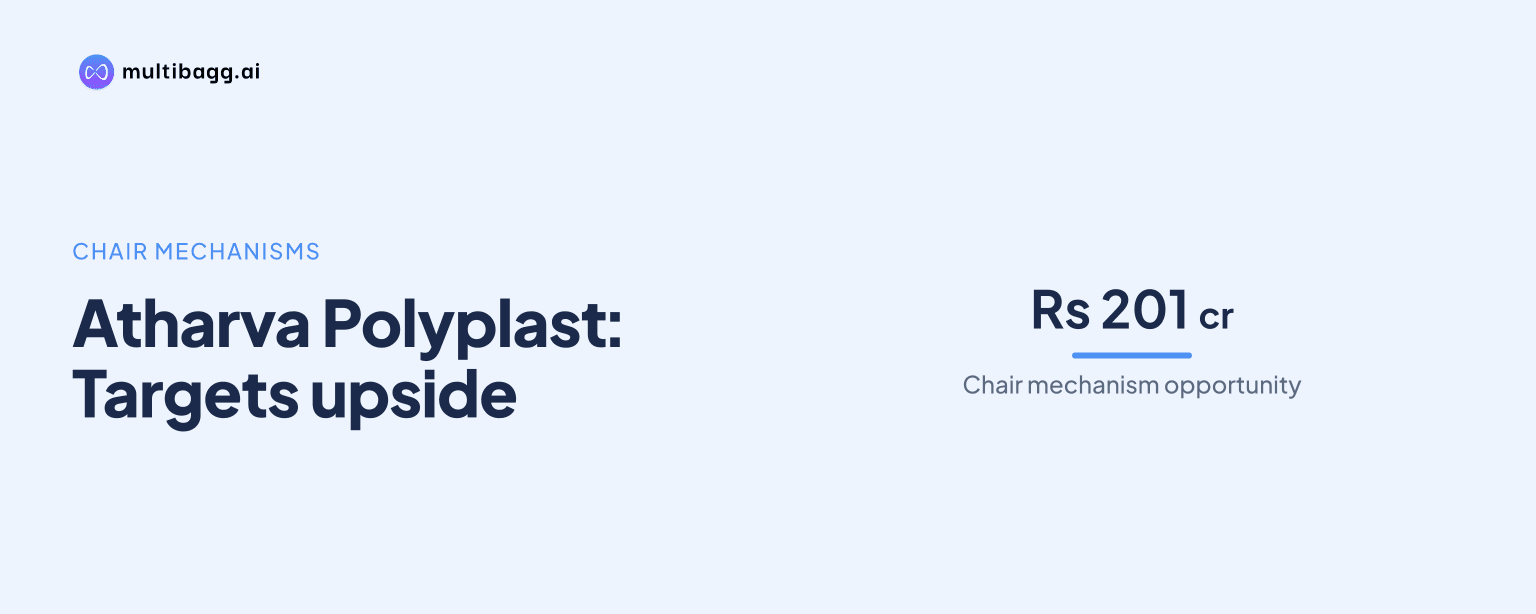
Atharva Polyplast Limited said in its 2 November 2026 H1 FY27 presentation that it targets a Rs 201 crore chair-mechanism opportunity, based on management’s aim for 30% of an estimated annual Rs 670 crore market. Atharva Polyplast reported 67% capacity utilisation and said its owned land and selected customer-funded development can support growth without immediate large investment.
Know Atharva Poly-Plast inside out
Results, valuation, peers and who's buying, in one view.
What is Atharva Polyplast targeting in chair mechanisms?
Atharva Polyplast is targeting a 30% share of a chair-mechanism market that management estimates at 6.7 million units annually and Rs 670 crore in value. This represents a Rs 201 crore revenue opportunity, rather than reported revenue, an order book or a customer contract. The planned product is a tilt-and-recline mechanism, a higher-value sub-assembly used in premium chairs.
The initiative sits within the premium office furniture vertical, which supplied 53.40% of H1 FY27 revenue, compared with 52.72% in FY26 and 28% in FY23. Management says these components carry higher design content and better pricing than home-appliance parts. The mix shift coincided with EBITDA, or earnings before interest, tax, depreciation and amortisation, margin rising from 10.5% in FY23 to 20.7% in FY26.
Revenue growth was lower than the rise in profitability over the FY23-to-FY26 period. Revenue from operations increased from Rs 45.30 crore to Rs 54.39 crore, while EBITDA rose from Rs 4.77 crore to Rs 11.25 crore and profit after tax rose from Rs 0.71 crore to Rs 6.47 crore. The mechanism plan extends Atharva Polyplast’s move from contract moulding into design-led products and sub-assemblies.
How can Atharva Polyplast expand without immediate major capital spending?
Atharva Polyplast has about one-third of installed production capacity available, as utilisation was 67% in H1 FY27 versus 78% in FY26. The presentation says this spare capacity can accommodate new business before equivalent additional factory capacity is required. Its plant has more than 20 injection-moulding machines, ranging from 100 tonnes to 1,000 tonnes, and produces more than 300 products.
Atharva Polyplast owns 5.5 acres, or 2,34,614 square feet, of land, of which 40,000 square feet is built up. Management describes the unbuilt portion as providing 5.8 times room for brownfield expansion without buying land. The presentation does not disclose the cost, timing or scale of any future construction.
Atharva Polyplast raised Rs 27 crore through its initial public offering, or IPO, and listed on BSE SME on 7 July 2026. Net worth increased from Rs 19.58 crore in March 2026 to Rs 46.06 crore in September 2026, while debt to equity declined from 0.50 times to 0.10 times. Management says IPO proceeds and internal accruals can largely fund growth, but gives no capital-expenditure budget for chair mechanisms.
Got a follow-up? Ask IRIS
How do engineering services and localisation support Atharva Polyplast’s plan?
Atharva Polyplast supports its plan by converting global original equipment manufacturers’, or OEMs’, concepts into drawings, prototypes and production moulds before manufacturing components. This differs from its earlier model, under which customers supplied both designs and moulds. Management says in-house design, engineering and tooling enable better pricing and longer multi-year growth avenues.
Management says OEM localisation in India is about 8% to 10% currently and is expected to reach 75% within five years. This is an industry expectation disclosed by the company, not a forecast of Atharva Polyplast orders or revenue. The presentation does not state how many localisation programmes, products or customers it expects to win.
Management says engineering projects deliver net margins of about 16% to 18% and targets engineering services to account for 15% to 20% of revenue in the long term. It also targets co-designed categories at about 20% of revenue. Neither target includes a stated target year, but both indicate an intended greater contribution from engineering, design and sub-assemblies.
What evidence does Atharva Polyplast have for co-designed product growth?
Atharva Polyplast has co-designed a pressure-compensating drip-irrigation product with Toro, for which the customer funds moulds and development. The company says this avenue carries five years of assured business. The presentation does not disclose its revenue value, production volume or start date.
Customer funding of tooling can reduce Atharva Polyplast’s upfront capital requirement on specific projects. The company also cites long qualification periods with global OEMs and multi-year programmes as sources of revenue visibility. Its named premium-furniture customers include MillerKnoll, Steelcase, HNI, Haworth and Kokuyo, although the presentation assigns no mechanism revenue or orders to individual customers.
Premium furniture is described as growing 19% year on year and represented 53.40% of H1 FY27 revenue. Home appliances accounted for 26.90%, while engineering and others represented 19.70%. Against FY26, premium furniture gained 0.68 percentage points of revenue share, home appliances gained 2.54 percentage points and engineering and others declined 3.21 percentage points.
Conclusion
Atharva Polyplast’s Rs 201 crore chair-mechanism figure is a management opportunity estimate tied to a proposed 30% share of a Rs 670 crore market. Its strategy combines premium furniture, engineering services and co-designed products with 67% plant utilisation, customer-funded tooling on selected programmes and 2,34,614 square feet of owned land.
The next disclosed milestones are whether chair mechanisms move from a market-share target into customer programmes and production, and whether engineering services approach management’s 15% to 20% long-term revenue target. Capacity utilisation, any brownfield expansion and progress toward the cited rise in OEM localisation from 8% to 10% to 75% over five years are also relevant disclosed indicators.