










Triveni H1 profit reaches ₹97 crore as margin hits 6.9%
Key highlights
- Triveni reported H1 FY27 PAT of ₹97 crore, versus a ₹18 crore loss in H1 FY26.
- H1 FY27 EBITDA margin rose to 6.9% from 3.1%, while EBITDA increased to ₹229 crore from ₹97 crore.
- Net debt fell to ₹157 crore at September 30, 2026 from ₹702 crore a year earlier.
- Sugar PBIT reached ₹113 crore in H1 FY27 versus a ₹5 crore loss in H1 FY26.
powered by IRIS
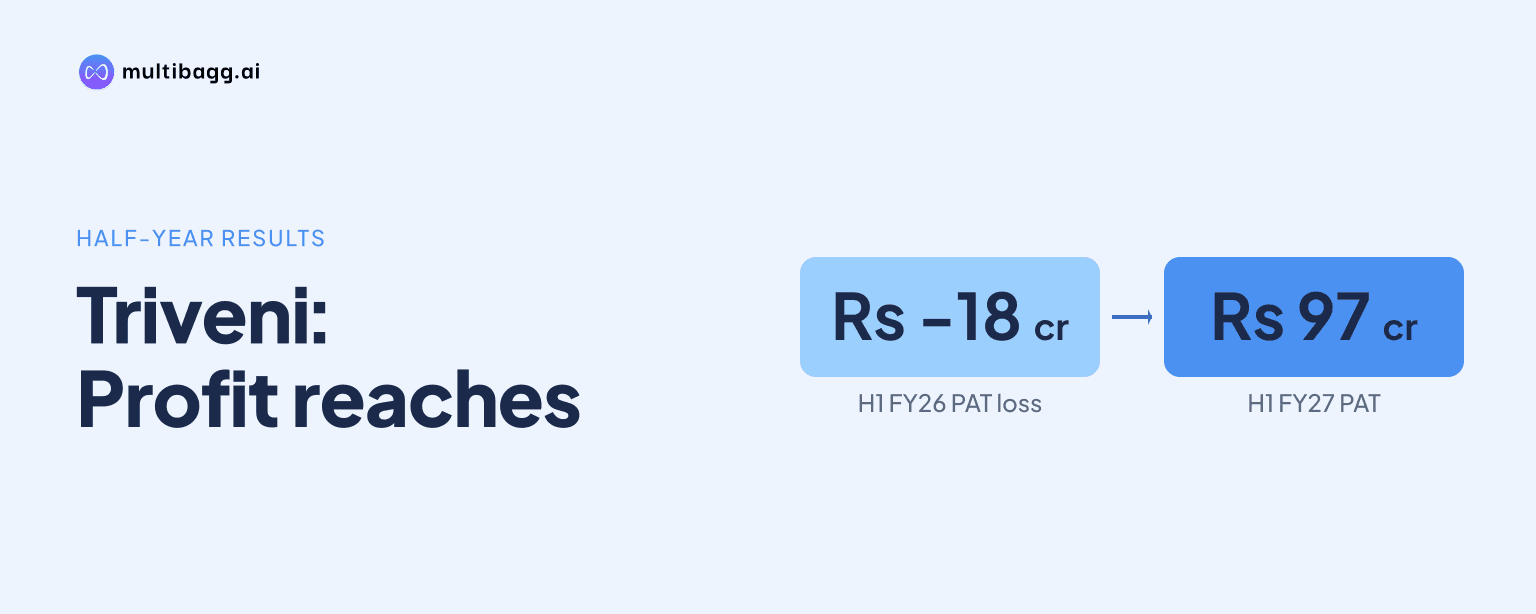
Triveni Engineering & Industries Ltd. reported a ₹97 crore profit after tax in H1 FY27 ended September 30, 2026, compared with a ₹18 crore loss a year earlier, as EBITDA margin reached 6.9%. The turnaround accompanied ₹3,311 crore of net revenue, higher sugar realisations, improved grain-feedstock mix, DDGS income and lower finance costs.
Know Triveni Engineering and Industries inside out
Results, valuation, peers and who's buying, in one view.
Why did Triveni return to profit in H1 FY27?
Triveni returned to profit because EBITDA, or earnings before interest, tax, depreciation and amortisation, rose 136.7% year on year to ₹229 crore in H1 FY27 from ₹97 crore in H1 FY26. Profit after tax, or PAT, moved to ₹97 crore from a ₹18 crore loss, while profit before tax changed to ₹131 crore from a ₹25 crore loss. Management attributed the improvement primarily to higher sugar margins, a higher proportion of high-margin maize feedstock, improved DDGS realisations and lower finance cost.
Net revenue, excluding excise duty, increased 5.3% to ₹3,311 crore in H1 FY27 from ₹3,145 crore in the prior-year half. The EBITDA margin increased 383 basis points, with one basis point equal to one-hundredth of a percentage point, to 6.9% from 3.1%. The result relates to continuing operations and excludes the discontinued PTB operation; prior-period figures were restated to reflect the demerger.
How much did Triveni's second-quarter performance improve?
Triveni's Q2 FY27 PAT was ₹94 crore, reversing a ₹11 crore loss in Q2 FY26, while EBITDA rose to ₹165 crore from ₹37 crore. Q2 net revenue rose 8.4% to ₹1,731 crore from ₹1,597 crore, and margin increased to 9.5% from 2.3%. The quarterly margin was therefore 2.6 percentage points above the 6.9% H1 level, reflecting the sharper improvement reported in the July-to-September period.
Management said Q2 revenue benefited from significantly higher sugar realisation, higher alcohol sales volume, and higher DDGS volume and realisation. This occurred despite lower sugar volumes and lower water-business revenue. Q2 profit before tax was ₹126 crore against a ₹16 crore loss, and earnings per share, not annualised, were ₹4.25 compared with negative ₹0.52 in the previous-year quarter.
Which businesses drove Triveni's operating improvement?
Triveni said both Sugar and Alcohol contributed to the H1 FY27 profitability improvement, with Sugar segment profit before interest and tax, or PBIT, reaching ₹113 crore from a ₹5 crore loss. Sugar revenue increased 4.7% to ₹2,497 crore from ₹2,384 crore, even though domestic dispatches were broadly unchanged at 5,32,738 tonnes compared with 5,34,421 tonnes. The main change was average sugar realisation, which rose 9.3% to ₹44,281 per metric tonne from ₹40,505 per metric tonne.
The Alcohol business benefited from higher grain-based ethanol dispatches, improved DDGS realisations and operational efficiencies, according to management. DDGS, or distillers dried grains with solubles, is a grain-distillery by-product. Water revenue declined because execution slowed on select engineering, procurement and construction projects, though management said the water business retained an order book with a significant long-duration operations and maintenance component. Sugar inventory was 1.03 lakh metric tonnes at September 30, 2026, versus 1.69 lakh metric tonnes a year earlier, and its valuation rose to ₹38.6 per kilogram from ₹37.4 per kilogram.
Got a follow-up? Ask IRIS
How far did Triveni reduce debt and finance costs?
Triveni reduced net debt to ₹157 crore at September 30, 2026 from ₹702 crore a year earlier, which management linked to improved profitability and lower working-capital intensity. Consolidated gross debt declined to ₹470 crore from ₹741 crore, while the average consolidated cost of funds fell 37 basis points to 6.9% in H1 FY27 from 7.2% in H1 FY26. Lower finance cost was one of the factors identified for the H1 profit improvement.
At September 30, 2026, consolidated gross debt consisted of ₹388 crore of term loans and ₹82 crore of working-capital loans. Standalone gross debt of ₹410 crore included ₹328 crore of term loans, of which ₹69 crore had interest subvention, and ₹82 crore of working-capital borrowing. These debt figures show that gross debt fell by ₹271 crore on a consolidated basis over the 12 months, alongside the reported reduction in net debt.
What could shape Triveni's second-half FY27 performance?
Triveni's second-half outcome will depend on sugarcane availability, recoveries, sugar pricing, feedstock economics and ethanol policy, according to management. For sugar season 2026-27, the Central Government raised the Fair and Remunerative Price for cane by ₹10 per quintal to ₹365 per quintal. Management said late-October rainfall, including heavy rain and thunderstorms in parts of Uttar Pradesh on October 29 and 30, requires field-level assessment and could delay crushing to limit any impact on recoverable sugar.
The latest oil marketing company tender for ethanol supply season 2026-27 excludes ethanol made from sugarcane juice, syrup and B-heavy molasses, and reduces the maize-ethanol price, management said. It also noted that firmer maize procurement prices and the lower ethanol price create a more challenging near-term environment. In sugar, management cited estimated industry opening stocks of about 3.5 million metric tonnes against estimated consumption of 28.5 million to 29.0 million metric tonnes, while cautioning that weather and policy actions can affect the domestic balance.
Conclusion
Triveni's H1 FY27 turnaround combined ₹97 crore of PAT with a 6.9% EBITDA margin, compared with a ₹18 crore loss and 3.1% margin in H1 FY26. Higher sugar realisations lifted Sugar PBIT to ₹113 crore, while the Alcohol business added gains from grain-based dispatches and DDGS. Net debt fell to ₹157 crore from ₹702 crore, while the average consolidated cost of funds declined to 6.9% from 7.2%.
The next period will test Triveni's plans to increase cane crush through cane development, crop surveillance, better operating efficiency and higher recovery. Management will also seek to optimise alcohol product mix, allocation and by-product value under the 2026-27 ethanol tender, while rainfall effects in Uttar Pradesh, maize costs, ethanol pricing, sugar policy and commodity-price movements remain unresolved variables.