










Triveni returned ₹1,501 crore and retained ₹2,736 crore
Key highlights
- Triveni generated ₹4,237 crore of standalone cash during FY21-26.
- Triveni allocated ₹1,501 crore, including taxes, to dividends and buybacks, equal to 35% of cash generation.
- Triveni allocated ₹1,495 crore to capital expenditure and ₹1,241 crore to working capital.
- Triveni’s non-sugar revenue contribution rose from 20% in FY21 to 46% in FY26.
powered by IRIS
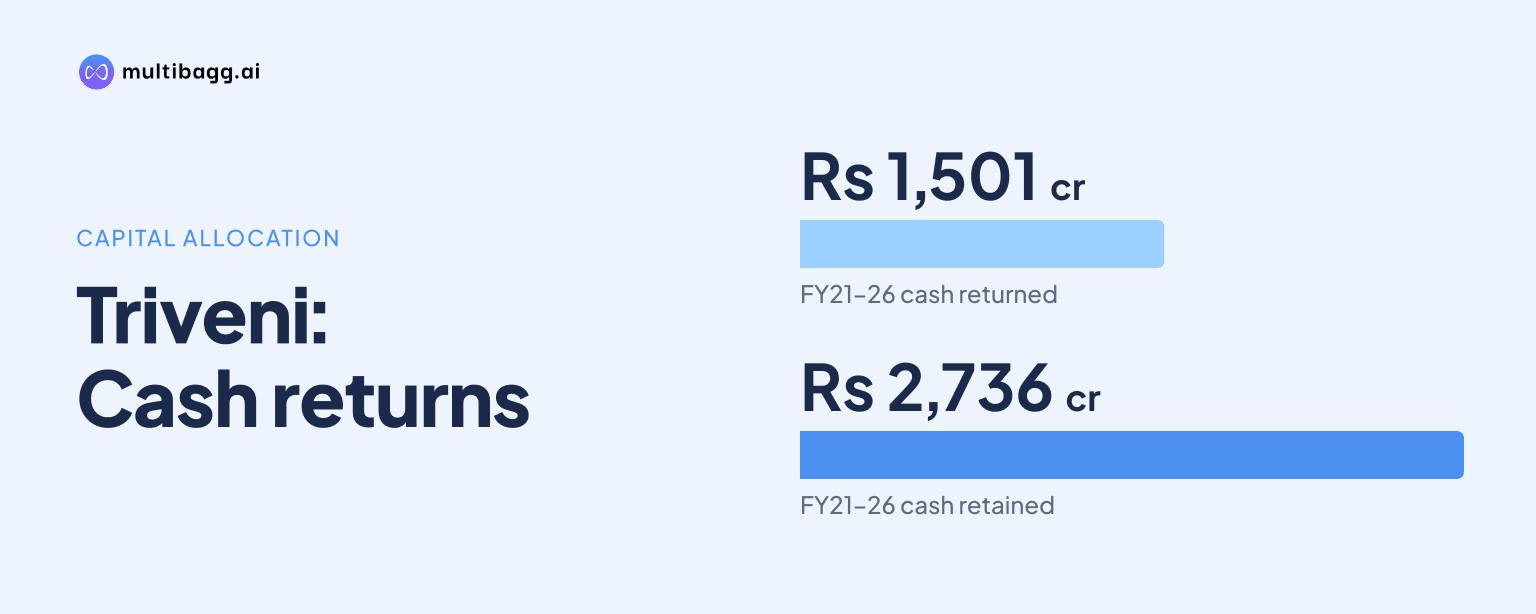
Triveni Engineering & Industries Limited returned ₹1,501 crore, including taxes, to shareholders during FY21-26, while retaining ₹2,736 crore, or 65% of ₹4,237 crore cash generation, for capital expenditure and working capital. Triveni allocated ₹1,495 crore to capital expenditure and ₹1,241 crore to working capital over the six financial years.
Know Triveni Engineering and Industries inside out
Results, valuation, peers and who's buying, in one view.
How did Triveni allocate cash generated in FY21-26?
Triveni allocated 35% of its FY21-26 cash generation to dividends and buybacks, while 65% was divided between capital expenditure and working capital. The company’s ₹4,237 crore total is based on standalone statements of cash flows from FY21 through FY26, rather than consolidated financial statements.
Triveni’s largest individual use of cash was ₹1,501 crore for shareholder distributions, although capital expenditure of ₹1,495 crore was only ₹6 crore lower. Working capital absorbed ₹1,241 crore, taking the combined internal deployment to ₹2,736 crore, or ₹1,235 crore more than shareholder distributions.
What did Triveni’s capital expenditure fund?
Triveni allocated ₹1,495 crore, or 36% of FY21-26 cash generation, to capital expenditure. The company defines this measure as purchases of property, plant and equipment and intangible assets, net of term loans availed or repaid.
The presentation identifies investment in sugar facilities to improve sugarcane crushing rates, sugar quality and operating efficiencies. It also cites expansion of alcohol distillation capacity in alignment with the Government’s Ethanol Blended Petrol Program, and capacity expansion in the power transmission business alongside a rising order book.
Triveni’s business mix changed during the same FY21-FY26 period. Non-sugar businesses contributed 46% of gross revenue in FY26, compared with 20% in FY21, while gross revenue from operations increased from ₹4,703 crore to ₹7,621 crore over the six years.
How were Triveni shareholders paid during the period?
Triveni used dividends and buybacks for ₹1,501 crore of FY21-26 shareholder returns, including taxes. Separately, the presentation reports ₹865 crore of buybacks and ₹433 crore of dividends excluding taxes, so those figures cannot be directly equated with the ₹1,501 crore cash-allocation total.
Triveni concluded an ₹800 crore buyback in February 2023, which the presentation describes as its record buyback. It was substantially larger than the ₹65 crore buyback shown in FY21; the company notes that the FY21 buyback had been announced in the preceding year.
Dividend payments peaked at ₹125.9 crore in FY24, declined to ₹54.7 crore in FY25 and increased to ₹60.4 crore in FY26. Triveni reported a FY26 dividend of ₹2.75 per equity share, while its policy specifies a dividend payout ratio of 15% to 25% of normal business income after tax; FY24 also included a ₹2.25-per-share special dividend.
Got a follow-up? Ask IRIS
How did cash allocation compare with Triveni’s financial performance?
Triveni’s gross revenue increased by ₹2,918 crore between FY21 and FY26 to ₹7,621 crore, while profit before interest and tax declined by ₹30 crore from ₹510 crore to ₹480 crore. Profit before interest and tax reached ₹603 crore in FY23, fell to ₹408 crore in FY25 and then recovered by ₹72 crore in FY26.
Total consolidated debt increased from ₹994 crore in FY21 to ₹2,147 crore in FY26, while the cash-allocation analysis is prepared on a standalone basis. Consolidated debt-to-equity was 0.64 times in FY21 and 0.65 times in FY26, after reaching 0.35 times in FY23; average standalone cost of debt was 6.1% in FY21 and 7.0% in FY26.
Triveni reported an ICRA AA+ Stable long-term credit rating for FY26. The presentation says the rating was upgraded to AA+ Stable on March 27, 2024, placed on watch with developing implications on December 19, 2024, and reaffirmed at AA+ Stable after removal of the watch on May 27, 2026.
What does Triveni’s allocation record show about priorities?
Triveni’s FY21-26 record shows a three-way split between shareholder returns at 35%, capital expenditure at 36% and working capital at 29%. Capital expenditure exceeded shareholder distributions by ₹6 crore, while working capital was ₹254 crore below capital expenditure.
The ₹1,241 crore working-capital allocation was material relative to the ₹1,495 crore directed to capital expenditure. The presentation does not provide a breakdown of the working-capital requirement among inventories, receivables, payables or other operating-cash components.
Conclusion
Triveni generated ₹4,237 crore of standalone cash during FY21-26 and allocated ₹1,501 crore, including taxes, to dividends and buybacks. The remaining ₹2,736 crore funded ₹1,495 crore of capital expenditure and ₹1,241 crore of working capital, alongside a rise in non-sugar revenue contribution from 20% in FY21 to 46% in FY26.
The next point to watch is whether future dividends remain within Triveni’s stated 15% to 25% payout range for normal business income after tax. Investors can also track whether the company continues its disclosed investment in sugar-facility improvements, alcohol distillation capacity and power transmission capacity expansion.