










Triveni sugar profit reaches ₹113 crore on higher pricing
Key highlights
- Triveni’s sugar PBIT reached ₹113 crore in H1 FY27, compared with a ₹5 crore loss in H1 FY26.
- H1 FY27 average sugar realisation increased 9.3% to ₹44,281 per tonne while dispatches declined 0.3%.
- Q2 FY27 sugar PBIT was ₹99 crore, compared with a ₹12 crore loss in Q2 FY26.
- India’s SS 2025-26 closing sugar stock is estimated at 3.5 million tonnes, down from 5.0 million tonnes in SS 2024-25.
powered by IRIS
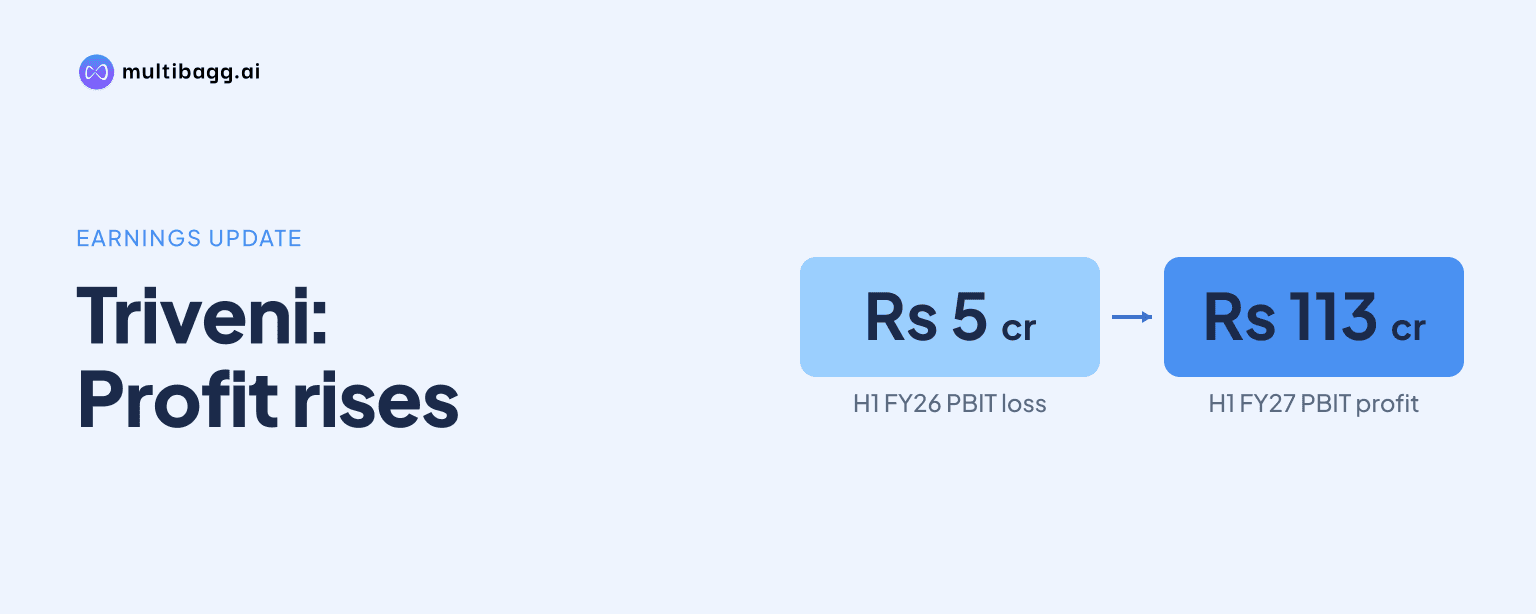
Triveni reported profit before interest and tax (PBIT) of ₹113 crore in the first half (H1) of financial year (FY) 2027, reversing a ₹5 crore loss in H1 FY26, as average realisation rose 9.3% to ₹44,281 per tonne while domestic dispatches declined 0.3%. The presentation attributes the improvement to higher sugar prices and sales contribution margins.
Know Triveni Engineering and Industries inside out
Results, valuation, peers and who's buying, in one view.
Why did Triveni’s sugar profit improve in H1 FY27?
Triveni’s sugar profit improved because higher realised prices lifted sales contribution margins despite almost unchanged first-half volumes. Sugar-segment revenue increased 4.7% to ₹2,497 crore in H1 FY27 from ₹2,384 crore in H1 FY26, while PBIT moved from a ₹5 crore loss to a ₹113 crore profit. The presentation identifies higher sugar prices, rather than growth in domestic dispatches, as the driver of improved segment profitability.
The quarterly movement showed the same pattern in the second quarter (Q2). Revenue increased 3.9% to ₹1,262 crore in Q2 FY27 from ₹1,215 crore in Q2 FY26, while PBIT moved from a ₹12 crore loss to a ₹99 crore profit. The ₹111 crore change in quarterly PBIT came alongside a ₹47 crore increase in quarterly revenue.
Did volumes or pricing drive Triveni’s H1 FY27 growth?
Pricing drove Triveni’s H1 FY27 sugar growth because average realisation rose 9.3% while domestic sugar dispatches declined 0.3%. Average realisation reached ₹44,281 per tonne in H1 FY27, compared with ₹40,505 per tonne in H1 FY26. Domestic dispatches were 5,32,738 tonnes, compared with 5,34,421 tonnes in the previous first half.
The quarterly comparison showed a wider divergence between pricing and volume. Q2 FY27 dispatches declined 7.6% to 2,55,334 tonnes from 2,76,225 tonnes, while average realisation rose 16.5% to ₹47,275 per tonne from ₹40,583 per tonne. Triveni said the rise in quarterly and half-year realisations reflected overall market conditions, while a growing share of refined sugar and pharmaceutical-grade sugar had supported realisations over time.
Monthly domestic realisations reached ₹5,044 per quintal in August FY27, after ₹4,445 per quintal in July and ₹4,204 per quintal in June. They then eased to ₹4,705 per quintal in September FY27. The September FY27 figure nevertheless remained above ₹4,118 per quintal in September FY26, consistent with the higher H1 FY27 average.
What changed in Triveni’s sugar inventory during the period?
Triveni held lower sugar inventory by volume but at a higher value per kilogram on 30 September 2026. Inventory was 1.03 lakh tonnes, valued at ₹38.6 per kilogram, compared with 1.69 lakh tonnes valued at ₹37.4 per kilogram on 30 September 2025. Inventory volume was therefore lower by 0.66 lakh tonnes year on year.
The inventory comparison accompanies the pricing-led increase in sugar-segment revenue to ₹2,497 crore in H1 FY27. It does not establish why inventory volume changed, but it shows that Triveni had fewer tonnes on hand at a stated value that was ₹1.2 per kilogram higher than a year earlier. The presentation separately links higher sugar prices to the improvement in segment profitability.
Got a follow-up? Ask IRIS
How did Triveni’s cane performance change in SS 2025-26?
Triveni’s sugarcane crushing fell to 825 lakh quintals in sugar season (SS) 2025-26 from 905 lakh quintals in SS 2024-25, while gross recovery increased to 11.06% from 10.80%. Sugar production was 91 lakh quintals in SS 2025-26, compared with 92 lakh quintals in the preceding season. The presentation says climatic factors across Uttar Pradesh affected crushing during SS 2025-26.
Area under sugarcane was 2.11 lakh hectares in SS 2025-26, compared with 2.14 lakh hectares in SS 2024-25. Gross recovery of 11.06% was below 11.49% in SS 2023-24 but above the immediately preceding season’s 10.80%. Triveni states that its gross-recovery data is adjusted for diversion of B-heavy molasses and syrup.
The physical-output comparison differs from the pricing trend in H1 FY27. Sugar production of 91 lakh quintals in SS 2025-26 was below 95 lakh quintals in SS 2022-23, while H1 FY27 average realisation rose to ₹44,281 per tonne. The disclosed figures therefore show lower recent crushing and production alongside higher domestic sugar realisations.
Can India’s sugar balance support Triveni’s realisations?
The presentation says tight domestic sugar balances could keep prices firm, estimating SS 2025-26 closing stock at 3.5 million tonnes. That estimate is below closing stocks of 5.0 million tonnes in SS 2024-25 and 7.0 million tonnes in SS 2023-24. Triveni describes the estimated SS 2025-26 closing stock as the lowest end-of-season level since September 2017.
The SS 2025-26 estimate assumes production of 27.8 million tonnes, imports of 0.3 million tonnes, internal consumption of 28.8 million tonnes and exports of 0.8 million tonnes. The presentation characterises the market as having a net deficit of 1.5 million tonnes despite imports, based on gross production of 30.8 million tonnes and diversion of 3.0 million tonnes to ethanol. These figures are market estimates rather than final industry results.
Triveni also cites the Fair and Remunerative Price of sugarcane, the minimum selling price of sugar, ethanol diversion and export policies among measures that have reduced industry cyclicality. Its sugar-segment earnings before interest and tax (EBIT) margin averaged 8.4% in FY21-25, compared with 7.9% in FY16-20 and negative 0.7% in FY11-15. The reported FY26 EBIT margin was 6.1%.
Conclusion
Triveni’s H1 FY27 sugar result was driven by price and margin rather than volume: average realisation rose 9.3%, revenue increased 4.7%, and PBIT reached ₹113 crore after a ₹5 crore loss a year earlier, while domestic dispatches declined 0.3%. Q2 FY27 followed the same direction, with a 16.5% rise in realisation occurring alongside a 7.6% reduction in dispatches.
The next issue is whether the SS 2025-26 market develops in line with the estimated 3.5 million-tonne closing stock and 1.5 million-tonne net deficit. Climatic factors had affected Uttar Pradesh crushing in SS 2025-26, while Triveni’s disclosed cane-development programme includes varietal substitution, crop protection, digital initiatives and yield-improvement measures.