










Triveni alcohol PBIT rises 44% despite lower H1 production
Key highlights
- Triveni’s H1 FY27 alcohol PBIT rose 43.9% to Rs 73 crore from Rs 51 crore.
- Triveni’s H1 FY27 alcohol production fell 12.8% to 1,08,540 kilolitres.
- Triveni’s Q2 FY27 alcohol sales rose 15.8% to 61,424 kilolitres.
- The ESY 2026–27 tender reduces maize ethanol procurement pricing by Rs 3 per litre.
powered by IRIS
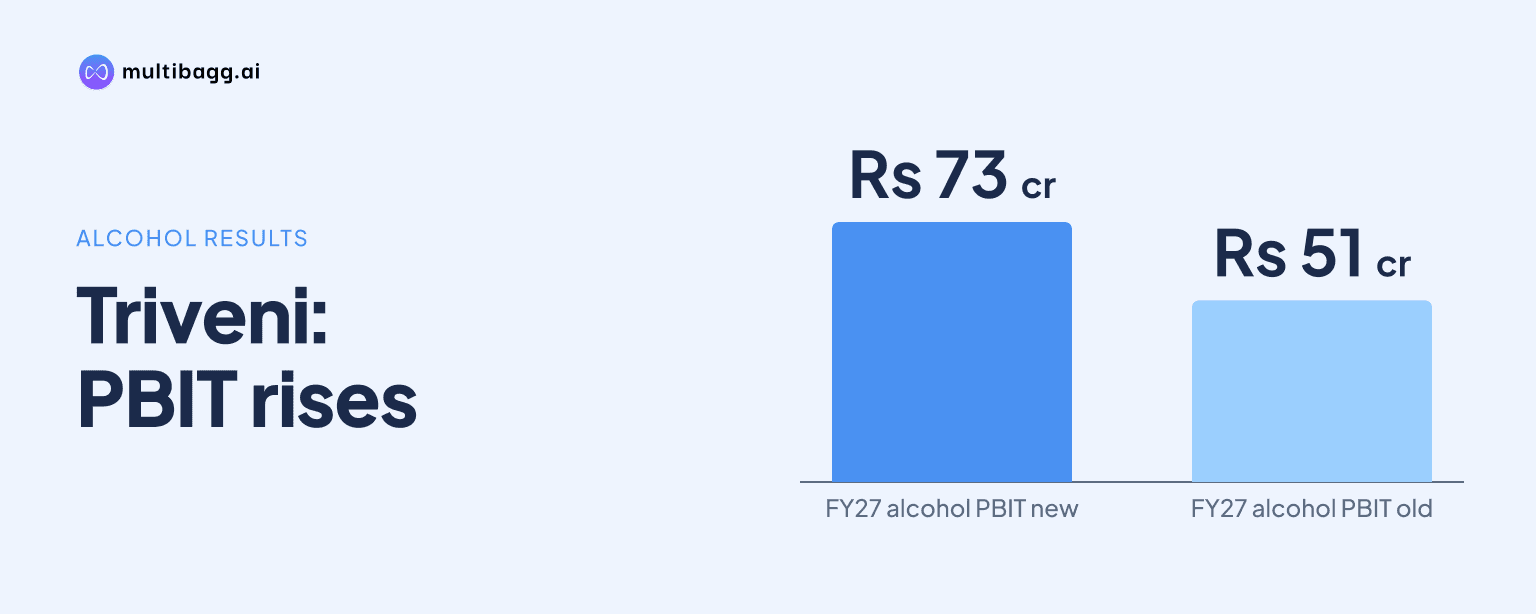
Triveni Engineering & Industries Limited reported alcohol PBIT of Rs 73 crore in H1 FY27, up 43.9% from Rs 51 crore in H1 FY26, despite a 12.8% fall in production to 1,08,540 kilolitres. Triveni attributed the increase to a higher proportion of maize-based ethanol, DDGS realisation, higher sales volume and higher realisation.
Know Triveni Engineering and Industries inside out
Results, valuation, peers and who's buying, in one view.
Why did Triveni alcohol PBIT rise while production declined?
Triveni’s alcohol profitability rose because its feedstock and product mix changed even though output was reduced to match demand conditions. Profit before interest and tax, or PBIT, increased by Rs 22 crore year on year in H1 FY27, while net revenue, stated after excise duty, increased 2.5% to Rs 846 crore from Rs 825 crore in H1 FY26. Triveni specifically cited the higher proportion of ethanol made from maize and realisation from distillers’ dried grains with solubles, or DDGS, as contributors.
The improvement was more pronounced in the second quarter. Q2 FY27 PBIT was Rs 43 crore, 53.5% higher than Rs 28 crore in Q2 FY26, while net revenue rose 19% to Rs 473 crore from Rs 397 crore. Triveni said higher sales volume supported Q2 revenue growth, meaning the quarterly earnings increase coincided with sales growth rather than higher distillery production.
PBIT grew faster than net revenue in H1 FY27 while both production and sales volumes declined from the corresponding period. Triveni’s explanation places the change in profitability in maize ethanol mix and DDGS realisation rather than broad H1 volume expansion. Average realisation rose 1.1% to Rs 61.85 per litre from Rs 61.20 per litre, another disclosed contributor to the period’s earnings outcome.
How far did lower offtake reduce Triveni alcohol volumes?
Lower offtake reduced Triveni’s H1 FY27 production by 15,980 kilolitres and sales by 3,451 kilolitres compared with H1 FY26. Triveni said it lowered production to synchronise output with offtake, address finished-stock storage constraints and move away from B-Heavy molasses ethanol. This explains why the production decline of 12.8% was larger than the 3.0% reduction in H1 sales.
Q2 showed a different volume pattern from the first half. Production fell 14.3% to 51,052 kilolitres from 59,550 kilolitres in Q2 FY26, but sales increased 15.8% to 61,424 kilolitres from 53,024 kilolitres. Triveni described Q2 volume growth as decent and said the decline in Q1 moderated the H1 sales result, which ended at 1,11,907 kilolitres.
Triveni’s reported average realisation increased in both reported periods despite the lower production. Q2 realisation rose 1.1% to Rs 64.01 per litre from Rs 63.29 per litre, and H1 realisation rose by the same percentage to Rs 61.85 per litre. The Q2 sales increase alongside lower production is consistent with the company’s stated effort to align output with offtake and finished-stock storage capacity.
Got a follow-up? Ask IRIS
What alcohol manufacturing capacity does Triveni operate?
Triveni operates facilities across Central and Western Uttar Pradesh, including two multi-feed plants of 200 kilolitres per day, or KLPD, each at Rani Nagar and Milak Narayanpur. Its Western Uttar Pradesh operations include 200 KLPD molasses and 60 KLPD grain facilities at Muzaffarnagar, a 200 KLPD molasses facility at Sabitgarh and a 100 KLPD molasses facility at Shamli.
The listed network produces bio-ethanol, extra neutral alcohol, rectified spirit and denatured spirit, plus co-products including DDGS, potash-rich ash and carbon dioxide. The presentation excludes the 100 KLPD Shamli distillery because it did not operate during the year. That exclusion is relevant when interpreting the listed asset base and the FY27 production decline.
Triveni’s longer-term data show alcohol production rising from 1,07,027 kilolitres in FY21 to 2,36,510 kilolitres in FY26. Alcohol sales increased from 1,03,637 kilolitres to 2,13,453 kilolitres over the same period, while average realisation rose from Rs 48.90 to Rs 61.00 per litre. In H1 FY27, production moved lower because of offtake, stock-storage and B-Heavy molasses considerations identified by Triveni.
How could the next OMC tender affect Triveni economics?
The next ethanol procurement tender changes the permitted feedstocks and reduces the maize procurement price by Rs 3 per litre, according to Triveni’s presentation. Oil marketing companies, or OMCs, invited bids for about 1,100 crore litres for Ethanol Supply Year, or ESY, 2026–27. The tender excludes ethanol from sugarcane juice or syrup and B-Heavy molasses, while allowing maize, broken rice, surplus Food Corporation of India, or FCI, rice and C-Heavy molasses.
This matters because Triveni identified high-margin maize ethanol as a contributor to its Rs 73 crore H1 FY27 PBIT. The disclosed Rs 3-per-litre reduction applies to maize-based ethanol procurement, changing a price parameter for a feedstock mix that supported reported profitability. The presentation does not quantify Triveni’s maize volumes, tender allocation, cost base or the resulting effect on future PBIT.
National supply data in the presentation show a shift towards grain ethanol. In ESY 2025–26, grain-based ethanol supply was 705 crore litres, compared with 282 crore litres from sugarcane-based feedstocks, and blending reached 20.0%. By 30 September 2026, 82% of the total allocated volume of 1,197 crore litres had been supplied; grain ethanol represented 76% of allocation and 71% of supplies to that date. The tender restricts FCI rice-based ethanol to 324 crore litres, adding another disclosed constraint to the eligible-feedstock market.
Conclusion
Triveni’s H1 FY27 alcohol result combined lower physical production with higher profitability: output fell 12.8% to 1,08,540 kilolitres, but PBIT rose 43.9% to Rs 73 crore. Triveni attributes that divergence to a greater share of maize ethanol, DDGS realisation, higher Q2 sales volume and a 1.1% increase in average H1 realisation to Rs 61.85 per litre.
The next point to watch is the ESY 2026–27 OMC tender for about 1,100 crore litres, particularly its Rs 3-per-litre reduction in the maize ethanol procurement price. Triveni has not disclosed its tender allocation, maize production volume or expected earnings effect, while the tender’s exclusion of B-Heavy molasses and sugarcane juice or syrup also changes the available feedstock routes.