










Triveni water revenue falls 17% as EPC execution slows in H1 FY27
Key highlights
- Triveni reported H1 FY27 water revenue of Rs 90 crore, down 17.1% from Rs 109 crore in H1 FY26.
- Triveni's H1 FY27 water PBIT fell to Rs 3 crore from Rs 13 crore a year earlier.
- Triveni's water order book was Rs 1,452 crore at September 30, 2026, down 4.5% from H1 FY26.
- Extended-duration O&M contracts accounted for Rs 1,048 crore of Triveni's September 2026 water order book.
powered by IRIS
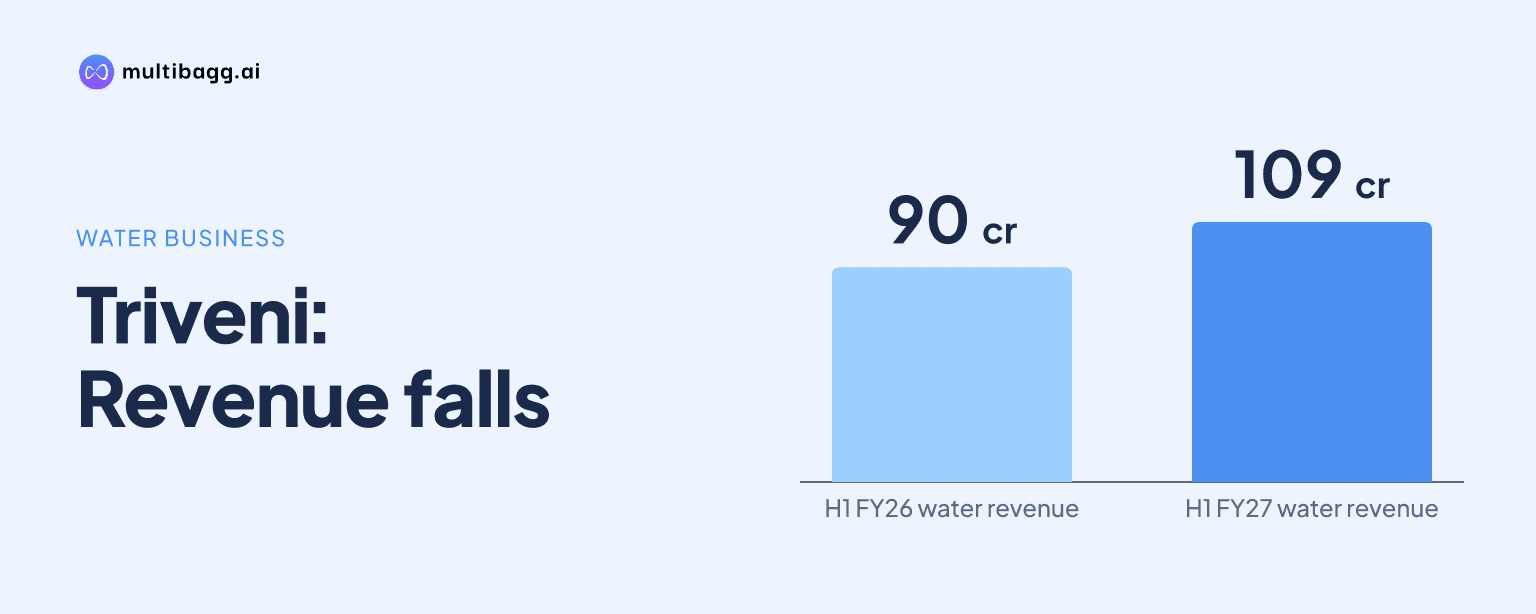
Triveni reported first-half (H1) fiscal year 2027 (FY27) water revenue of Rs 90 crore, down 17.1% from Rs 109 crore a year earlier, as execution slowed on certain engineering, procurement and construction (EPC) jobs; its order book was Rs 1,452 crore at September 30, 2026, including Rs 1,048 crore of operations and maintenance (O&M) contracts.
Know Triveni Engineering and Industries inside out
Results, valuation, peers and who's buying, in one view.
Why did Triveni water revenue decline in H1 FY27?
Triveni water revenue declined primarily because certain EPC jobs were executed slowly, according to the presentation. Revenue was Rs 47 crore in the second quarter (Q2) of FY27, 12.9% below Rs 54 crore in Q2 FY26, while H1 revenue fell by Rs 19 crore to Rs 90 crore from Rs 109 crore in H1 FY26.
Profit before interest and tax (PBIT) also declined alongside revenue. Q2 FY27 PBIT was Rs 1 crore versus Rs 2 crore in Q2 FY26, a 55.9% fall, while H1 FY27 PBIT was Rs 3 crore compared with Rs 13 crore a year earlier, an 81% decline. Triveni says the profitability decline was commensurate with lower revenue and does not identify a separate cost, pricing or margin driver.
The slowdown was reported in both the quarter and the first half, rather than only in Q2 FY27. Revenue declined by Rs 7 crore in Q2 and Rs 19 crore in H1, whereas PBIT fell by Rs 1 crore and Rs 10 crore respectively. The presentation does not provide project-level milestones, billing schedules or expected completion dates for the EPC jobs described as slow.
How large is Triveni's water order book?
Triveni's closing water order book was Rs 1,452 crore at September 30, 2026, down 4.5% from Rs 1,520 crore at H1 FY26. The Rs 68 crore year-on-year reduction occurred even as the order book remained substantially larger than the Rs 90 crore of water revenue reported for H1 FY27.
Extended-duration O&M contracts accounted for Rs 1,048 crore of the September 2026 order book. The presentation states that its closing-order-book measure includes long-duration O&M orders, meaning the Rs 1,452 crore total combines work that may be performed over different contract periods. The disclosed balance outside extended-duration O&M contracts was Rs 404 crore.
The order book represents outstanding contracted work, rather than a disclosed forecast of FY27 revenue. Triveni identifies recurring revenue streams from long-term O&M contracts, while EPC revenue depends on project execution progress. The presentation does not split the Rs 1,048 crore O&M balance by customer, tenure, project stage or annual revenue contribution.
Got a follow-up? Ask IRIS
What water projects and services does Triveni provide?
Triveni operates across the water and wastewater-treatment value chain through EPC projects, products, solutions, concessions and O&M. Its wastewater offerings cover municipal sewage, industrial effluent, sludge treatment and biogas handling, while its water-treatment work includes municipal water, seawater, industrial process water, high-purity water and intake works.
The division also lists municipal sewage recycling, industrial wastewater recycling and desalination under its water-recycle, zero-liquid-discharge (ZLD) and desalination offerings. Triveni says it has executed more than 100 projects, has more than 1,500 installations across India and has treated more than 12,000 million litres per day (MLD) of wastewater.
Triveni's disclosed delivery models include turnkey EPC work, design-build-operate (DBO) projects combining EPC and operational management, and public-private partnership (PPP) projects. It says two hybrid annuity model (HAM) PPP projects are operational. The reported water results include wholly owned special-purpose vehicles (SPVs) executing the Mathura PPP/HAM project awarded by UP Jal Nigam and funded by the National Mission of Clean Ganga under the Namami Gange Programme, as well as Palizd Pvt. Ltd.
What demand areas does Triveni identify for water treatment?
Triveni identifies municipal sewage and water treatment, power, oil and gas, chemicals, textiles, steel, non-ferrous industries and desalination as key industry areas. It also lists India, South Asian Association for Regional Cooperation (SAARC) markets, the Middle East, Europe and Africa as key regions, and says it has in-house manufacturing capacity in the National Capital Region for specific equipment.
The presentation identifies regulatory support, increased sewage-treatment capacity, urbanisation, industrial wastewater-treatment compliance, recycled-water demand, desalination and traditional industrial segments as long-term Indian demand factors. These are market factors identified by management, not quantified revenue forecasts. The document provides no FY27 target for water revenue, PBIT, order intake or the timing of normalised EPC execution.
Triveni says its water division has operated for more than 40 years, supported by in-house product development, relationships with key Indian institutions and global partnerships. Its specialised project capabilities include desalination, recycling, ZLD and utility management for water and sewerage networks. However, the reported FY27 outcome remains Rs 90 crore of H1 revenue, with slower EPC execution cited as the reason for the decline.
Conclusion
Triveni's H1 FY27 water figures show a gap between contracted work and revenue conversion during the period. Revenue fell 17.1% to Rs 90 crore and PBIT declined 81% to Rs 3 crore, while the September 30, 2026 order book stood at Rs 1,452 crore. The Rs 1,048 crore O&M component also means a substantial part of outstanding work is linked to contracts with extended durations.
The next reported results will indicate whether execution improves on the EPC jobs cited by Triveni. Changes in the Rs 1,452 crore order book and its Rs 1,048 crore extended-duration O&M component are also relevant, because the presentation does not disclose an FY27 execution target, order-intake target or project-completion schedule.