










Aurobindo says Lannett profitability supports CDMO discipline
Key highlights
- Aurobindo said Lannett is profitable despite underutilised facilities on 5 November 2026.
- Existing CDMO activity represents about 10% to 15% of Lannett’s total capacity or utilisation.
- Aurobindo said Lannett’s first-quarter performance exceeded expectations across multiple operating metrics.
- Management said FY28 should be better than FY27 partly from Lannett’s full-year benefit.
powered by IRIS
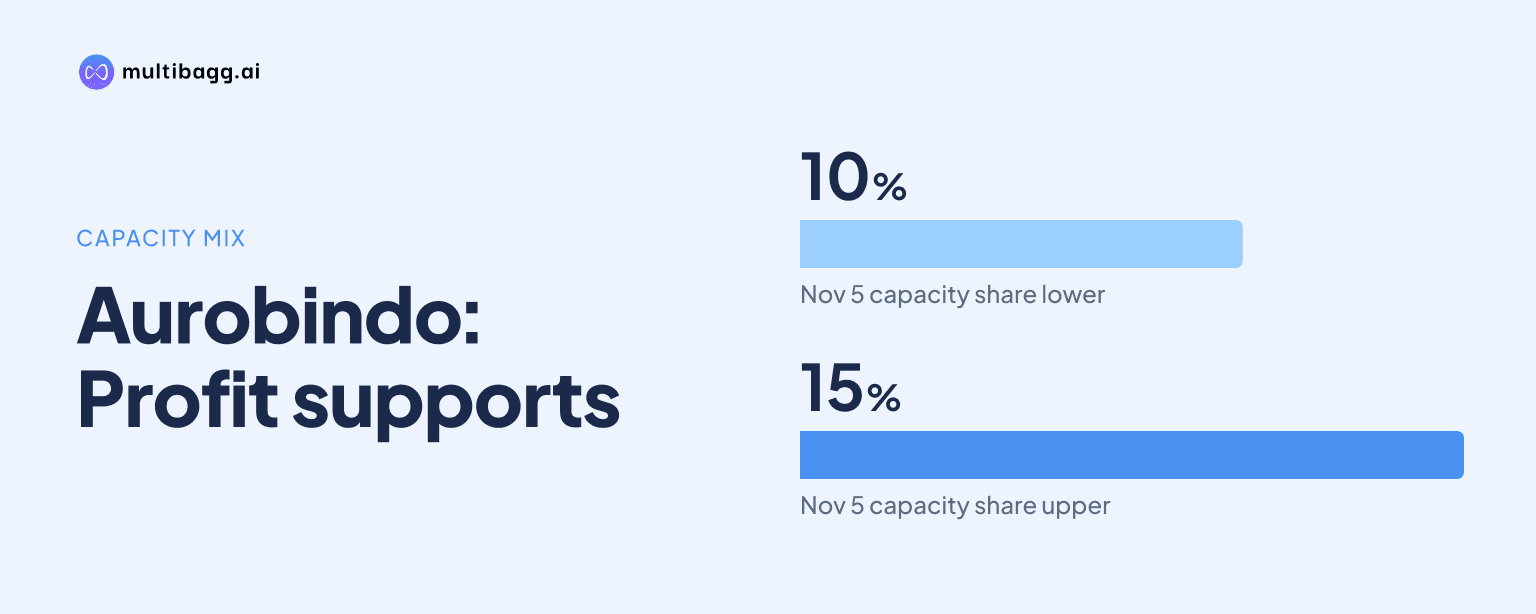
Aurobindo Pharma Limited said on 5 November 2026 that Lannett is profitable despite low utilisation and will not add contract development and manufacturing organisation (CDMO) work merely for volume, as existing CDMO activity represents only about 10% to 15% of total capacity or utilisation.
Know Aurobindo Pharma inside out
Results, valuation, peers and who's buying, in one view.
Is Lannett profitable despite being underutilised?
Yes, Aurobindo said Lannett is profitable at its current operating level despite underutilised facilities. Management attributed that position to Lannett’s existing portfolio of decent and niche products, which it said are doing well. It did not disclose revenue, profit, production volume or a profit margin for Lannett on the 5 November 2026 call.
Management said Lannett’s first-quarter performance exceeded its expectations across multiple operating metrics. That comparison is between the acquired business’s first-quarter outcome and management’s prior expectations, rather than a disclosed year-on-year financial comparison. The company did not specify which metrics exceeded expectations or quantify the degree of outperformance.
Aurobindo also said Lannett’s integration is progressing extremely well and could provide meaningful momentum to the long-term growth of its US business. In its outlook, management said FY28 should be better than FY27, citing various initiatives, China, biosimilars and the full-year benefit of Lannett. This is management’s expectation, not numerical guidance for Lannett revenue, earnings or utilisation.
How much Lannett capacity is used for CDMO work?
Aurobindo said existing CDMO opportunities account for roughly 10% to 15% of Lannett’s total capacity or utilisation. Management described that contribution as marginal, although the call did not define whether the percentage is measured against installed plant capacity, actual production utilisation or another internal operating measure.
The 10% to 15% CDMO share shows that Lannett was already undertaking third-party manufacturing work before the latest discussions. Management said it was considering further opportunities and had discussed the issue with potential partners as recently as the day before the 5 November call. It did not identify those partners, potential products, contract values or a timetable for agreements.
The current CDMO proportion also has to be viewed against the profitable existing product base. Aurobindo said it was quite happily situated with its current products and that operating metrics were doing very well. Consequently, the company did not present a rise from the current 10% to 15% CDMO level as necessary to sustain Lannett’s present profitability.
Got a follow-up? Ask IRIS
Will Aurobindo take low-margin work to fill Lannett plants?
No, Aurobindo said it would not enter an arrangement unless it made adequate money and adequate margins. Management explicitly said it did not want to bring in work simply because it generated volume, and it did not need products solely to lift utilisation at the underused Lannett facilities.
This makes the company’s stated approach margin-led rather than volume-led. Aurobindo did not disclose a minimum acceptable margin, the margin on the existing 10% to 15% CDMO activity, or a preferred type of customer contract. Its stated filter is therefore qualitative: additional manufacturing work must have adequate economics rather than only increasing throughput.
Management said utilisation can improve through selected CDMO opportunities as well as products Aurobindo intends to bring on board. The product-transfer route has regulatory steps, because filings and approvals are required before products can be manufactured at the facility. Management said that process takes time, leaving the pace of any utilisation increase unresolved.
What could lift Aurobindo's US manufacturing utilisation?
Aurobindo said products planned for Lannett are progressing well, but it did not name them or provide filing and launch dates. The company’s wider US respiratory programme includes one approved metered-dose inhaler, or MDI, product for which manufacturing and commercial preparations are under way, plus at least four inhalation products in development at different stages.
The respiratory pipeline has products and partnerships beyond Lannett, so it should not be assumed that these programmes will be made at the acquired facilities. Aurobindo said gAdvair was launched in the middle of the quarter under discussion and did not deliver its full benefit in that quarter. It expects higher benefits later, while one partnered inhalation asset was commercially launched during the same quarter.
At the Raleigh, North Carolina facility, utilisation is currently nominal because MDI manufacturing has not started and the dermal operation has only one smaller-volume product. Management expects Raleigh utilisation to improve in about 6 to 9 months. That timeline differs from Lannett, where the route to higher loading depends on product transfers, regulatory clearances and CDMO contracts meeting its stated margin test.
Conclusion
Lannett’s reported profitability, its first-quarter performance above management expectations and its existing product portfolio give Aurobindo scope to reject CDMO work that only adds volume. With current CDMO activity at about 10% to 15% of capacity or utilisation, the company is seeking more opportunities but has not made plant loading an end in itself.
The next issues to watch are whether partner discussions result in manufacturing agreements, whether filings and approvals allow further products to move into Lannett, and whether utilisation rises on acceptable economics. Management has identified FY28 as a period that should benefit from Lannett for a full year, but it has not quantified the acquisition’s expected contribution in FY27 or FY28.