










Aurobindo selects biosimilars over the portfolio scale race
Key highlights
- Aurobindo said it will not seek to match Sandoz’s 100-product biosimilar ambition or Fresenius Kabi’s 37-product agreement.
- Management said broad biosimilar programmes extending to 2040 require sustained investment in manufacturing, development and commercial infrastructure.
- Aurobindo described its European presence as 10 countries, alongside Orion in the Nordics and STADA agreements for a couple of products.
- Management said 2030 or 2031 may clarify how many Indian companies become serious biosimilar differentiators.
powered by IRIS
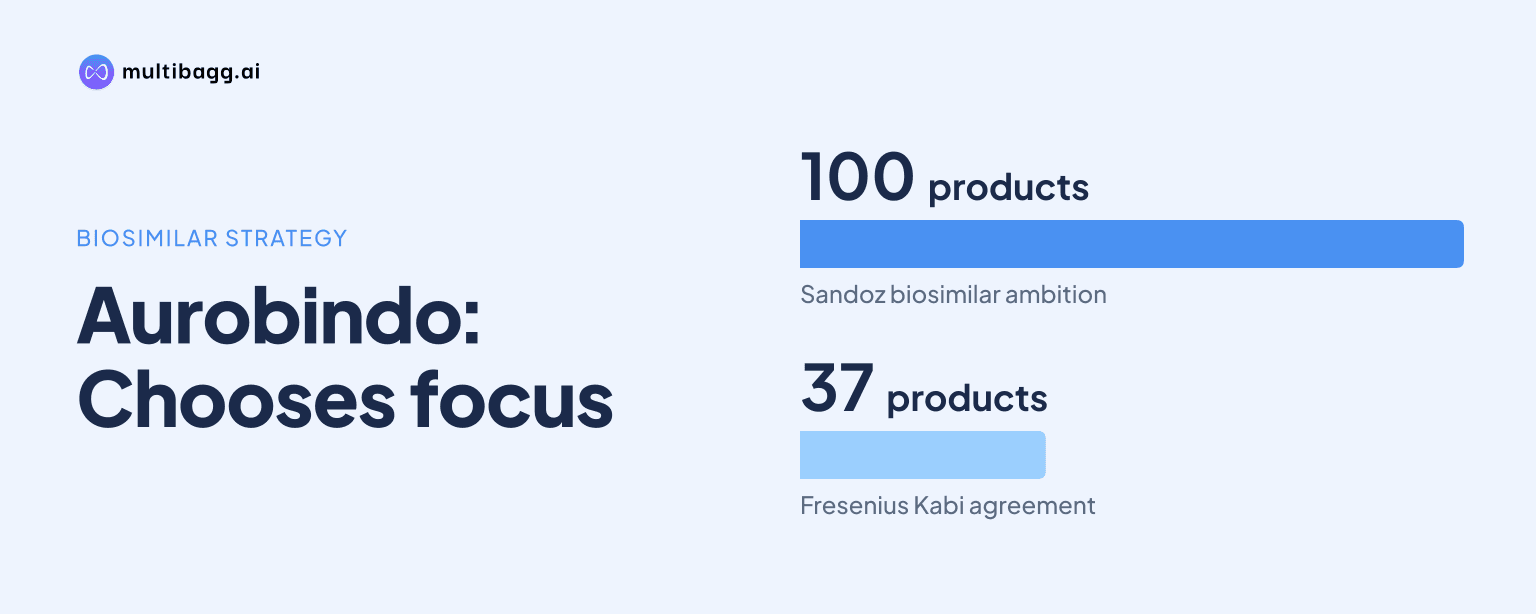
Aurobindo Pharma Limited said on 5 November 2026 that it will pursue selected biosimilars, commercial partners and differentiated formats rather than match the scale of Sandoz’s 100-product ambition or Fresenius Kabi’s agreement covering 37 biosimilars. Management said broad portfolios require years of sustained manufacturing, development and commercial investment.
Know Aurobindo Pharma inside out
Results, valuation, peers and who's buying, in one view.
Why is Aurobindo avoiding a broad biosimilar portfolio?
Aurobindo is avoiding a broad portfolio because management said it cannot, and should not, seek to replicate the molecule counts targeted by larger biosimilar specialists. In response to a comparison with Sandoz’s Bio100 plan and Fresenius Kabi’s 37-biosimilar arrangement, Dr. Satakarni Makkapati said Aurobindo would be “very selective” rather than attempt to match those ambitions.
Management presented the 100-product and 37-product plans as evidence that biosimilars are becoming an important category for generic-drug companies, but also as evidence of the cost of scale. Dr. Makkapati said such programmes, planned over a horizon to 2040, need sustained investment in manufacturing, product development and commercial infrastructure over many years.
Aurobindo’s position is not that the biosimilar opportunity is limited. Management said losses of exclusivity over the next decade create a large opportunity and described biosimilars as a durable, growing and differentiating business. Its decision is instead to screen opportunities rather than treat every product facing loss of exclusivity as a development target.
Management said a tier-one group is already emerging, naming Sandoz, Fresenius Kabi and Celltrion. Against that competitive structure, Aurobindo said it would build a portfolio that advances its interests in selected markets, rather than pursue a product count comparable with the 100 and 37 products cited by the analyst.
How will Aurobindo decide which biosimilars to develop?
Aurobindo will select biosimilars based on whether the molecule, manufacturing requirements and commercial market can support viable economics over a longer product life cycle. Management said not every loss of exclusivity, meaning the end of a product’s protected market period, creates a viable biosimilar market.
The company identified three filters that can alter a molecule’s economics: manufacturing complexity, a small patient population and patient or manufacturing barriers. These factors mean that a product with an approaching loss of exclusivity may still not justify development, even during the large opportunity management sees over the coming decade.
Aurobindo also pointed to capabilities that may support a selective model. Dr. Makkapati cited cost-efficient development, growing scientific maturity during the past five to six years, and regulatory approvals obtained by Indian companies in Europe and the United States. He added that companies able to meet regular European Medicines Agency scrutiny could benefit where regulators waive efficacy trials.
The approach leaves room for in-licensing rather than requiring every product to be internally developed. Management said Aurobindo is open to licensing in a molecule that sits outside its pipeline when that product suits a territory it wants to serve. The mechanism gives the company another route to a selected market while keeping its central focus on portfolio fit rather than molecule volume.
Got a follow-up? Ask IRIS
How will Aurobindo use partners in biosimilar markets?
Aurobindo will use a mix of direct operations and territory-specific partners to commercialise selected biosimilars. Management said it has its own European presence in “9+1,” or 10, countries, has Orion as a partner in the Nordic region, and has signed STADA for a couple of products.
This structure links the choice of molecule to the route through which it can reach patients and prescribers. Dr. Makkapati said the portfolio is intended to support territory players that can market a product and sustain it over a longer life cycle. That differs from building the full commercial infrastructure needed to support a 37-product or 100-product programme across every market.
The company’s approach also distinguishes products it may develop from products it may access through partners. Where a molecule is outside Aurobindo’s internal pipeline but fits the needs of a particular territory, management said in-licensing remains an option. It did not identify the molecules covered by Orion or STADA, or provide a timetable for launches under those arrangements.
Management’s comments positioned partnerships as a way to extend reach, not a replacement for its European footprint across 10 countries. The company also referred to CuraTeQ and Eugia launches expected in coming years in its broader European discussion, but it did not provide a biosimilar revenue target, product count or market-by-market forecast for CuraTeQ.
What differentiated formats will Aurobindo pursue in biosimilars?
Aurobindo will consider differentiated formats, including subcutaneous products and device combinations, where management believes the economics can help it compete with tier-one players. Dr. Makkapati identified those formats as a route to differentiation distinct from adding a large number of biosimilar molecules.
A subcutaneous format or a product-device combination may matter because management said biosimilar viability depends on more than an upcoming loss of exclusivity. Complexity in making a product, a limited patient population and access barriers can change the commercial case. A differentiated presentation is therefore part of the company’s selection framework rather than a stated plan to reformulate every product.
Management described this strategy as deliberate for Aurobindo and CuraTeQ. The company said it will choose a portfolio that supports its interests and those of its territory partners, while seeking formats where the economics could allow competition with larger companies. It did not disclose how many subcutaneous products or device combinations are in development.
The 5 November 2026 discussion did not include spending, approval dates or launch targets for a differentiated-format pipeline. Management’s disclosed commitment was narrower: Aurobindo will make careful choices about what it develops, expand reach through partners and remain open to in-licensing when a molecule fits a territory outside its existing pipeline.
Conclusion
Aurobindo’s strategy rejects a race to equal the 100-product and 37-product biosimilar plans cited for Sandoz and Fresenius Kabi. Management sees a large opportunity from losses of exclusivity over the next decade, but will filter it through manufacturing complexity, patient population, access conditions, territory fit, partners and differentiated formats such as subcutaneous products and device combinations.
The next issue to watch is whether Aurobindo discloses additional product launches, in-licensing agreements or territory partnerships for CuraTeQ. Management said 2030 or 2031 may provide a clearer picture of how many Indian companies have made a serious effort to differentiate themselves in biosimilars, while it gave no product-count target or revenue guidance for its own programme.