










AUSTERE cites 40% lower manual review in AI-enabled workflows
Key highlights
- AUSTERE reports a 40% reduction in manual data review from AI-infused applications.
- AUSTERE reports 25% faster form processing in its AI-infusion examples.
- AUSTERE’s full-time-engagement model provides 160 hours per month per resource.
- AUSTERE’s AI workflow covers ingestion, extraction, reconciliation, summaries and approval or rejection actions.
powered by IRIS
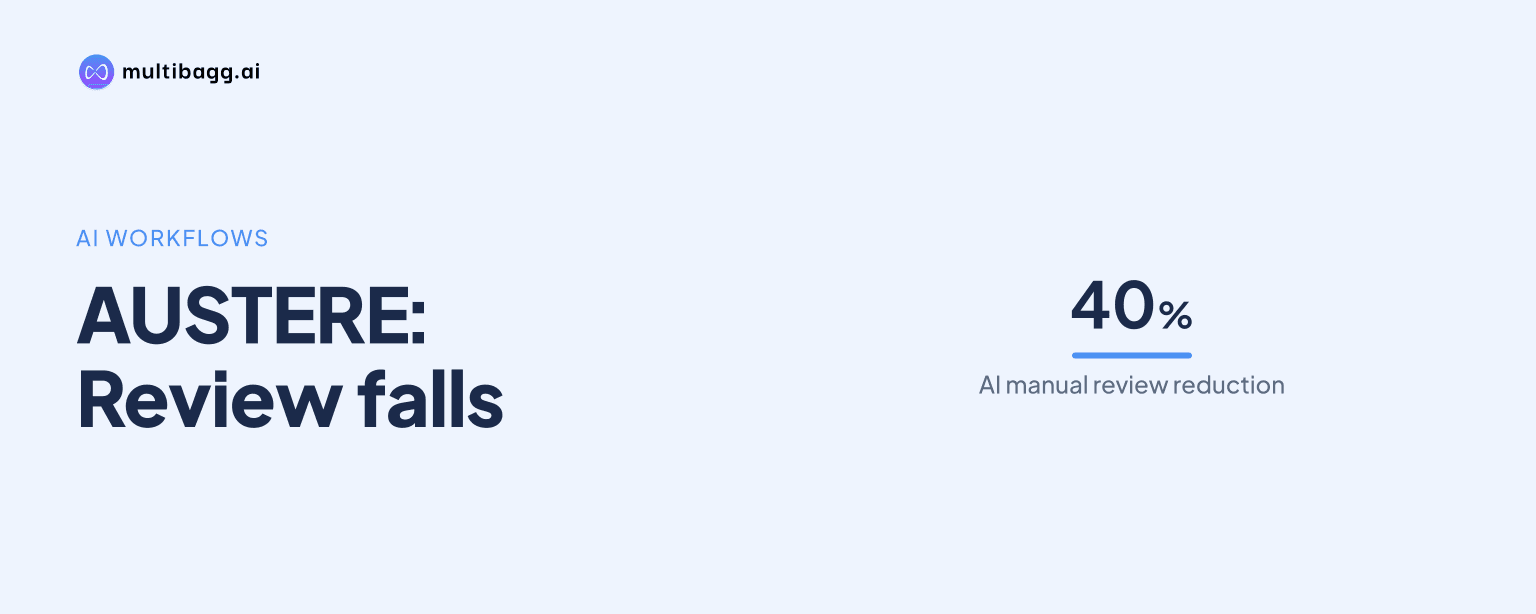
In its investor presentation, AUSTERE says artificial intelligence (AI)-infused applications reduced manual data review by 40% and made form processing 25% faster, using document extraction, validation and automated workflows in government-service and pathology-application examples.
Know Austere Systems inside out
Results, valuation, peers and who's buying, in one view.
How does AUSTERE automate government document work?
AUSTERE’s government-focused AI and agentic AI workflow begins with intelligent ingestion of PDFs, scanned files, emails and data feeds. The system is described as automatically classifying citizen documents, including know-your-customer (KYC), tax and legal records, before moving them into a broader processing workflow.
The next mechanism is smart data extraction from both typed and handwritten documents. AUSTERE says this capability eliminates the need for manual tagging or rule-based systems. Its government-oriented process links ingestion, extraction, validation and action, rather than limiting the capability to scanning or storing a document.
What happens after AUSTERE extracts the data?
AUSTERE says extracted information can be cross-verified against enterprise resource planning (ERP) systems, goods received notes (GRNs) and databases, with mismatches detected and explained. This validation and reconciliation stage compares document fields with records held in other systems, rather than only digitising the original file.
After reconciliation, AUSTERE says its workflow can generate instant summaries such as “KYC mismatch” or “Missing data” and trigger an approval or rejection action. The presentation also describes traceability of system actions through dashboards for fraud alerts, service-level agreement (SLA) breaches and audit logs, linking automation to compliance and transparency functions.
What operating gains does AUSTERE claim from AI-infused applications?
AUSTERE reports a 40% reduction in manual data review and 25% faster form processing among the benefits delivered by AI infusion. The presentation does not provide a baseline volume, customer name, measurement period or methodology for either measure, so these are company-presented operating benefits rather than independently detailed performance data.
The two metrics cover different parts of a process. The 40% figure concerns the amount of manual data review, while the 25% figure concerns form-processing speed. AUSTERE links the outcomes to automated test-result classification in pathology applications and to smart form validation and recommendation engines for government services.
AUSTERE also lists document summarisation, data extraction, AI chatbots and virtual assistants, predictive analytics using machine-learning models, and workflow automation through large language models (LLMs). The presentation names OpenAI and Azure AI as LLM examples, extending the stated capability set beyond government document processing to pathology classification.
Got a follow-up? Ask IRIS
How does AUSTERE connect AI to its wider technology portfolio?
AUSTERE places AI within a portfolio that includes data analytics and business intelligence, security testing, cloud deployment on Amazon Web Services, Azure and Google Cloud Platform, proof-of-concept and request-for-proposal work, and information-technology staff augmentation. Its extended enterprise offerings include SAP, Oracle ERP and Salesforce, which connect to its stated ability to reconcile document data with ERP systems and databases.
Data services are a supporting layer for AI deployment. AUSTERE says it provides data cleaning, warehousing and readiness pipelines that are essential for deploying AI. These services support the data preparation needed for extraction, validation, prediction and workflow automation.
AUSTERE also identifies robotic process automation (RPA) as an emerging vertical. Its RPA examples include bots for invoice processing and compliance tracking, while its ServiceNow customer relationship management work covers public-sector IT ticketing, human-resources workflows and asset management. Compared with the AI workflow’s document classification, handwritten-data extraction and summaries, RPA is presented as automating repetitive tasks including data entry, reporting and approvals.
How can clients buy or deploy AUSTERE’s AI services?
AUSTERE offers fixed-price, time-and-material and full-time-engagement models for AI and related technology work. Fixed pricing is intended for pilot projects with defined scope, milestones and timelines, while time and material is intended for mid- to long-term work with flexible scope and fixed hourly rates based on skill level.
For longer projects, AUSTERE’s full-time-engagement model provides dedicated resources working exclusively for a client at 160 hours per month per resource. Its Build, Operate, Optimize and Transfer team-as-a-service model involves managing human resources, finance and payroll, scaling teams according to demand, and transferring a trained team to the client. AUSTERE characterises the model as avoiding long-term client liabilities.
Conclusion
AUSTERE’s presentation sets out an AI operating model from document intake through extraction, reconciliation, summaries and workflow decisions. Its principal quantified claim is a 40% reduction in manual data review, compared with 25% faster form processing, measuring reviewer workload and the speed of form handling respectively.
What to watch next is execution of AUSTERE’s stated expansion into AI, delivery capacity and government and enterprise business. The presentation lists formation of a Hyderabad subsidiary to strengthen South India delivery, pursuit of strategic acquisitions for specialised talent and service expansion, and scalable operations for larger projects, but it gives no dated target or customer-specific AI contract for the 40% and 25% outcomes.