










Austere lists six state engagements and four governance tools
Key highlights
- Austere lists government engagements with 6 states: Haryana, Punjab, Uttar Pradesh, Himachal Pradesh, Maharashtra and Assam.
- Austere identifies 6 empanelments, including MyGov, TCIL and HARTRON.
- Austere presents 4 ready-to-deploy products: D2P2, RuralSphere, Education Doctor and UrbanSphere Dial 11.
- Austere cites AI examples of 40% lower manual data review and 25% faster form processing.
powered by IRIS
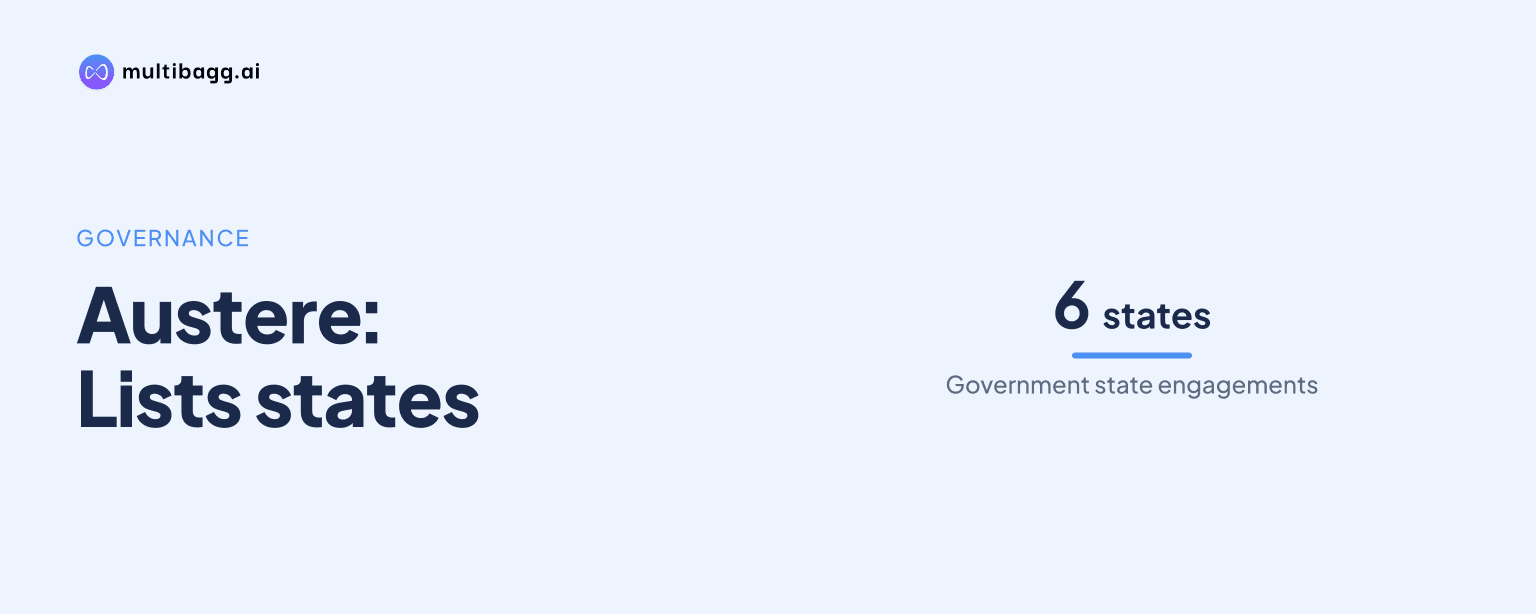
In its investor presentation, Austere lists six state-government engagements and four ready-to-deploy governance tools. The six engagements span Haryana, Punjab, Uttar Pradesh, Himachal Pradesh, Maharashtra and Assam, while RuralSphere and UrbanSphere address panchayat administration and urban citizen services, respectively; no related contract value or revenue is disclosed.
Know Austere Systems inside out
Results, valuation, peers and who's buying, in one view.
Which government relationships does Austere list?
Austere lists government engagements with Haryana, Punjab, Uttar Pradesh, Himachal Pradesh, Maharashtra and Assam. These six state names are presented in a dedicated government-engagements segment, separately from the company’s corporate and financial engagement lists.
The presentation identifies eight corporate engagements, namely EY, KPMG, PwC, Mazars, Meta, GAR, Protiviti and Genpact, and four financial engagements: HDFC Bank, IndusInd Bank, ICICI Bank and Axis Bank. This three-way presentation separates the six government relationships from commercial and banking relationships, but does not state the services, products or project stage associated with any named state.
Austere does not disclose a contract date, work order, project duration, implementation status, revenue contribution or contract value for the six state engagements. It also does not link Haryana, Punjab, Uttar Pradesh, Himachal Pradesh, Maharashtra or Assam to any one of its four ready-to-deploy products, including RuralSphere or UrbanSphere.
Which empanelments does Austere list for public-sector work?
Austere lists six empanelments: MyGov, TCIL, Indian Port Rail & Ropeway Corporation Ltd., HARTRON, HP State Electronics Development Corporation Ltd and Haryana Knowledge Corporation Ltd. The six entries appear in the same presentation segment as the government engagements, but under a separate empanelments heading.
The empanelment list includes MyGov and TCIL alongside Indian Port Rail & Ropeway Corporation Ltd., HARTRON, HP State Electronics Development Corporation Ltd and Haryana Knowledge Corporation Ltd. Austere does not disclose panel tenure, tender identifiers, work orders, contract values, bidding activity or revenue generated from any of these six entries.
The presentation separately lists five accreditations or memberships: AWS, Microsoft, PostgreSQL, Confederation of Indian Industry, or CII, and OpenAI Select Partner. Austere does not state that any of the five affiliations is tied to a specific state engagement, empanelment, RuralSphere deployment or UrbanSphere deployment.
The distinction matters because the presentation supplies counts and names rather than commercial outcomes. Its public-sector overview records six state engagements, six empanelments and five accreditations or memberships, without quantifying the contribution of any category to revenue, order book or deployment volume.
What ready-to-deploy software does Austere offer governments?
Austere presents four ready-to-deploy solutions: D2P2 Social Media Analytics, RuralSphere, Education Doctor and UrbanSphere Dial 11. RuralSphere and UrbanSphere are explicitly described around rural and urban governance, while D2P2 covers intelligence and monitoring and Education Doctor is designed for schools and colleges.
RuralSphere is Austere’s rural and panchayat enterprise resource planning, or ERP, platform. Its listed functions cover funds, works, payroll and assets, while its monitoring mechanism combines dashboards with WhatsApp integration; the presentation describes these as end-to-end governance features rather than separate applications.
UrbanSphere Dial 11 is an artificial intelligence, or AI, enabled mobile platform for citizen engagement. Austere says the product integrates services, grievance redressal and citizen data through a single interface for urban governance, making it the citizen-facing counterpart to RuralSphere’s panchayat administration functions.
D2P2 tracks profiles, keywords and trends across platforms and provides descriptive and predictive analytics for intelligence, monitoring and decision-making. Education Doctor, by comparison, is a web-based ERP that automates academic, administrative and operational workflows for schools and colleges and is described as scalable across institutions.
Got a follow-up? Ask IRIS
How does Austere separate rural and urban governance software?
Austere separates rural administration from urban citizen service delivery through RuralSphere and UrbanSphere Dial 11. RuralSphere covers four panchayat operating areas, funds, works, payroll and assets, whereas UrbanSphere combines three citizen-service elements, services, grievance redressal and citizen data, in a mobile interface.
The two products also use different stated operating mechanisms. RuralSphere provides real-time monitoring through dashboards and WhatsApp integration, while UrbanSphere is described as AI-enabled and focused on citizen engagement; Austere does not disclose user numbers, deployment locations, transaction volumes or financial metrics for either product.
Austere’s AI capability slide gives examples of smart form validation and recommendation engines for government services. The company reports a 40% reduction in manual data review and 25% faster form processing in its AI-infusion examples, but does not identify the customer, period, government deployment or product responsible for those results.
Austere’s strategy is to expand across underserved urban and rural markets through partnerships with governments and local bodies. Management also says it plans to deepen existing client relationships, acquire clients and use end-to-end solutions with a rural focus, but the presentation gives no numerical target for government wins, deployments or geographic expansion.
How could Austere deliver its government software projects?
Austere outlines three delivery models: fixed pricing, time and material, or T&M, and full-time engagement, or FTE. Fixed pricing is described for pilot projects with defined scope and milestones, while T&M is positioned for mid- to long-term work with flexible scope and hourly rates.
The FTE model is intended for long-term projects and assigns dedicated resources exclusively to the client, with 160 hours a month per resource. Austere also presents a build-operate-optimize-transfer model in which it builds a skill-matched team, manages human resources, finance and payroll, scales the team based on demand and transfers the trained team.
These delivery models sit alongside the four-product portfolio rather than being assigned to a named government engagement. The presentation does not say whether any of the six states, six empanelments, RuralSphere deployments or UrbanSphere implementations use fixed pricing, T&M, FTE or the build-operate-optimize-transfer model.
Conclusion
Austere’s disclosed public-sector proposition combines six state-government engagements, six empanelments and four ready-to-deploy products. RuralSphere provides a panchayat ERP covering funds, works, payroll and assets, while UrbanSphere Dial 11 is designed for mobile citizen engagement, services, grievance redressal and citizen data; D2P2 and Education Doctor extend the range into analytics and education workflows.
The next item to watch is management’s stated plan to expand through government and local-body partnerships in underserved urban and rural markets. The presentation does not provide targets for this plan or disclose contract values, panel tenures, deployment counts, public-sector revenue or product-specific revenue, leaving future disclosures on those measures as the main test of execution.