










Austere Systems Receivables Growth Trails H1 FY27 Revenue
Key highlights
- Austere said H1 FY27 trade receivables rose approximately 6% year on year versus 9% revenue growth.
- Austere said cash flow from operating activities was positive in H1 FY27, but did not disclose the amount.
- An analyst cited Rs 3.51 crore of positive operating cash flow for Austere in FY26.
- Austere said customer retention is approximately 80%.
powered by IRIS
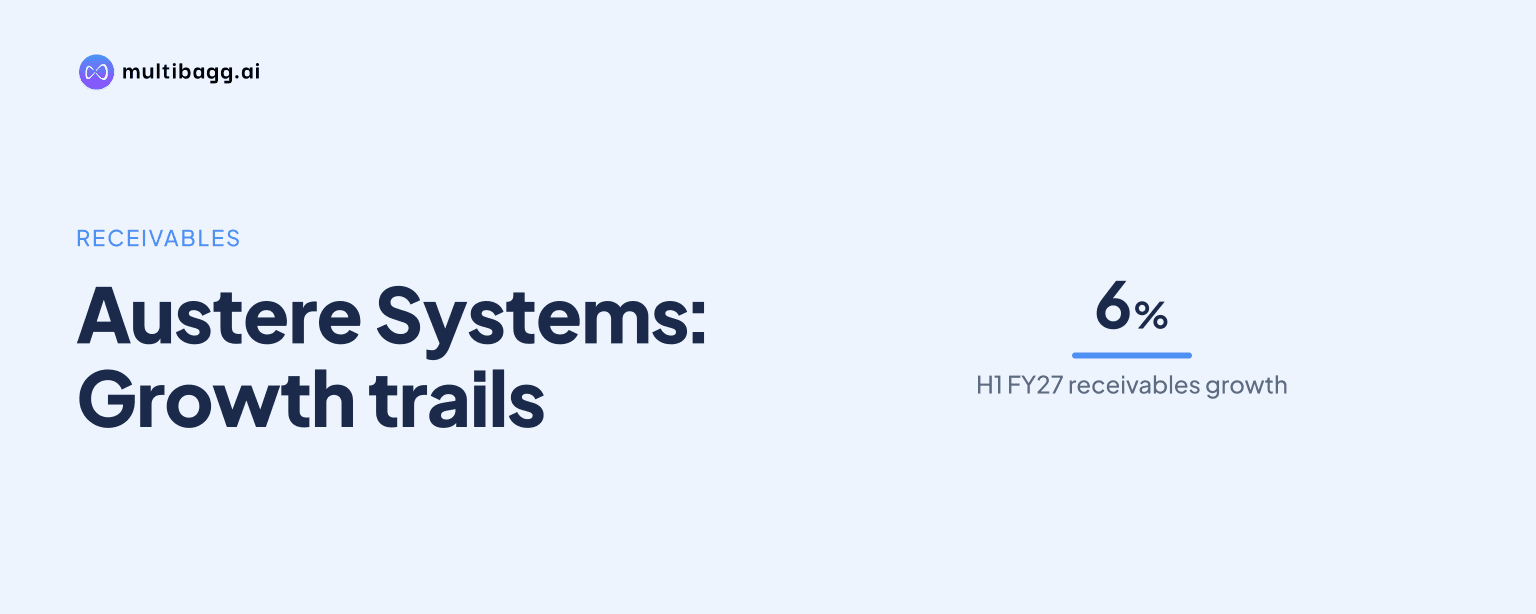
Austere Systems said H1 FY27 trade receivables increased by approximately 6% year on year, below 9% revenue growth, as it monitored invoice ageing, followed up on overdue bills and split project milestones to collect cash at more delivery stages. Management said absolute receivables nevertheless remained elevated.
Know Austere Systems inside out
Results, valuation, peers and who's buying, in one view.
Why did Austere’s receivables grow more slowly than revenue?
Austere said trade receivables rose by approximately 6% year on year in H1 FY27, compared with revenue growth of 9%. The 3-percentage-point difference means receivables grew more slowly than revenue during the half year. Management said the same broad pattern occurred in FY26, although it did not disclose a comparable annual receivables-growth percentage during the call.
Management also acknowledged that the absolute receivables balance remained elevated. The company did not disclose the H1 FY27 trade-receivables balance, debtor days or ageing buckets, so the 6% increase indicates the direction of movement rather than the scale of outstanding collections. It also did not provide a receivables-to-revenue target for H2 FY27.
How does Austere collect payments on its projects?
Austere said its payments are mainly milestone-based, with payment executed when work is delivered. This structure links collection timing to delivery stages rather than to a recurring billing schedule. Management said it is closely monitoring all invoice ageing, regularly following up on overdue invoices and focusing on better collections.
The company is also splitting milestones “as much as possible” to obtain cash collection earlier across a project. Management identified urban digital governance as a key growth area in H1 FY27 and described a HARTRON order to roll out its UrbanSphere model in another corporation. It did not disclose the order value, milestone schedule or payment dates, so the project’s effect on future receivables cannot be quantified from the call.
A second HARTRON work order concerns analytics on complaints filed at police stations for a home department. Management said the solution is being rolled out in one Indian state and could be replicated in other states after the model is tested. That potential expansion was described by management and was not presented as a confirmed order-book forecast.
What does positive operating cash flow indicate for Austere?
Austere said cash flow from operating activities was positive in H1 FY27, which management said reflected better cash generation from operations. The company did not state the H1 FY27 operating-cash-flow amount, preventing a numerical comparison with the preceding half year. Management said its focus remains on collection efficiency and discipline over operating expenses as the business grows.
An analyst cited positive operating cash flow of Rs 3.51 crore in FY26, and management said operating cash flow was positive again in the latest half year. This provides a qualitative comparison between FY26 and H1 FY27: both periods were described as cash-flow positive, despite elevated absolute receivables in H1 FY27. The call did not provide cash conversion, working-capital movement or free-cash-flow figures.
The analyst also referred to an earnings before interest, tax, depreciation and amortisation, or EBITDA, margin of approximately 25% in H1 FY27. Management said a provision for a pending appeal affected the margin and that, without the provision, it was broadly in line with earlier half-year periods. It identified productivity, utilisation and cost discipline as areas of ongoing management focus.
Got a follow-up? Ask IRIS
Which business plans could affect Austere’s working capital?
Austere said it does not provide forward-looking revenue guidance or publish a consolidated order book, so it did not quantify how much H2 FY27 revenue is supported by existing orders. Management instead cited customer retention of approximately 80%, continued engagement with existing clients and pursuit of additional opportunities from those clients as pipeline sources.
Management said it had established a sales team and invested in AustereNext and a Delaware entity to create a pipeline for the next half year. Austere Systems LLC is the company’s disclosed overseas subsidiary in Delaware. Management said its sales team is active in the US and European markets and that it had begun getting clients, but it did not disclose client names, order values or revenue-conversion timing.
AustereNext has a different stated role. Management said its primary purpose is serving corporate customers with enterprise solutions, including SAP, Salesforce, ServiceNow and Oracle enterprise resource planning services. It also identified health and education as sectors where it is developing services aggressively in India and overseas, without disclosing H1 FY27 revenue from those initiatives.
Management said artificial intelligence, or AI, can reduce delivery time for repetitive work and potentially speed deal closure. It cited computer vision, image analysis and logistics-planning use cases for financial institutions and government implementations. However, management also said AI implementation can take time because outputs require validation against actual use cases and data.
Conclusion
Austere’s H1 FY27 disclosure points to a slower increase in trade receivables than revenue, with receivables up about 6% year on year against 9% revenue growth. Its milestone-based billing, invoice-ageing review and overdue-payment follow-up are the mechanisms management identified to manage collections, while positive operating cash flow in both FY26 and H1 FY27 provides context for that approach.
The next disclosure to watch is whether receivables continue to grow more slowly than revenue while operating cash flow remains positive. Management’s disclosed plans include developing urban digital-governance work, building enterprise business through AustereNext and pursuing US and European opportunities through its Delaware entity, but it has not issued H2 FY27 revenue guidance or a consolidated order-book figure.