










Axis Max Life sees commission path from 25% EOM to 15%
Key highlights
- Axis Max Life said its Expenses of Management-to-gross-written-premium ratio is about 25%.
- Management expects commission realignment and GST adjustments to provide about 5%-7% of improvement.
- Business and efficiency measures are expected to add another 2%-3% of improvement.
- Axis Max Life's GST-adjusted policyholder operating-expense ratio fell to 11.7% in H1 FY27 from 14.6% in H1 FY26.
powered by IRIS
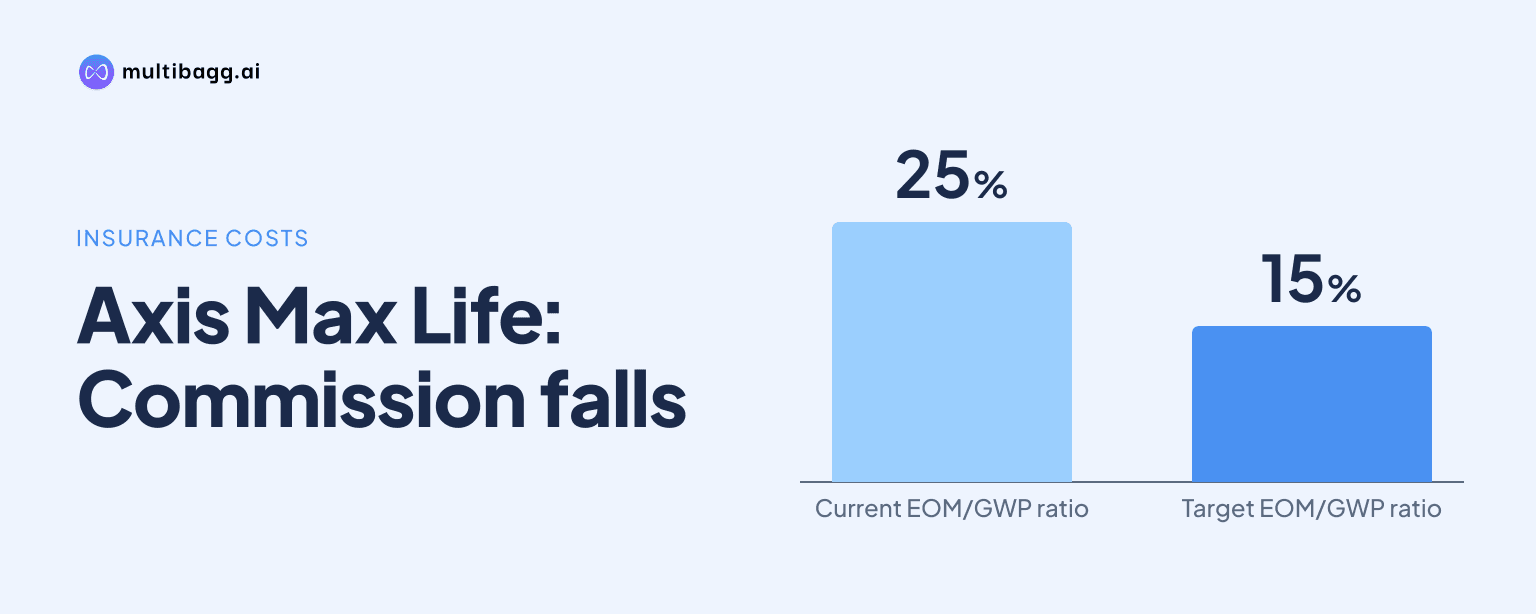
In its H1 FY27 earnings call, Axis Max Life said it can move its Expenses of Management ratio from about 25% to 15% through commission realignment, GST adjustments and 2%-3% of business and efficiency measures.
Know Max Financial Services inside out
Results, valuation, peers and who's buying, in one view.
How would Axis Max Life reach a 15% expense ratio?
Axis Max Life’s stated route to a 15% Expenses of Management, or EOM, ratio combines changes in commission structure with operating-cost actions over roughly 2.5 years. Management said its EOM-to-gross-written-premium, or GWP, ratio is around 25%, making the planned move to 15% a reduction of about 10 percentage points under the consultation paper’s indicated direction.
The target is not presented as a final regulatory requirement because the proposal remains a consultation paper. An analyst asked about reaching a 12.5% EOM level over the next five years, and management said it had submitted views to the regulator and expected active engagement. Management nevertheless said its internal calculations gave it confidence in the path from 25% to 15% and subsequently to 12.5%, if the final guideline takes that form.
Axis Max Life’s confidence rests on a combination of specified levers rather than a single expense cut. Management described the proposed arrangement as a reset for the life-insurance industry, while also cautioning that a unified cap has both advantages and disadvantages. Its submissions included views on transition arrangements, group credit life and the treatment of goods and services tax, or GST, in EOM calculations.
What role would commission changes and GST play?
Axis Max Life expects commission realignment and GST adjustments together to account for about 5%-7% of the improvement discussed by management. The commission mechanism is a shift in commissions towards renewal business and away from first-year business, in line with what management said was indicated in the consultation paper. This would alter the timing of distribution costs rather than depend solely on cutting internal operating spending.
Management did not quantify how much of the 5%-7% range would come separately from commission changes and how much from GST. That distinction matters because management said GST is already excluded from the EOM computation today, describing its treatment as a grey area. The company has nonetheless asked the regulator to consider GST exclusion as part of its representations on the final framework.
The proposed commission change also has implications for a retail-focused insurer’s distribution model, but Axis Max Life did not provide a channel-by-channel commission forecast. It instead said that industry representations covered group credit life, or GCL, because GCL provides pure life protection for customers not reached through detailed term cover. The disclosed plan therefore identifies the broad cost mechanisms without estimating their effect on agency, bank or other individual channels.
Got a follow-up? Ask IRIS
What efficiency actions support Axis Max Life’s plan?
Axis Max Life said business and efficiency measures should provide another 2%-3% of improvement after the commission and GST-related benefit. Separately, management said it may need to optimise a “7% kind” of operating-expense number, or roughly 3.5% in each of two periods. The call did not define that 7% estimate as a percentage of GWP, so it should not be read as a directly comparable EOM-ratio target.
The company pointed to prior productivity work as evidence for its ability to execute operating changes. In H1 FY27, policyholder operating expenses rose 3%, while total expenses including commissions rose 9%. Management attributed efficiency gains to productivity initiatives and said its technology investments and the wider industry reset would support the next phase of optimisation.
Digital systems are one mechanism behind that effort, although management did not assign their savings to the 2%-3% estimate. Axis Max Life reported more than 47 artificial-intelligence solution tracks across recruitment, sales, underwriting, servicing and customer engagement. Its artificial-intelligence recruitment tools generated more than 60,000 leads, and a sales copilot supported more than 82,000 sales interactions during the year.
Automation also features in underwriting and customer servicing. Management said artificial-intelligence models delivered nearly Rs 1,000 crore of risk avoidance through fraud and mortality detection, while financial frictionless underwriting supports half of its protection business. Its app ecosystem had more than 12 lakh installs, providing a platform for servicing tools that management said reduce turnaround times and improve responsiveness.
How does current cost performance compare with last year?
Axis Max Life reported an improvement in policyholder operating expenses as a share of GWP, a different measure from the approximately 25% EOM-to-GWP ratio discussed in the regulatory plan. The policyholder operating-expense ratio fell 174 basis points year on year to 13.7% in H1 FY27. One basis point equals one-hundredth of a percentage point, so the reported change equals 1.74 percentage points.
After adjusting for GST in the H1 FY27 run rate, management said the policyholder operating-expense ratio was 11.7%, compared with 14.6% in H1 FY26. That is a 300-basis-point decline. The company’s reported expense trends therefore show internal cost growth lagging premium-related activity, but the distinct definitions mean the 11.7% figure should not be treated as evidence that the 15% EOM requirement has already been met.
Profitability and sales mix are also relevant to management’s capacity to absorb the transition. Value of new business, or VNB, increased 21% to Rs 1,180 crore in H1 FY27, and VNB margin rose to 25.4% from 23.3% a year earlier. Management said the margin expansion was largely driven by product mix and inherent product-margin improvement, with a smaller contribution from operating leverage.
For the second half of FY27, management said annualised premium equivalent, or APE, growth should improve from the first half and that margins could be closer to 26% within its stated 25%-26% range. This is management’s operating outlook, not a quantified forecast of the regulatory plan’s cost savings. It reflects management’s view that higher sales volume can improve margins because expenses are reported on an as-is operating-expense basis.
Conclusion
Axis Max Life’s disclosures indicate that its response to prospective expense limits depends on distribution-cost restructuring as well as internal productivity, rather than on a single operating-cost reduction. The H1 FY27 decline in the GST-adjusted policyholder operating-expense ratio to 11.7% from 14.6% provides evidence of progress, though that measure is not interchangeable with the EOM ratio.
The next development to watch is the final consultation outcome, including its treatment of GST, the transition period and any provisions affecting group credit life. Management said it is confident about the route to 15% over roughly 2.5 years and then to 12.5% if the eventual guideline adopts that structure, but the final rules will determine the precise timetable and cost treatment.