










Axis Max Life links Smart RISE to 130% annuity growth
Key highlights
- Axis Max Life said Smart RISE contributed around 8% of total APE in Q2 FY27.
- Axis Max Life annuity business grew 130% in Q2 FY27.
- Axis Max Life H1 FY27 VNB rose 21% to Rs 1,180 crore and margin increased to 25.4%.
- Axis Max Life pure retail protection grew 31% in Q2 FY27.
powered by IRIS
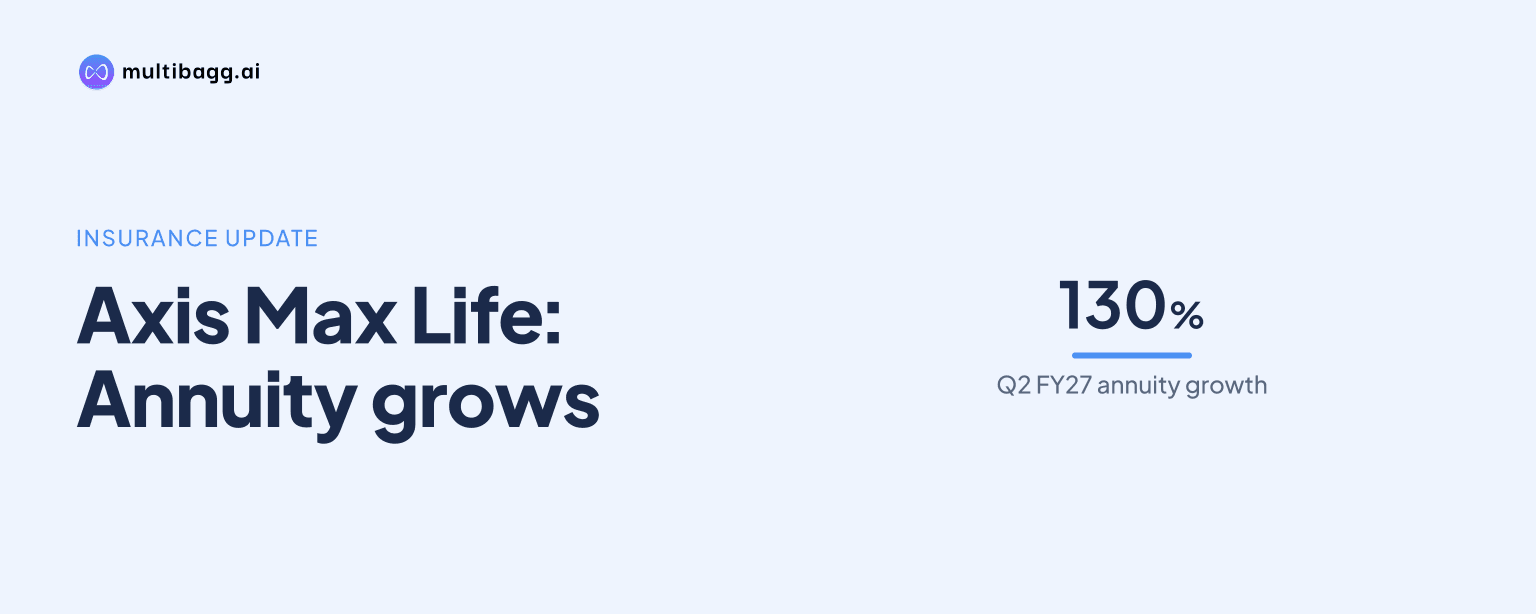
Axis Max Life Insurance said its Smart Retirement Income with Sustained Earnings Plan, or Smart RISE, helped lift annuity business by 130% in Q2 FY27, while a retirement and protection-led mix contributed to a 210-basis-point increase in H1 FY27 value of new business margin to 25.4%.
Know Max Financial Services inside out
Results, valuation, peers and who's buying, in one view.
How did Smart RISE affect Axis Max Life annuity growth?
Smart RISE was a material early contributor to Axis Max Life's Q2 FY27 annuity expansion because the newly launched product already accounted for about 8% of total annualised premium equivalent, or APE. Management said the product combines flexible lifelong income with a variable annuity option linked to the Nifty 50, giving customers potential participation in long-term market growth.
Axis Max Life said customer demand and Smart RISE's reception drove annuity business growth of 130% in Q2 FY27. The product launch placed retirement alongside protection as a stated growth area, rather than leaving growth concentrated in savings products or unit-linked insurance plans, known as ULIPs. Management did not separately disclose Smart RISE premium, policy count or its standalone profitability.
The annuity increase came within a retail APE mix that remained spread across several categories in Q2 FY27. ULIPs were the largest component at 37%, followed by annuity at 19%, participating savings at 15%, non-participating savings at 15%, and protection and health at 14%. Thus, even after the 130% annuity growth, ULIPs remained the largest retail product category by mix.
The 19% annuity share shows that the business had become a meaningful part of retail APE in the quarter, although management did not provide the comparable Q2 FY26 share. Smart RISE's disclosed contribution of about 8% of total APE indicates that the new offering had become relevant to the overall new-business mix during its launch quarter.
Why did Axis Max Life's VNB margin rise to 25.4%?
Axis Max Life's H1 FY27 value of new business, or VNB, margin rose to 25.4% from 23.3% a year earlier, an expansion of 210 basis points, as management cited continued momentum in retirement and protection business. VNB rose 21% year on year to Rs 1,180 crore during H1 FY27, meaning margin improvement was accompanied by higher new-business value.
Management attributed the outcome to product mix and profitability, specifically the growth in retirement and protection. Pure retail protection rose 31% in Q2 FY27, while individual sum assured grew 18% in H1 FY27. Axis Max Life remained ranked third in individual sum assured, although management noted that faster annuity growth can reduce the relationship between protection growth and sum-assured growth because annuities do not carry sum assured.
The quarterly margin was higher at 27% in Q2 FY27, according to the chief financial officer, despite the goods and services tax, or GST, effect. In response to an analyst's question on whether the H1 margin was sustainable, management said higher sales volumes create operating leverage because it reports margin using operating expenses as they are incurred. That is management's explanation of the margin trajectory, not a formal margin target.
Management also said protection could moderate against a high base in the second half of FY27, while non-participating savings was expected to keep declining. Nevertheless, it expressed confidence that the overall margin profile would continue its expansion journey. The statement reflects management's outlook and depends partly on sales volumes and the mix of products sold.
Got a follow-up? Ask IRIS
What other products supported the retirement and protection mix?
Axis Max Life supported the retirement-led mix with product activity in protection, NRI-focused ULIPs and group credit life during Q2 FY27. It relaunched Smart Term Plan Plus with eight protection variants, cover up to age 100, and women-focused features including maternity cover and Lifetime Plus benefits, alongside 31% growth in pure retail protection.
The insurer also said its USD-denominated Smart GIFT proposition was gaining traction among non-resident Indian customers. GIFT City business accounted for more than 5% of ULIP APE, while the company added five new partnerships during the quarter. Those partnerships were part of a broader distribution effort intended to reduce dependence on a single channel.
In group credit life, APE grew 41% in Q2 FY27. Partnerships added during the prior three years generated more than 35% of group credit life APE, according to management. This differs from the Smart RISE contribution: the annuity product was a new retail offering contributing roughly 8% of total APE, whereas newer partnerships were contributing to a group protection-related segment.
At the overall business level, total APE grew 11% in H1 FY27 and 8% in Q2 FY27. Individual adjusted first-year premium rose 12% in H1 FY27 and 9% in Q2 FY27, while private-market share was 10.1%. The comparison shows first-half growth was faster than the second-quarter rate, even as the company described product and channel growth as broad based.
What costs and regulation could influence Axis Max Life's margin path?
Axis Max Life reported lower expense ratios in H1 FY27, which management linked to productivity measures and which can support its operating-leverage argument. Policyholder operating expenses as a percentage of gross written premium, or GWP, improved 174 basis points year on year to 13.7%, while policyholder expenses rose only 3% and total expenses including commission rose 9%.
On a GST-adjusted basis, management said the policyholder operating-expense ratio improved 300 basis points to 11.7% in H1 FY27 from 14.6% in H1 FY26. Gross written premium increased 17% to Rs 18,066 crore in H1 FY27, and renewal business rose 18% to Rs 11,247 crore. These figures show premium and renewal growth outpaced reported policyholder expense growth over the half year.
A separate uncertainty is the regulator's consultation on commission structure and Expenses of Management, or EOM, limits. In the analyst discussion, management said its EOM-to-GWP ratio was around 25% and that commission realignment toward renewals, plus cost actions over the next 2.5 years, could allow it to meet the proposed journey to 15%.
Management estimated that roughly 7% of operating expenses may need optimisation, described as 3.5% in each of two years. It also stressed that the proposal remained a consultation paper and that it had submitted views to the regulator. Therefore, the final rules, timing and ultimate financial effect were not established in the call.
Conclusion
Axis Max Life's disclosed figures point to a product mix shifting toward retirement and protection: Smart RISE represented about 8% of total APE after its Q2 FY27 launch, annuity business grew 130%, and H1 VNB margin increased to 25.4% from 23.3%. Protection also grew 31% in Q2 FY27, while the 19% annuity share of retail APE remained below ULIPs' 37% share.
The next issue to watch is whether second-half FY27 APE growth accelerates as management expects while the company maintains margin expansion amid a high protection base and softer ULIP sentiment. The final EOM framework and Axis Max Life's disclosed plan to optimise about 7% of operating expenses over two years, alongside commission changes aimed more toward renewals, remain relevant factors for the margin path.