










Axis Max Life says 95% of business is unaffected by proposed rules
Key highlights
- Axis Bank contributes about 42-43% of Axis Max Life’s overall sales.
- Agency represents 21% of sales, while direct-to-consumer business contributes 6-7%.
- Axis Max Life said the effective exposure in its smaller-bank category is about 1-1.5% of overall business.
- Axis Max Life’s Axis Bank counter share was about 62-63% in the second quarter versus its usual level near 65%.
powered by IRIS
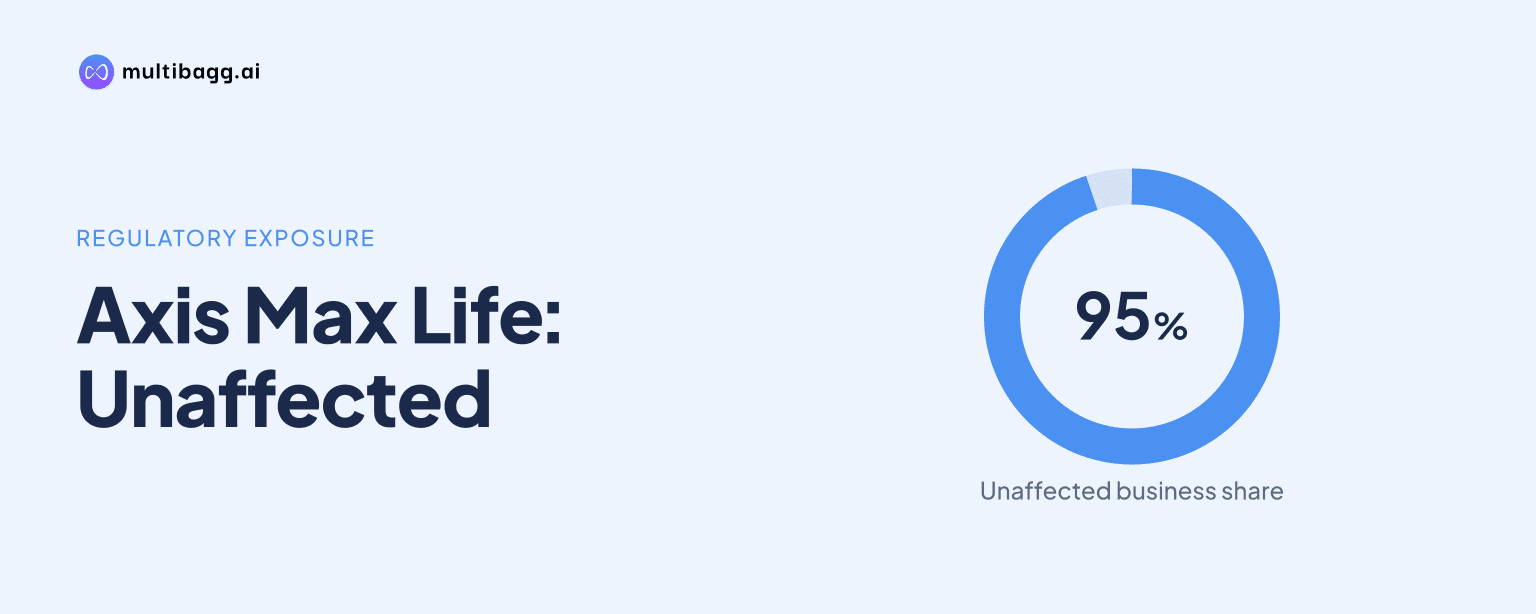
Axis Max Life Insurance said about 95% of its business would not be impacted by proposed distribution-rule changes, based on its channel mix and share positions at partner banks. Axis Bank accounts for about 42-43% of sales, while management said its assessment indicates the practical exposure in smaller-bank relationships is only about 1-1.5%.
Know Max Financial Services inside out
Results, valuation, peers and who's buying, in one view.
How much of Axis Max Life business could avoid the proposed rule impact?
Axis Max Life said about 95% of its business would not get impacted after reviewing its distribution exposure under the consultation paper. Management initially identified 83% of sales as largely insulated, comprising about 43% from Axis Bank, 21% from agency, 6-7% from direct-to-consumer business and 12% from Direct Sales Force, or DSF. It later said the fuller review supported a 95% estimate.
The 95% assessment is management’s scenario analysis rather than an outcome of a final regulation. Management had earlier estimated that around 90% of business could stand to gain rather than lose, after adding the 5-6% contribution from YES BANK to the 83% identified across Axis Bank, agency, direct-to-consumer and DSF channels. It said smaller banks, brokers and group credit life, or GCL, create the main areas of possible exposure.
Which channels underpin Axis Max Life’s 95% assessment?
Axis Max Life’s largest components are Axis Bank at about 42-43% of sales and agency at 21%, together representing roughly 64% of overall sales. Management said it does not see a downside for the Axis Bank portion because insurer consolidation at banks could lift its counter share. For agency, it said new agents and existing advisers are largely paid below the proposed limits.
Axis Max Life said its direct-to-consumer sales, made through its own app and website, contribute 6-7% of business and are outside the cited distribution concern. Its 12% DSF business is driven by employees undertaking upselling and cross-selling while receiving salary and incentives. Using a 7% direct-to-consumer contribution, management’s calculation rises from 64% to 71%, then to 83% after including DSF.
Where could Axis Max Life still face distribution pressure?
Axis Max Life identified newer or smaller bank partnerships, smaller brokers and GCL as the channels where some impact could arise. Smaller banks contribute about 3% of total business, while small brokers represent about 2-3% and GCL represents about 1%. Management said this exposure is limited relative to the 42-43% contribution from Axis Bank.
Management said the effective exposure within the smaller-bank category is only about 1-1.5% of overall business, even though the category contributes roughly 3%. It said Axis Max Life holds the number-one counter share at three of those smaller banks. The company also said its business from banks where it is not among the top two insurers is about 3%, supporting its conclusion that consolidation would not necessarily affect all smaller-bank sales.
Got a follow-up? Ask IRIS
Could bank consolidation help Axis Max Life at Axis Bank?
Management said the proposed expense-of-management, or EoM, framework could give banks greater incentive to consolidate their insurer partnerships, potentially benefiting Axis Max Life at Axis Bank. It stressed that this is an internal view of how the consultation paper could work, not a decision made by Axis Bank. Management said it cannot speak for the actions of Axis Bank or any other bank.
Axis Max Life said it had not held a formal conversation with Axis Bank or another bank on insurer consolidation. Still, management said its channel position supports confidence in gaining share at Axis Bank if the number of insurer relationships declines. It also linked this view to its existing counter share, which it said normally stands at around 65% at Axis Bank.
What has changed in Axis Max Life’s Axis Bank performance?
Axis Max Life said its Axis Bank counter share was around 62-63% in the second quarter, below its normal level of about 65%. Management attributed the decline in August and September to conscious product-led decisions rather than to competitive intensity or a systemic channel problem. It said the counter share should return towards its usual level from the current quarter.
An analyst cited 4% Axis Bank growth in the latest quarter, but management compared that with 14% growth in the first quarter and about 9-10% growth in the fourth quarter. Management said it had seen encouraging input signs and expected healthy Axis Bank growth in the second half. It also cited Parivartan Plus, its transformation project, as part of its effort to address the opportunity at the bank.
How do agency payouts affect Axis Max Life’s rule assessment?
Axis Max Life said new agents and base advisers are largely unaffected because their existing payouts are already below the proposed limits. Agency contributes 21% of overall sales, making that conclusion material to management’s 83% calculation for business that is not expected to face much impact. The company said this assessment followed a detailed review of the agency base.
Management acknowledged that some top agents could face an effect in net present value, or NPV, terms. However, it described the effect as manageable on a pool basis and said it had strategies to address it. This distinction is important because the company did not say every agency payout would remain unchanged, only that the broader agency channel would be largely unaffected.
Conclusion
Axis Max Life’s case rests on the concentration of sales in channels it considers insulated or potentially advantaged by the proposed framework. Axis Bank, agency, direct-to-consumer and DSF together account for about 83% of sales, while YES BANK adds another 5-6%. Management’s 95% estimate also reflects its view that only 1-1.5% of total business is effectively exposed within its smaller-bank category.
The next issue to watch is whether the consultation paper is implemented in the form management has modelled and whether banks reduce their insurer relationships. Axis Max Life disclosed no formal discussions with Axis Bank on consolidation. Management also expects healthier second-half Axis Bank growth and is pursuing Parivartan Plus after its second-quarter counter share of 62-63% fell below its usual level of around 65%.