










Baazar Style Retail Limited FY26 revenue rose as debt doubled
Key highlights
- Style Baazar's revenue from operations rose 89% to Rs 1,840.9 crore in FY26 from Rs 972.9 crore in FY24.
- FY26 EBITDA increased 40% year on year to Rs 264.1 crore, while EBITDA margin was 14.3%.
- Total borrowings reached Rs 347.7 crore at 31 March 2026, up from Rs 166.5 crore a year earlier.
- FY26 operating cash flow was Rs 125.5 crore, while ROCE declined to 14.4% from 20.6% in FY24.
powered by IRIS
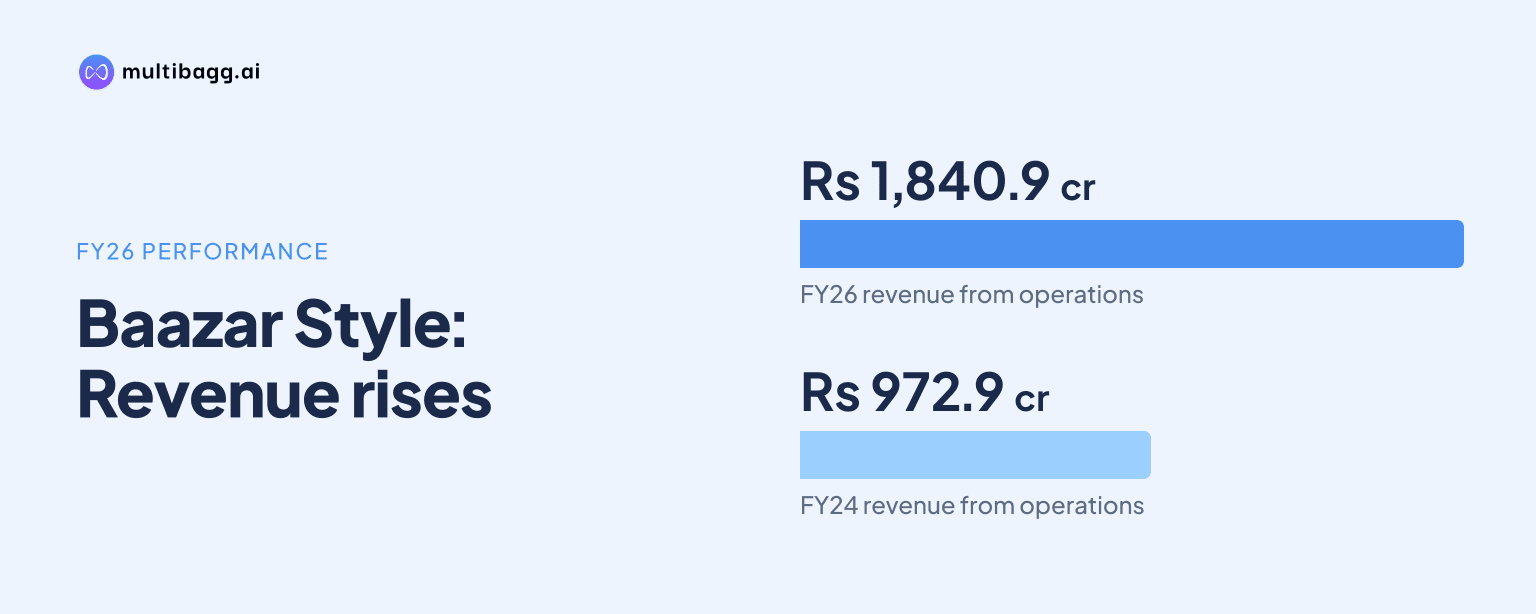
Baazar Style Retail Limited increased revenue from operations 1.9 times to Rs 1,840.9 crore in FY26 from Rs 972.9 crore in FY24, while total borrowings rose to Rs 347.7 crore from Rs 178.2 crore and return on capital employed declined to 14.4% from 20.6%. Style Baazar also reported higher operating cash flow and faster inventory turnover.
Know Baazar Style Retail inside out
Results, valuation, peers and who's buying, in one view.
How fast did Style Baazar's revenue and operating profit grow?
Style Baazar's FY26 revenue from operations was Rs 1,840.9 crore, up 37% year on year from Rs 1,343.1 crore in FY25 and 89% above FY24's Rs 972.9 crore. The presentation describes the FY24-to-FY26 increase as 1.9 times, equivalent to a 38% compound annual growth rate. Total income rose to Rs 1,852.6 crore in FY26, including Rs 11.6 crore of other income.
Earnings before interest, tax, depreciation and amortisation, or EBITDA, reached Rs 264.1 crore in FY26, compared with Rs 189 crore in FY25 and Rs 142.2 crore in FY24. EBITDA grew 40% in FY26, faster than the 37% revenue increase, while EBITDA margin moved to 14.3% from 14.1% in FY25; it was 14.6% in FY24. Gross margin was 33.4% in FY26, matching FY24 and slightly below FY25's 33.6%.
Why did Style Baazar's FY26 profit after tax increase?
Style Baazar reported FY26 profit after tax of Rs 46.9 crore, up 219% from Rs 14.7 crore in FY25 and more than twice FY24's Rs 21.9 crore. The profit-after-tax margin increased to 2.5% from 1.1% in FY25 and 2.2% in FY24. However, profit before exceptional items and tax declined 3% year on year to Rs 28.8 crore from Rs 29.6 crore, despite the rise in revenue and EBITDA.
The presentation attributes the difference to exceptional items. FY26 included a Rs 55.3 crore gain from reassessing store lease terms, partly offset by a Rs 20.6 crore insurance-claim settlement loss and other items, resulting in a net exceptional gain of Rs 32.5 crore. FY25 included a Rs 10.8 crore exceptional loss related to a fire. Finance cost rose to Rs 76.8 crore in FY26 from Rs 69 crore, while depreciation and amortisation increased to Rs 170.1 crore from Rs 99.9 crore.
What changed in Style Baazar's balance sheet and borrowings?
Style Baazar's total borrowings increased to Rs 347.7 crore at 31 March 2026 from Rs 166.5 crore a year earlier and Rs 178.2 crore at 31 March 2024. The FY26 increase was concentrated in short-term borrowings, which reached Rs 315.1 crore, compared with Rs 148.8 crore in March 2025. Long-term borrowings were Rs 32.6 crore, versus Rs 17.7 crore a year earlier.
Inventory rose to Rs 682.5 crore at March 2026 from Rs 521.5 crore at March 2025, while trade payables increased to Rs 394.3 crore from Rs 310.8 crore. Current assets totalled Rs 836.6 crore and current liabilities Rs 863.4 crore, producing the reported current ratio of 0.97 times, down from 1.21 times in FY25. Style Baazar states that its stores sell only for cash or card, so it has no trade receivables.
Got a follow-up? Ask IRIS
Did Style Baazar generate more cash as it expanded?
Style Baazar generated Rs 125.5 crore of net cash from operating activities in FY26, more than double FY25's Rs 52.7 crore and above FY24's Rs 111.7 crore. Management attributes the FY26 recovery to higher profits and better stock management as new stores matured. In FY25, operating cash flow was lower because inventory was built for 58 new stores.
Investment cash outflow rose to Rs 145.5 crore in FY26 from Rs 102.8 crore in FY25, primarily for store fit-outs, warehouse infrastructure and technology. Financing activities supplied Rs 14.3 crore in FY26, after providing Rs 54.1 crore in FY25. Cash and cash equivalents at year-end fell to Rs 12.5 crore from Rs 18.2 crore, as operating inflow did not fully cover investment outflow.
How did Style Baazar's efficiency and return ratios change?
Style Baazar's return on capital employed, or ROCE, declined to 14.4% in FY26 from 19.6% in FY25 and 20.6% in FY24. The presentation defines ROCE as earnings before interest and tax divided by average capital employed. Return on equity increased to 11% in FY26 from 4.8% in FY25 and slightly exceeded FY24's 10.8%, following the increase in reported profit after tax.
Inventory turnover improved to 2.04 times in FY26 from 1.87 times in FY25 and 1.73 times in FY24. Inventory days on revenue fell to 119 from 129 and 141 respectively, meaning inventory moved through the business in fewer days under the presentation's measure. At the same time, trade payable days on purchases declined to 93 in FY26 from 101 in FY25, while debt to equity, excluding lease liabilities, rose to 0.74 times from 0.37 times.
Conclusion
Style Baazar's FY24-to-FY26 figures show revenue growth from Rs 972.9 crore to Rs 1,840.9 crore and EBITDA growth from Rs 142.2 crore to Rs 264.1 crore, alongside improved FY26 operating cash flow and inventory turnover. The balance-sheet funding requirement also increased: borrowings reached Rs 347.7 crore, the current ratio fell below 1 time, and ROCE declined by 6.2 percentage points from FY24.
The next disclosed items to watch are management's intended use of up to Rs 331.53 crore from Cupid Limited's proposed equity warrants, priced at Rs 328.25 each and convertible within 18 months. Management says a significant part is earmarked to repay bank borrowings, with the balance intended for store expansion; it also targets private-label sales contribution of 65% in FY27, against more than half currently.