










Baazar Style Retail Limited Q2 Revenue Falls 10% on Calendar Shift
Key highlights
- Q2 FY27 revenue from operations was ₹478.1 crore, down 10% year-on-year.
- H1 FY27 revenue from operations rose 6% year-on-year to ₹964.5 crore.
- The retail network reached 283 stores, up 13% year-on-year, with rental area of 26.69 lakh sq. ft.
- Reported same-store sales growth was -25% in Q2 FY27 and -11% in H1 FY27.
powered by IRIS
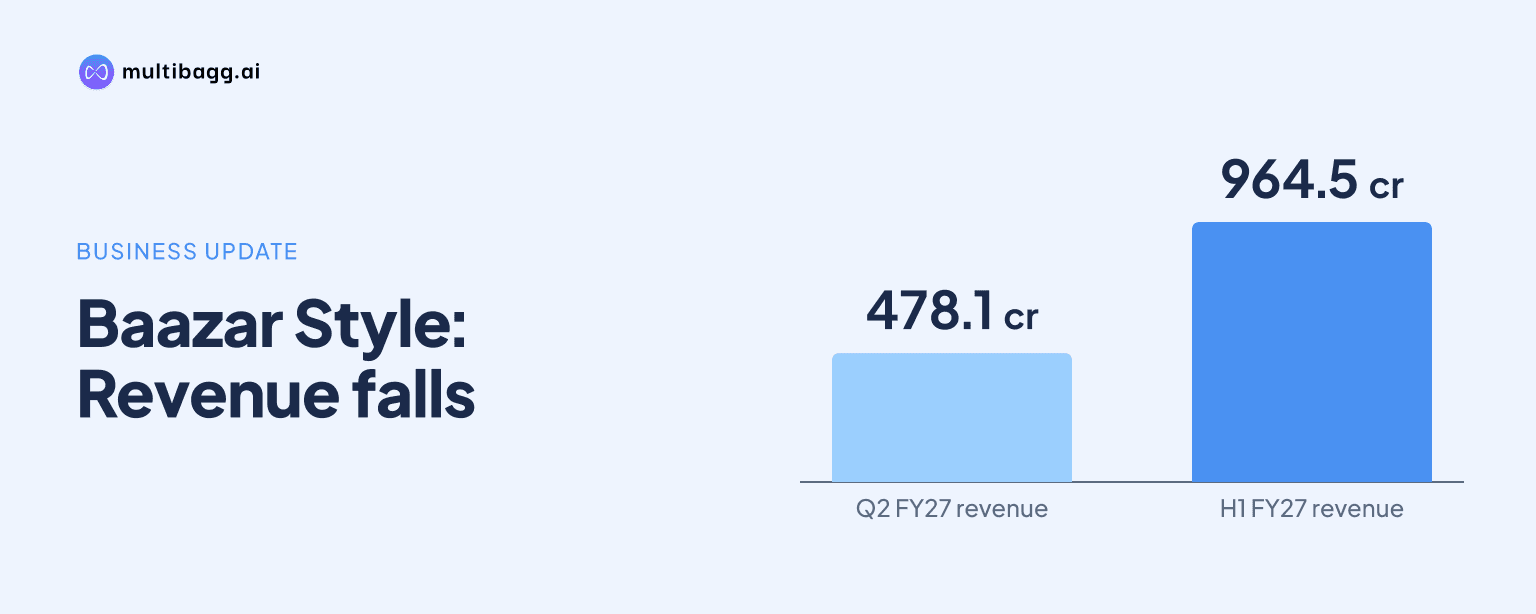
Baazar Style Retail Limited reported Q2 FY27 revenue from operations of ₹478.1 crore, down 10% year-on-year, after Durga Puja demand shifted from Q2 FY26 to Q3 FY27. The retailer nevertheless recorded H1 FY27 revenue from operations of ₹964.5 crore, up 6% year-on-year, while expanding its store network by 13%.
Know Baazar Style Retail inside out
Results, valuation, peers and who's buying, in one view.
Why did Baazar Style Retail's Q2 FY27 revenue decline?
Baazar Style Retail said the 10% year-on-year fall in Q2 FY27 revenue from operations was primarily caused by a shift in the festive calendar. Durga Puja, a major demand period for the company, fell in Q2 in FY26 but moved to Q3 in FY27. This changed the timing of seasonal sales and affected the reported comparison for the quarter ended September 30, 2026.
Revenue from operations was ₹478.1 crore in Q2 FY27. The company separately reported revenue of ₹486.38 crore in its earnings data, representing a 4.44% quarter-on-quarter increase from ₹465.71 crore. The disclosures label the former as revenue from operations, while the latter is reported as revenue. No reconciliation between these two reported revenue measures was provided in the supplied material.
Reported same-store sales growth was negative 25% in Q2 FY27. Sales per square foot declined to ₹642 a month from ₹865 a month in Q2 FY26. These store productivity measures were also affected by the change in the timing of the festival-led sales period.
How did Baazar Style Retail perform in the first half of FY27?
Baazar Style Retail recorded H1 FY27 revenue from operations of ₹964.5 crore, a 6% year-on-year increase despite the weaker reported Q2 comparison. The half-year performance indicates that revenue growth continued over the six-month period even as the seasonal demand cycle moved between quarters.
Same-store sales growth was negative 11% for H1 FY27, and sales per square foot stood at ₹660 a month, compared with ₹768 a month a year earlier. The company attributed the reported comparable-store metrics to the festive calendar shift, which reduced the contribution of Durga Puja demand in the first half relative to the prior year.
The business update also showed continued physical expansion. Its retail network reached 283 stores as of September 30, 2026, up 13% year-on-year. Total rental area increased 16% year-on-year to 26.69 lakh square feet, increasing the company's operating footprint across its markets.
What were the key operating metrics for Q2 and H1 FY27?
Baazar Style Retail added 14 stores and closed seven stores during Q2 FY27, resulting in a net addition of seven stores during the quarter. The combination of openings and closures reflects network expansion alongside portfolio optimisation, as stated by the company.
The store count and rental-area growth show that Baazar Style Retail continued investing in retail capacity while quarterly sales productivity declined. More stores can broaden consumer reach, but the reported data also shows lower sales per square foot compared with the prior-year periods.
The company also became principal partner for India's international football matches against Brazil and Uruguay in Kolkata. The disclosure described the association as part of wider consumer engagement and brand visibility efforts, without providing a financial cost or expected revenue impact.
Got a follow-up? Ask IRIS
What did the board approve on November 13, 2026?
Baazar Style Retail's board approved unaudited standalone and consolidated financial results for the quarter and half year ended September 30, 2026. The limited review reports on these results carried unmodified opinions, meaning the reviewers did not report a modification to their conclusions.
The board also approved the appointment of Avishek Prasad as Whole-time Director. In addition, it approved the reappointment of Bhagwan Prasad as Whole-time Director and Dr. Dhanpat Ram Agarwal as Non-Executive Independent Director. These appointments and reappointments remain subject to shareholder approval.
The earnings date was November 13, 2026. The board actions place financial reporting and governance decisions together, while the operating update issued earlier had focused on revenue, store additions, retail area and same-store sales performance through September 30.
How do these results affect investors and retail operations?
For investors, the main issue is the difference between quarterly and half-year trends. Q2 revenue from operations declined 10% year-on-year and same-store sales growth was negative 25%, while H1 revenue from operations increased 6%. The company has specifically linked the Q2 decline to the movement of Durga Puja demand into Q3 FY27 rather than describing it as a permanent change in demand.
For operations, the larger store base raises the importance of sales productivity and portfolio management. Baazar Style Retail had 283 stores and 26.69 lakh square feet of rental area at the end of September, but sales per square foot was below the prior-year level in both Q2 and H1. Its stated focus remains expansion of the value-fashion retail network along with improvements in store productivity and operating efficiency.
Conclusion
Baazar Style Retail's Q2 FY27 numbers reflect a seasonal timing effect, with Durga Puja demand moving out of the comparable quarter and contributing to a 10% decline in quarterly revenue from operations. The H1 result was more resilient, with revenue from operations rising 6%, although same-store sales and sales per square foot remained below the prior-year levels. Store expansion continued, and the board also progressed three director appointments subject to shareholder approval.
The next reported period will show how demand performed during Q3 FY27, when the company said the major festive period fell. Investors can also track whether the larger 283-store network improves sales per square foot, the progress of portfolio optimisation after 14 openings and seven closures in Q2, and shareholder decisions on the director appointments.