










Balaji Amines moves DME and ACN projects into operation
Key highlights
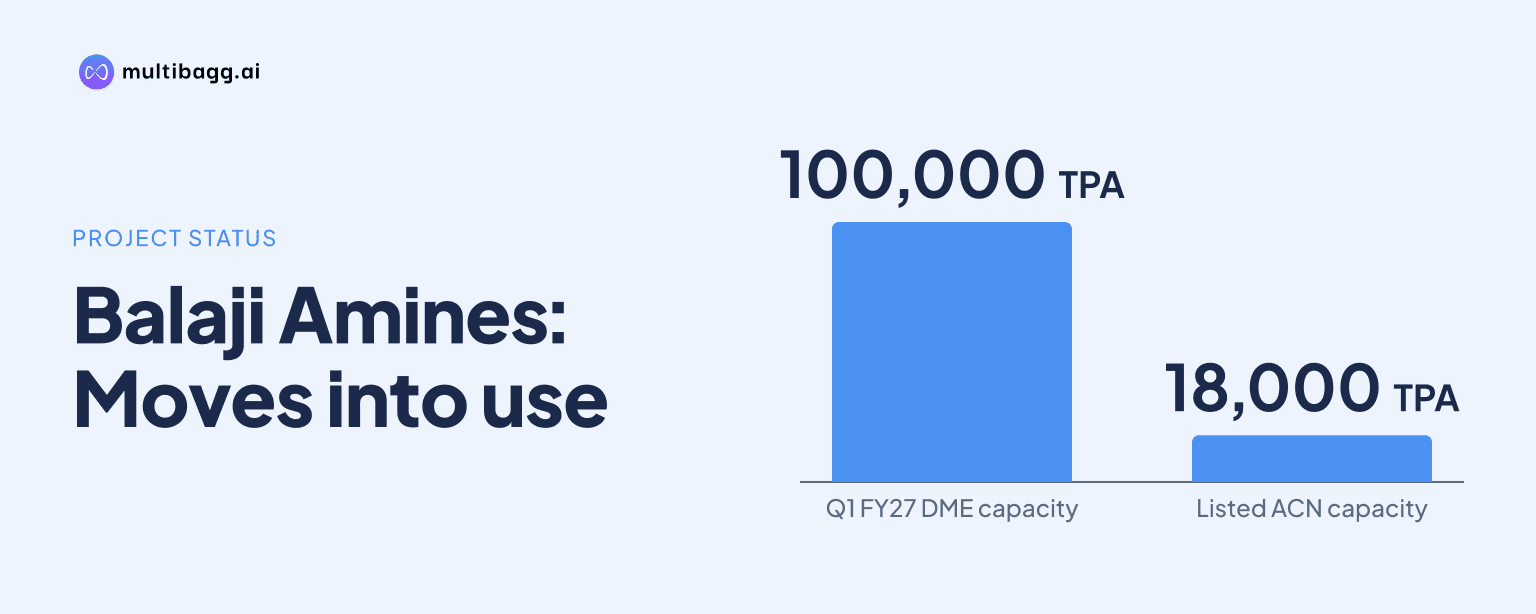
- Balaji Amines commissioned a 100,000 TPA DME plant in Q1 FY27.
- Balaji Amines began commercial ACN production at its expanded Unit III facility, with listed ACN capacity of 18,000 TPA.
- Balaji Amines expects to commission 5,000 TPA of NMM during FY27.
- BSCL proposes 57,000 TPA of additions, taking total capacity to 102,330 TPA.
powered by IRIS
Balaji Amines Limited commissioned its 100,000 tonnes per annum (TPA) dimethyl ether plant in Q1 FY27 and started commercial production at its expanded acetonitrile facility, moving its consolidated Rs 1,000 crore-plus expansion cycle toward commercialisation. The company says the cycle is nearing completion, while N-Methyl Morpholine and Balaji Speciality Chemicals projects remain under execution.
Know Balaji Amines inside out
Results, valuation, peers and who's buying, in one view.
What has Balaji Amines commissioned in FY27?
Balaji Amines commissioned a 100,000 TPA dimethyl ether (DME) plant in Q1 FY27, which it describes as India’s first commercial-scale DME manufacturing facility. The company identifies DME as a replacement for liquefied petroleum gas (LPG), with additional potential uses in LPG blending and as an aerosol propellant for healthcare and personal-care applications.
The DME plant is located at Balaji Amines’ Unit IV in Solapur, which also makes methylamines, ethylamines, n-butylamine, dimethyl carbonate, propylene carbonate and propylene glycol. The 100,000 TPA DME line is the largest individual capacity listed in the company’s manufacturing schedule, ahead of 88,000 TPA of methylamine capacity.
Balaji Amines has also commenced commercial production of acetonitrile (ACN) at its expanded Unit III facility in Solapur. Management says the ACN project incorporates an improved manufacturing process intended to strengthen cost competitiveness, although the presentation does not specify the capacity added through that expansion. The manufacturing schedule lists ACN capacity of 18,000 TPA for pharmaceutical, petrochemical, textile and plastics applications.
How much capacity is Balaji Amines adding?
Balaji Amines lists 12,500 TPA of proposed additions in its core manufacturing business, taking total licensed capacity to 415,100 TPA from 402,600 TPA. The remaining additions are 7,500 TPA of dimethylamine hydrochloride or dimethylacetamide capacity and 5,000 TPA of N-Methyl Morpholine (NMM) capacity.
The schedule shows that DME and ACN are already included in the post-expansion capacity base, whereas NMM remains the principal unfinished capacity item at Balaji Amines. The company expects to commission the 5,000 TPA NMM project during FY27 and identifies pharmaceutical and oil-and-gas uses for the product.
Balaji Amines says higher utilisation of recently commissioned capacities is expected to improve operational efficiency. Its overall installed capacity was stated as more than 402,600 metric tonnes per annum on the company overview page, while the detailed schedule sets out the increase to 415,100 TPA once the 12,500 TPA of listed additions are completed.
Got a follow-up? Ask IRIS
Which Balaji Amines speciality projects are still under execution?
Balaji Amines’ 55% subsidiary, Balaji Speciality Chemicals Limited (BSCL), has 57,000 TPA of proposed speciality-chemical additions, which would raise its total capacity to 102,330 TPA from 45,330 TPA. BSCL commenced commercial operations in 2019 and is located in Solapur, Maharashtra.
BSCL Unit II Phase I is a greenfield project comprising hydrogen cyanide (HCN), sodium cyanide, ethylenediaminetetraacetic acid (EDTA) and EDTA disodium salt (EDTA-2Na). Commissioning is targeted by the end of FY27, with the capacity schedule listing 10,000 TPA of HCN, 12,000 TPA of sodium cyanide and 5,000 TPA of EDTA and EDTA-2Na.
The Unit II products are intended for pharmaceutical, agrochemical, mining and water-treatment markets. The schedule also includes 7,500 TPA of ammonium sulphate and 5,300 TPA of sodium sulphate, taking the Unit II platform beyond the three headline products cited in the project update.
BSCL Unit I is progressing an ethylenediamine derivative platform that management targets for commissioning during FY27. It covers diethylenetriamine, triethylenetetramine, piperazine, aminoethyl ethanolamine and aminoethyl piperazine. Piperazine capacity is planned to rise to 7,350 TPA from 4,050 TPA, while diethylenetriamine capacity is planned to increase to 12,050 TPA from 3,150 TPA.
A second BSCL phase remains at the planning stage. Balaji Amines identifies triethyl orthoformate as the next expansion product, but provides neither a capacity figure nor a commissioning date for that project. The company also describes its cyanation research and development programme as an in-house mechanism for translating cyanide chemistry into commercial production.
What does management expect from the capex-to-cashflow transition?
Management says its consolidated Rs 1,000 crore-plus expansion cycle is nearing completion and expects earnings acceleration as DME and ACN commercialise and NMM and BSCL projects ramp up in the ensuing financial year. This is management’s expectation rather than a reported earnings outcome, and it depends on utilisation of the newly commissioned and planned assets.
Management targets earnings before interest, tax, depreciation and amortisation (EBITDA) margin of 22% to 23% in FY27, compared with about 20% in FY26. It also gives FY27 profit-growth guidance of 200 to 300 basis points, although the presentation does not define the precise profit measure to which that guidance applies.
The stated drivers for the margin target are indigenous technology without a royalty burden, backward integration and methylamines scale-up. Balaji Amines also says its standalone business remains debt-free and that the expansion has been funded through internal accruals. The company reports net worth of Rs 2,262 crore, while separately describing the expansion cycle on a consolidated basis.
The presentation places DME, ACN and NMM in a broader speciality-chemicals portfolio that includes electronic-grade dimethyl carbonate for electric-vehicle battery applications and N-Methyl-2-Pyrrolidone. Balaji Amines describes itself as the only Indian producer of electronic-grade dimethyl carbonate and the first and sole domestic manufacturer of N-Methyl-2-Pyrrolidone.
Conclusion
Balaji Amines has shifted two major projects from execution into commercial operation, with the 100,000 TPA DME plant commissioned in Q1 FY27 and ACN production underway at the expanded Unit III facility. The remaining core-company addition is 12,500 TPA, while BSCL’s proposed 57,000 TPA programme would more than double its licensed capacity from 45,330 TPA to 102,330 TPA.
The next disclosed milestones are NMM commissioning during FY27, BSCL Unit I commissioning during FY27 and BSCL Unit II Phase I commissioning by end-FY27. Management’s FY27 EBITDA-margin target of 22% to 23%, versus about 20% in FY26, will depend on the ramp-up and utilisation of DME, ACN, NMM and BSCL capacities.