










Balkrishna Industries cash flow falls to Rs 26.82 crore
Key highlights
- Consolidated operating cash inflow was Rs 26.82 crore for the half year ended 30 September 2026, versus Rs 1,262.85 crore a year earlier.
- Inventory absorbed Rs 754.55 crore and trade and other receivables absorbed Rs 571.32 crore in half-year cash flow.
- Consolidated profit before tax rose to Rs 990.41 crore from Rs 751.68 crore in the prior-year half.
- Consolidated property, plant and equipment purchases were Rs 1,966.83 crore in the half year ended 30 September 2026.
powered by IRIS
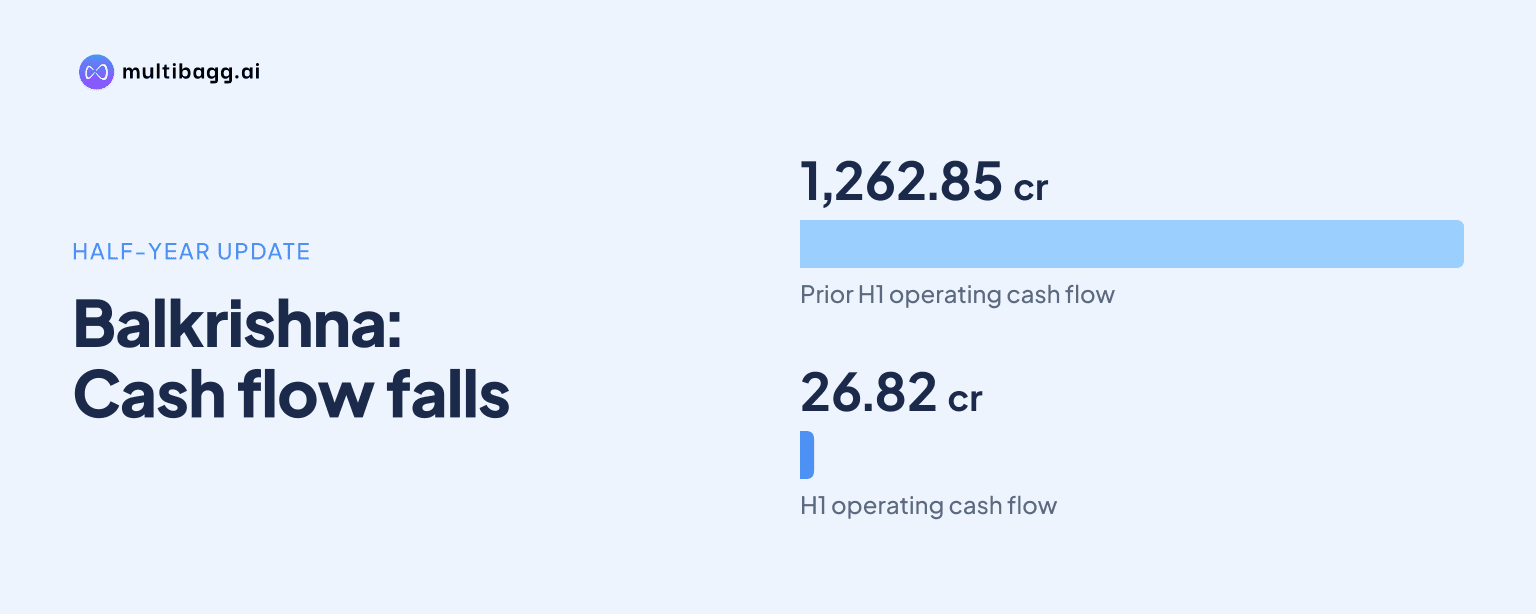
Balkrishna Industries Limited generated consolidated operating cash inflow of only Rs 26.82 crore in the half year ended 30 September 2026, despite reporting Rs 990.41 crore of profit before tax, as inventory absorbed Rs 754.55 crore and trade and other receivables absorbed Rs 571.32 crore. The comparable prior-year operating cash inflow was Rs 1,262.85 crore.
Know Balkrishna Industries inside out
Results, valuation, peers and who's buying, in one view.
Why did Balkrishna Industries’ operating cash flow decline?
Balkrishna Industries’ operating cash flow declined because working-capital movements consumed Rs 1,221.13 crore in the half year ended 30 September 2026, compared with a Rs 258.75 crore cash inflow from those movements a year earlier. This change followed Rs 754.55 crore absorbed by inventories and Rs 571.32 crore absorbed by trade and other receivables, whereas the corresponding prior-year movements generated Rs 37.48 crore and Rs 420.64 crore respectively.
Cash generated from operations consequently fell to Rs 179.35 crore from Rs 1,422.04 crore in the half year ended 30 September 2025. After direct taxes paid of Rs 152.54 crore, compared with Rs 159.19 crore in the earlier period, net cash from operating activities was Rs 26.82 crore. The operating cash figure was therefore Rs 1,236.03 crore lower year on year even though the tax payment was Rs 6.65 crore lower.
The reduction did not originate in profit before working-capital changes. Balkrishna Industries reported consolidated operating profit before working-capital changes of Rs 1,400.49 crore, up from Rs 1,163.29 crore in the prior-year half. The Rs 237.20 crore increase came alongside consolidated profit before tax of Rs 990.41 crore, against Rs 751.68 crore a year earlier, showing that the cash outcome was principally shaped by the timing and scale of balance-sheet movements.
How did inventory and receivables change at Balkrishna Industries?
Balkrishna Industries’ consolidated inventory balance rose to Rs 2,563.05 crore at 30 September 2026 from Rs 1,808.47 crore at 31 March 2026, an increase of Rs 754.58 crore. The cash-flow statement records a Rs 754.55 crore outflow for inventories for the half year, closely matching the movement in the reported closing balance.
Consolidated trade receivables were Rs 1,897.95 crore at 30 September 2026, compared with Rs 1,446.57 crore at 31 March 2026, an increase of Rs 451.38 crore. The cash-flow statement’s wider line for trade and other receivables shows a Rs 571.32 crore outflow, rather than the trade-receivables balance movement alone. The two measures should not be treated as identical because their labels cover different items.
Balkrishna Industries’ inventory turnover was 9.55 times for the consolidated half year ended 30 September 2026, compared with 9.47 times for the corresponding prior-year half. Consolidated debtors turnover was 8.28 times, compared with 7.34 times a year earlier. These disclosed turnover measures moved higher even as the closing inventory and trade-receivable balances increased from their 31 March 2026 levels.
Did profit growth support Balkrishna Industries’ cash generation?
Balkrishna Industries’ consolidated profit before tax increased to Rs 990.41 crore for the half year ended 30 September 2026 from Rs 751.68 crore a year earlier, a rise of Rs 238.73 crore. Profit after tax also increased to Rs 743.39 crore from Rs 561.49 crore. Yet the Rs 26.82 crore operating cash inflow was far below both reported profit measures because the Rs 1,221.13 crore working-capital outflow offset the operating cash build before tax.
Revenue from operations reached Rs 6,927.01 crore in the period, compared with Rs 5,153.47 crore in the half year ended 30 September 2025. Consolidated operating margin, defined in the filing as earnings before interest and tax less other income divided by revenue from operations, was 13.74%, up from 12.35%. Net profit margin was 10.51%, marginally below 10.53% in the comparable half.
Depreciation and amortisation was Rs 426.45 crore, compared with Rs 380.76 crore a year earlier, while finance cost was Rs 104.25 crore versus Rs 63.33 crore. Other adjustments in the operating-cash reconciliation totalled Rs 410.08 crore for the current half, compared with Rs 411.61 crore in the prior-year period. This meant reported profit and non-cash adjustments together produced Rs 1,400.49 crore before working capital, but not cash available after inventory and receivables movements.
Got a follow-up? Ask IRIS
How was Balkrishna Industries funding its cash requirements?
Balkrishna Industries recorded Rs 1,818.80 crore of net cash used in investing activities in the half year ended 30 September 2026, compared with Rs 1,296.25 crore a year earlier. Purchases of property, plant and equipment were Rs 1,966.83 crore, up from Rs 1,683.69 crore, while net purchases and sales of investments resulted in a Rs 110.31 crore inflow, based on Rs 1,514.77 crore of purchases and Rs 1,625.08 crore of sales.
Financing activities provided Rs 1,834.14 crore, compared with Rs 28.67 crore in the corresponding prior-year half. Balkrishna Industries received Rs 4,556.03 crore from long-term borrowings and repaid Rs 2,476.26 crore. Net short-term borrowings declined by Rs 26.42 crore, and finance costs paid were Rs 63.46 crore.
The funding flows left consolidated cash and cash equivalents at Rs 102.96 crore at 30 September 2026, up from Rs 60.92 crore at 31 March 2026. Total consolidated borrowings, combining non-current and current borrowings, were Rs 6,046.60 crore at 30 September 2026, compared with Rs 4,105.56 crore at 31 March 2026. The disclosed consolidated debt-equity ratio was 0.52 times at the half-year end, versus 0.37 times at 31 March 2026.
What does Balkrishna Industries’ balance sheet show?
Balkrishna Industries reported consolidated current assets of Rs 6,451.57 crore at 30 September 2026, up from Rs 5,154.47 crore at 31 March 2026. Consolidated current liabilities rose to Rs 6,441.93 crore from Rs 5,089.00 crore over the same six months. The disclosed current ratio, calculated as current assets divided by current liabilities, was 1.00 times, compared with 1.01 times at 31 March 2026.
Capital work-in-progress increased to Rs 3,740.51 crore from Rs 2,472.46 crore, a rise of Rs 1,268.05 crore. Property, plant and equipment increased to Rs 7,728.88 crore from Rs 7,326.54 crore. These movements coincide with the Rs 1,966.83 crore cash spending on property, plant and equipment recorded in the consolidated investing cash flow.
Balkrishna Industries has one reportable business segment, Tires, under Indian Accounting Standard 108. The filing says previously announced capital expenditures are expected to be completed as scheduled and within the approved budget. The board also declared a second interim dividend of Rs 4 per equity share for financial year 2026-27, with a disclosed cash outflow of Rs 77.32 crore.
Conclusion
Balkrishna Industries delivered higher half-year revenue, pre-tax profit and operating profit before working-capital changes through 30 September 2026, but these gains did not translate into comparable operating cash. Inventory and receivables together absorbed Rs 1,325.87 crore, while a Rs 103.98 crore cash contribution from trade and other payables only partly offset the outflows. The result was a Rs 26.82 crore operating cash inflow against Rs 1,262.85 crore a year earlier.
The next disclosures should show whether inventories of Rs 2,563.05 crore and trade receivables of Rs 1,897.95 crore convert into cash, and how Balkrishna Industries funds its announced capital-expenditure programme. Investors can also track completion against the company’s stated schedule and approved budget, as well as the Rs 77.32 crore expected cash outflow from the interim dividend declared on 4 November 2026.