










Balmer Lawrie Investments borrowings rise to Rs 116.62 crore
Key highlights
- Balmer Lawrie Investments’ short-term borrowings rose to Rs 116.62 crore at September 30, 2026 from Rs 3.45 crore at March 31, 2026.
- Trade receivables increased by Rs 134.38 crore to Rs 669.30 crore at September 30, 2026.
- Other current financial assets increased by Rs 165.25 crore to Rs 645.97 crore at September 30, 2026.
- Balmer Lawrie Investments reported net cash used in operating activities of Rs 134.50 crore for the six months ended September 30, 2026.
powered by IRIS
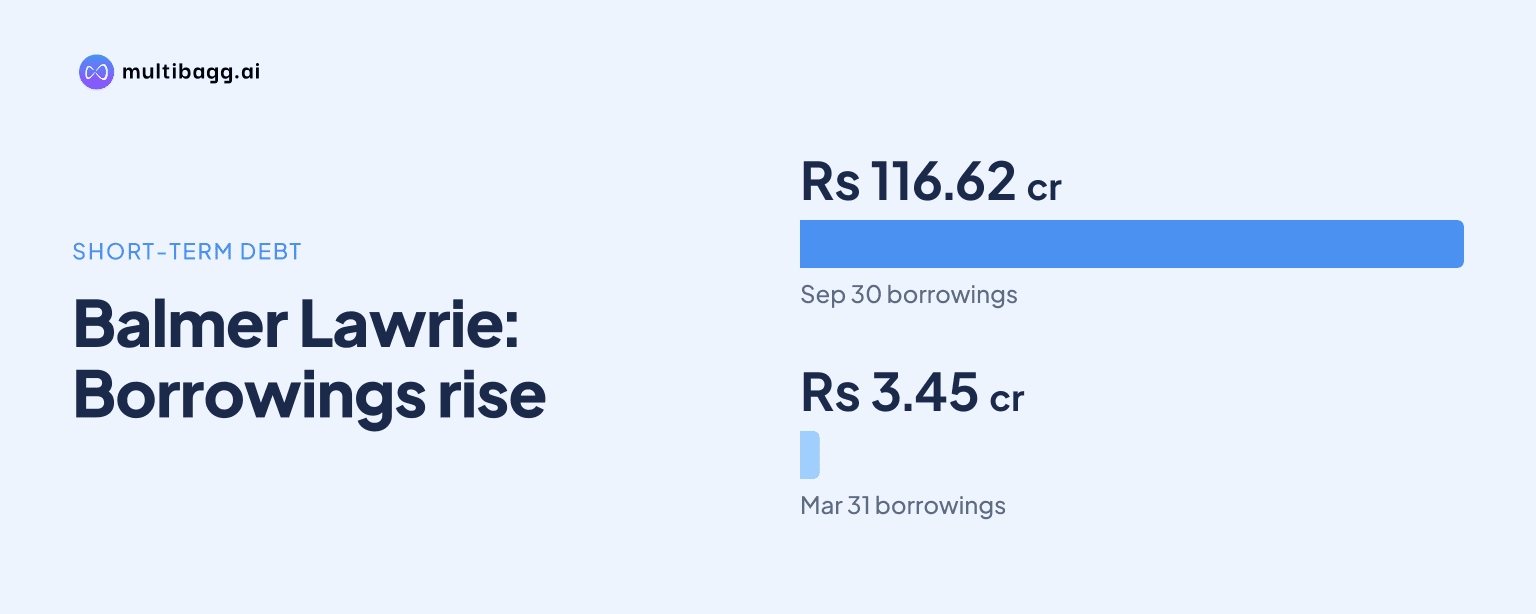
Balmer Lawrie Investments Limited reported short-term borrowings of Rs 116.62 crore at September 30, 2026, compared with Rs 3.45 crore at March 31, 2026. The Rs 113.17 crore increase coincided with higher trade receivables, inventories and other current financial assets, while the consolidated cash-flow statement showed a Rs 134.50 crore operating cash outflow for the six months.
Know Balmer Lawrie Investment inside out
Results, valuation, peers and who's buying, in one view.
What changed in Balmer Lawrie Investments’ short-term borrowings?
Balmer Lawrie Investments’ current borrowings rose to Rs 116.62 crore on September 30, 2026 from Rs 3.45 crore on March 31, 2026. This Rs 113.17 crore movement was recorded within current liabilities, alongside current lease liabilities of Rs 22.47 crore and other current financial liabilities of Rs 266.44 crore at the September reporting date.
Total current liabilities increased by Rs 196.83 crore to Rs 990.05 crore at September 30 from Rs 793.22 crore at March 31. Other current liabilities increased by Rs 44.12 crore to Rs 152.97 crore, while current tax liabilities rose by Rs 12.92 crore to Rs 66.87 crore. Trade payables due to creditors other than micro and small enterprises fell by Rs 10.91 crore to Rs 309.87 crore.
The filing does not identify a specific purpose, lender or repayment schedule for the increase in current borrowings. It does show that finance costs for the six months ended September 30 rose to Rs 24.18 crore from Rs 13.82 crore in the corresponding 2025 period, while profit before tax increased to Rs 201.78 crore from Rs 164.35 crore.
Which working-capital assets increased at Balmer Lawrie Investments?
Balmer Lawrie Investments’ trade receivables increased by Rs 134.38 crore to Rs 669.30 crore at September 30, 2026 from Rs 534.91 crore at March 31. Inventories rose by Rs 55.13 crore to Rs 223.78 crore, and other current financial assets increased by Rs 165.25 crore to Rs 645.97 crore over the same six-month balance-sheet period.
These three working-capital-related asset categories increased by a combined Rs 354.76 crore. The increase was partly offset by a Rs 127.89 crore fall in bank balances other than cash equivalents, which stood at Rs 448.64 crore, and a Rs 7.49 crore reduction in cash and cash equivalents to Rs 29.16 crore.
Total current assets rose by Rs 233.68 crore to Rs 2,081.90 crore, exceeding the Rs 196.83 crore increase in current liabilities. Total assets rose to Rs 3,782.24 crore from Rs 3,514.38 crore, while total equity increased by Rs 62.47 crore to Rs 2,306.53 crore, including non-controlling interest of Rs 828.60 crore.
Got a follow-up? Ask IRIS
Did Balmer Lawrie Investments generate operating cash in the six months?
Balmer Lawrie Investments recorded net cash used in operating activities of Rs 134.50 crore for the six months ended September 30, 2026, compared with an operating cash outflow of Rs 149.61 crore in the corresponding six months of 2025. Cash generated from operations before income taxes was negative Rs 100.06 crore, followed by Rs 34.44 crore of income taxes paid, net of refunds.
The cash-flow statement shows a Rs 201.48 crore increase in other short-term financial assets, a Rs 134.38 crore increase in trade receivables and a Rs 57.23 crore increase in inventories. These movements outweighed Rs 250.05 crore of operating cash flow before working-capital changes. Trade payables used Rs 19.26 crore of cash, compared with a Rs 21.09 crore cash inflow from trade payables in the prior-year period.
Balmer Lawrie Investments generated Rs 142.93 crore from investing activities, including Rs 127.89 crore from movement in bank deposits and Rs 30.40 crore of dividends received. Financing activities used Rs 15.91 crore, after Rs 110.79 crore from borrowings, Rs 85.48 crore of dividends paid including dividend tax, Rs 24.18 crore of finance costs paid and Rs 17.04 crore of lease-liability repayments.
The combination of operating, investing and financing cash flows reduced cash and cash equivalents by Rs 7.49 crore during the six months. Cash and cash equivalents were Rs 36.65 crore at April 1, 2026 and Rs 29.16 crore at September 30, 2026, according to the consolidated cash-flow statement and balance sheet.
Which operating segments provide context for Balmer Lawrie Investments’ balance-sheet movement?
Balmer Lawrie Investments’ revenue from operations increased to Rs 1,554.29 crore in the six months ended September 30, 2026 from Rs 1,321.87 crore a year earlier. Logistics Services recorded the largest absolute revenue increase, rising by Rs 128.22 crore to Rs 411.93 crore, while Industrial Packaging revenue increased by Rs 102.01 crore to Rs 555.27 crore.
Greases and Lubricants was the principal segment with a revenue decline in the six-month comparison, falling by Rs 42.95 crore to Rs 277.48 crore from Rs 320.44 crore. Travel and Vacations revenue increased by Rs 9.12 crore to Rs 159.94 crore, while Logistics Infrastructure revenue rose by Rs 23.53 crore to Rs 161.22 crore.
Segment assets totalled Rs 3,782.24 crore at September 30, compared with Rs 3,514.38 crore at March 31. Travel and Vacations segment assets rose by Rs 119.13 crore to Rs 748.36 crore, and Logistics Services assets increased by Rs 85.17 crore to Rs 339.40 crore. Logistics Services segment liabilities also rose by Rs 42.10 crore to Rs 253.28 crore.
The financial results do not allocate the Rs 116.62 crore of current borrowings to individual operating segments. They also do not link the higher receivables, inventories or other current financial assets to a particular segment, so the filing supports a group-level comparison rather than a segment-specific funding conclusion.
Conclusion
Balmer Lawrie Investments’ September 2026 balance sheet shows short-term borrowing growth alongside an expansion in working-capital-related assets. Current borrowings rose by Rs 113.17 crore, while trade receivables, inventories and other current financial assets increased by a combined Rs 354.76 crore. These movements occurred during a six-month period in which revenue increased by Rs 232.42 crore and operating activities used Rs 134.50 crore of cash.
The next item to watch is the company’s subsequent financial-results disclosure after the unaudited September 2026 results were approved by the board on November 10, 2026. That disclosure may show whether receivables of Rs 669.30 crore, other current financial assets of Rs 645.97 crore and short-term borrowings of Rs 116.62 crore decline, stabilise or increase further.