








Balrampur Chini expects 2% less cane after unseasonal rains
MAX Plan at ₹4,999/yr

Find your next multibaggerBe a Pro Investor
Research stocks and track your picks on the go. Download the app.
Key highlights
- Balrampur Chini expects cane availability to be about 2% below last season’s 1,040 lakh quintals.
- Balrampur Chini expects sugar recovery to be lower initially after unseasonal rains affected soil conditions.
- Balrampur Chini reported zero red rot incidence during the call.
- Balrampur Chini said variety 20016 may take at least 2 years to reach a 15% to 20% effective share.
powered by IRIS
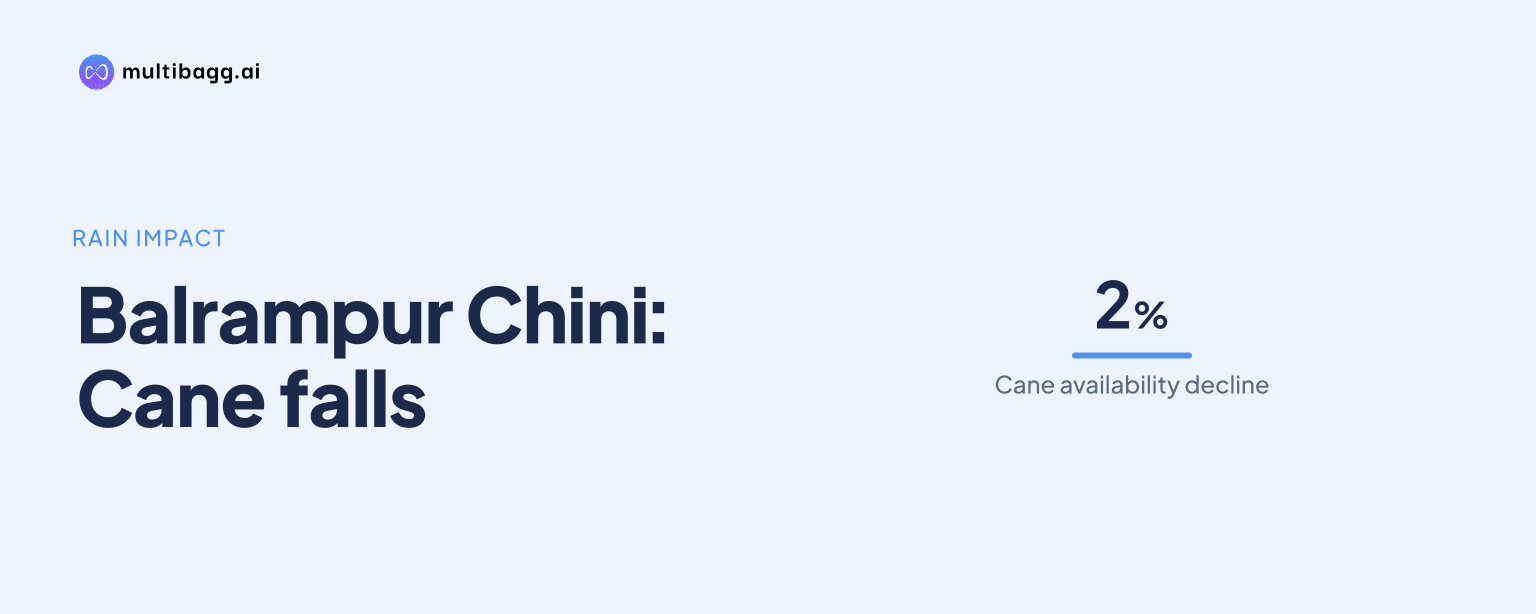
Balrampur Chini expects cane availability to be about 2% below last season’s 1,040 lakh quintals after unseasonal rains, while management expects sugar recovery to be lower at the start of crushing. The company is multiplying cane variety 20016, which management said could take at least two years to reach a 15% to 20% effective share.
Know Balrampur Chini Mills inside out
Results, valuation, peers and who's buying, in one view.
Why does Balrampur Chini expect less cane this season?
Balrampur Chini expects cane availability to decline by about 2% because unseasonal rains caused some crop damage. Vivek Saraogi described the estimate as a working scenario rather than a firm forecast, saying it was still early to predict the final crop outcome. He said cane availability was more measurable than recovery at this stage of the season.
The comparison is with the prior crushing season, when Balrampur Chini said it crushed 1,040 lakh quintals of cane on a season basis rather than a financial-year basis. Management did not provide an absolute crushing target for the current season. A 2% reduction would therefore mean lower cane supply relative to that reported base, subject to the eventual progression of the crop.
Management linked the expected reduction specifically to weather rather than to red rot or another identified disease issue. Mr. Saraogi said the weather had been “a little damaging” and told participants they could work with 2% lower cane availability until clearer information emerges. He also said the January call should offer a more informed assessment of both crop volume and recovery.
Will Balrampur Chini's sugar recovery be lower?
Balrampur Chini expects sugar recovery to be lower initially because rain affected soil conditions, although management hopes it will improve later in the crushing season. Mr. Saraogi said recovery “could be also 0.1” but stressed that this was a guesstimate; the transcript does not state the unit or define whether this refers to a percentage-point movement.
That outlook differs from the prior-season context raised by an analyst, who referred to a recovery uptick last year. Management did not say recovery would remain lower throughout the full season, nor did it provide a season-wide recovery target. Instead, the stated view is that the opening period may be weaker before conditions potentially improve.
Balrampur Chini reported no red rot issue when asked about the disease during the call. Mr. Saraogi answered “zero,” distinguishing the rain-related soil effect from a disease-led crop problem. The company did not disclose mill-level recovery data, the area affected by rain, or the quantity of cane that may have been affected.
What is Balrampur Chini doing with variety 20016?
Balrampur Chini is multiplying cane variety 20016 as a prospective replacement for Co 0238, with management indicating that broad adoption will take time. Avantika Saraogi initially named the variety as 21012, then corrected herself during the call and said the relevant variety was 20016.
Management described 20016 as more promising for yield and recovery and said it does not have the lodging or red-rot inclination associated with the concerns raised by the analyst. Ms. Saraogi said farmers apparently like the variety and that Balrampur Chini was multiplying it. The company did not disclose trial yields, recovery data, planted acreage or a quantified comparison with Co 0238.
The programme is not intended to offset the current season’s crop outlook. Ms. Saraogi said Balrampur Chini should see a percentage-level quantity within the next two years, while Mr. Saraogi said reaching a 15% to 20% effective share would take at least two years. That timing makes 20016 a medium-term crop-development initiative rather than an immediate response to the expected 2% decline.
Got a follow-up? Ask IRIS
When will Balrampur Chini provide a clearer crop update?
Balrampur Chini said the January call should provide a clearer view of cane availability and sugar recovery. Management said that, beyond the working assumption of 2% lower cane availability, crop estimates remained difficult, especially for recovery. The planned update is therefore the main disclosed point for reassessing the early-season weather impact.
The timing also reflects the staggered start of operations at Balrampur Chini’s 10 plants in Uttar Pradesh. Pramod Patwari said central Uttar Pradesh operations were expected to begin after Deepavali, while eastern Uttar Pradesh operations were expected to start around 20 November. Early crushing data may therefore not represent the full operating footprint at the outset of the season.
Balrampur Chini also said sugar availability determines how much sugarcane can be diverted into ethanol in a given year. Mr. Patwari said the diversion decision is dynamic, while noting that E20, meaning 20% ethanol blending, is the minimum blend under government policy. The company did not quantify how a 2% reduction in cane availability could alter sugar output, ethanol production or its feedstock mix.
What does Balrampur Chini's outlook mean for sugar prices?
Balrampur Chini management said it remained positively inclined on sugar prices but did not offer a formal price forecast. Mr. Saraogi said an average of 60 would be unrealistic and that becoming bearish below 50 would also not reflect reality, although the transcript does not specify a unit or period for those remarks.
The crop outlook provides context for that management view, because the company expects lower cane availability than the 1,040 lakh quintals crushed last season and initially lower recovery. However, Balrampur Chini did not directly link its 2% cane estimate to a specific sugar-price outcome. Management instead said precise numerical predictions were impossible.
The disclosed operational variables are clearer than the price commentary: a 2% working assumption for lower cane availability, initially weaker recovery, and no reported red rot issue. The longer-term variable is 20016, which management hopes can improve yield, recovery and disease resilience after it reaches a meaningful 15% to 20% effective share in at least two years.
Conclusion
Balrampur Chini’s commentary indicates a near-term crop headwind rather than a disclosed major disruption. Management expects cane availability to be about 2% lower than last season’s 1,040 lakh quintals after unseasonal rains, and it expects recovery to start lower because of rain-affected soil. At the same time, management reported zero red rot incidence and identified variety 20016 as a possible longer-term alternative to Co 0238.
The next event to watch is Balrampur Chini’s January call, when management said it should be able to give a more accurate assessment of cane availability and recovery. Readers can also watch progress in multiplying 20016 toward the 15% to 20% effective share management said would take at least two years, as well as any update on sugar availability and ethanol diversion.

