








Balrampur Chini Mills targets November PLA start, six-month ramp
MAX Plan at ₹4,999/yr

Find your next multibaggerBe a Pro Investor
Research stocks and track your picks on the go. Download the app.
Key highlights
- Balrampur targets November-end commissioning of its 80,000 PLA project.
- Balrampur had spent about Rs 2,400 crore on the PLA project by 15 October.
- Management expects roughly six months of PLA trials, customer qualification and cost validation.
- Balrampur reported Q2 FY 2027 sugar-segment PBIT of Rs 140 crore, up 166% year on year.
powered by IRIS
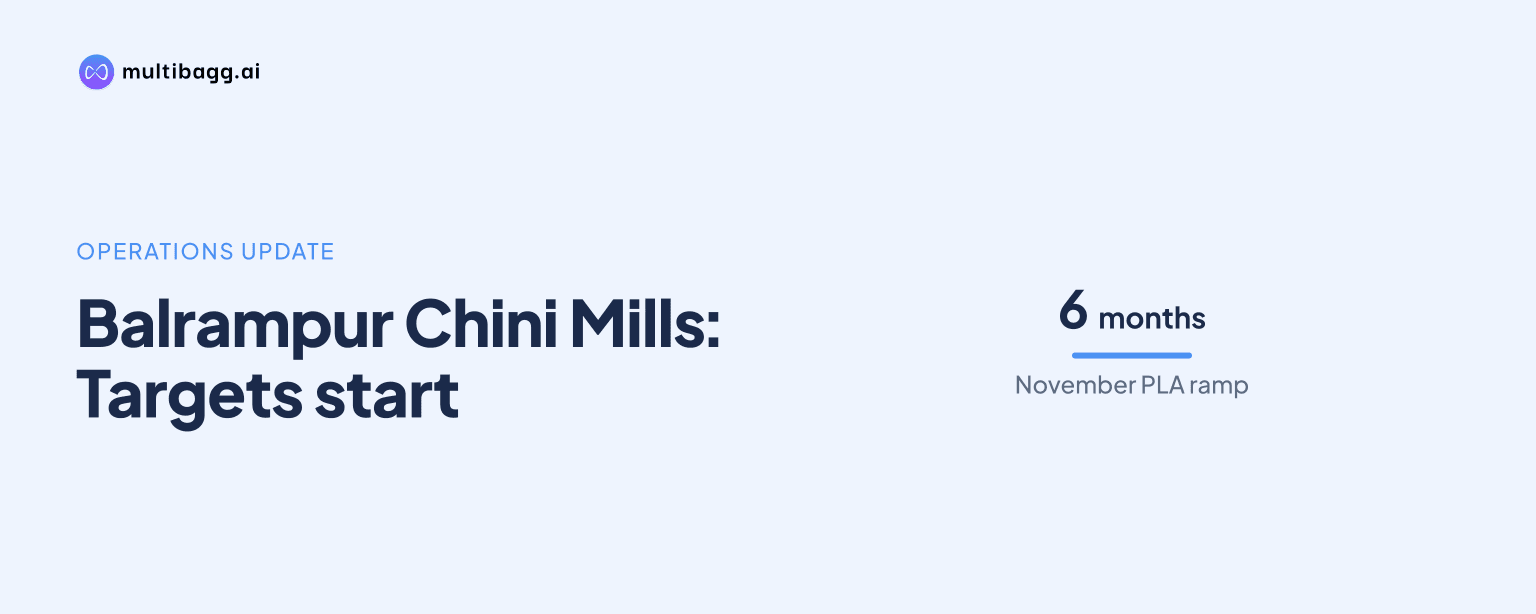
Balrampur Chini Mills is targeting November-end commissioning of its 80,000 PLA project after spending about Rs 2,400 crore by 15 October, but management says commercial development will require roughly six months of production trials, customer qualification and validation of actual operating costs. The company has also secured its first government institutional order for a PLA-based product.
Know Balrampur Chini Mills inside out
Results, valuation, peers and who's buying, in one view.
When will Balrampur start PLA production?
Balrampur is targeting November-end commissioning of its polylactic acid, or PLA, project. During the Q2 FY 2027 earnings call, management first said it hoped to commence operations in November and later specified that commissioning was planned for November-end, while construction activities were described as being in full swing.
The project is described as an 80,000 PLA project, and Balrampur said it had spent approximately Rs 2,400 crore by 15 October. The call did not disclose a revised project cost, a commissioning-day production target or an annual output forecast, so the November event marks the beginning of operational commissioning rather than an indicated level of commercial utilisation.
Management said suppliers had provided guarantees for quality and capacity, and it expects the plant to make high-quality PLA at a low conversion cost. These are management expectations, however, and Balrampur said actual performance can be assessed only after production establishes yields, chemical consumption and operating costs at the commissioned facility.
Why does Balrampur expect a six-month PLA ramp-up?
Balrampur expects a six-month ramp-up because PLA production and product marketing are both new activities for the company. Management initially described a minimum three-to-six-month period of patience, then said the first six months would involve quality trials, efforts to bring customers on board and work with large buyers before the business reaches a take-off stage.
The main production uncertainty is that the current cost model remains spreadsheet-based. Management said the company will learn actual costs only after commissioning, based on measures including plant yields and chemical consumption, and said it could provide more information on the difference between planned and actual outcomes on its next call.
Customer qualification is a separate issue from plant start-up. Balrampur said it was progressing with product development, customer trials and market engagement, but did not identify commercial buyers or state the volume, value or delivery schedule of the first government institutional order. Therefore, commissioning alone does not establish demand for the full 80,000 PLA project.
Balrampur also declined to provide PLA revenue or margin forecasts for FY 2028, FY 2029 and FY 2030. Management said conditions had been moving dramatically and that a one-year projection might be possible in six to eight months, leaving utilisation, selling prices and profitability undisclosed during the initial ramp-up period.
What PLA sales progress has Balrampur reported?
Balrampur has secured its first institutional order from the government for a PLA-based product while continuing customer trials and market engagement. Management called progress on production and product marketing encouraging and said it was working with several stakeholders and large names, although it did not disclose their identities or the size of any potential orders.
Balrampur said it had passed all testing protocols for an application discussed by an analyst and that a significant portion of PLA capacity could potentially serve that application. The company did not quantify the addressable market, allocate a defined share of the 80,000 PLA project to it, or state when related mandates and buyer approvals might be finalised.
Management positions PLA as a bio-based and biodegradable polymer compared with conventional fossil-based, non-biodegradable materials. It said industrial compostability is a subset of biodegradability, while the time needed for degradation in the environment depends on factors including temperature, climate and moisture.
On pricing, management said PLA prices had increased by about 10% in the preceding six months. It also said higher conventional-plastic prices had narrowed the price gap, although some of Balrampur's own production inputs had risen; no absolute PLA price, customer contract price or premium over conventional material was disclosed.
Got a follow-up? Ask IRIS
How could sugar and input costs affect Balrampur's PLA economics?
Balrampur said higher cane costs will increase the transfer price of sugar used in PLA production. Management said global sugar and sweetener prices had risen, putting producers on a more level footing, but acknowledged that higher sugar values create a trade-off between selling sugar and using it as a captive PLA input.
The company did not disclose the sugar required for each unit of PLA or calculate the effect of a higher transfer price on project margin. It also identified sulfur and chemical consumption as relevant cost variables, noting that sulfur prices had already fallen 20% from an earlier elevated level, while actual chemical usage will be known only after plant operations begin.
Balrampur asked investors not to expect quarterly guidance for the new business over the next two quarters. That caution contrasts with its established sugar operations, where Q2 FY 2027 sugar-segment profit before interest and tax, or PBIT, reached Rs 140 crore, up 166% from the corresponding quarter a year earlier on stronger volumes and realisations.
The distillery segment, by comparison, faced compressed margins because ethanol procurement prices had not been revised for three years while the Fair and Remunerative Price, or FRP, of cane rose 16% over the same period. For the wider business, management said every Rs 10 increase in cane price would add Rs 100 crore to raw-material cost, assuming crushing of about 10 crore quintals in the current season.
Cane pricing remains unresolved because the Uttar Pradesh government had not announced the State Advised Price during the call. Management said participants should wait until at most November rather than rely on scenario analysis, making the cane-price decision relevant to both core sugar profitability and the cost of sugar transferred into PLA production.
Conclusion
Balrampur is moving its PLA project from construction to commissioning, backed by about Rs 2,400 crore of spending by 15 October and an initial government institutional order. Management's central message is that a November-end start will not immediately prove the economics of the 80,000 PLA project, because product quality, buyer qualification, production yields and chemical consumption must first be established during the ramp-up.
The next event to watch is November-end commissioning and the operating information management said it may provide on its next call, including actual yields, chemical consumption and costs against its planning assumptions. Over the following six to eight months, management said it may be able to offer a one-year PLA projection, while the pending Uttar Pradesh cane-price announcement remains a separate cost variable.

