










Bandhan Bank says EEB decline stopped as collections improve
Key highlights
- Bandhan Bank's EEB collection efficiency rose to 99.3% in Q2 FY27 from 98.9% in Q1 FY27.
- Bandhan Bank's EEB DPD pool fell 17% sequentially to Rs 1,529 crore, or 2.9% of the portfolio.
- Bandhan Bank's EEB loan book was Rs 52,616 crore, broadly flat sequentially and up 1.7% year-on-year.
- Bandhan Bank reported Q2 FY27 profit after tax of Rs 622 crore, up 23.9% sequentially.
powered by IRIS
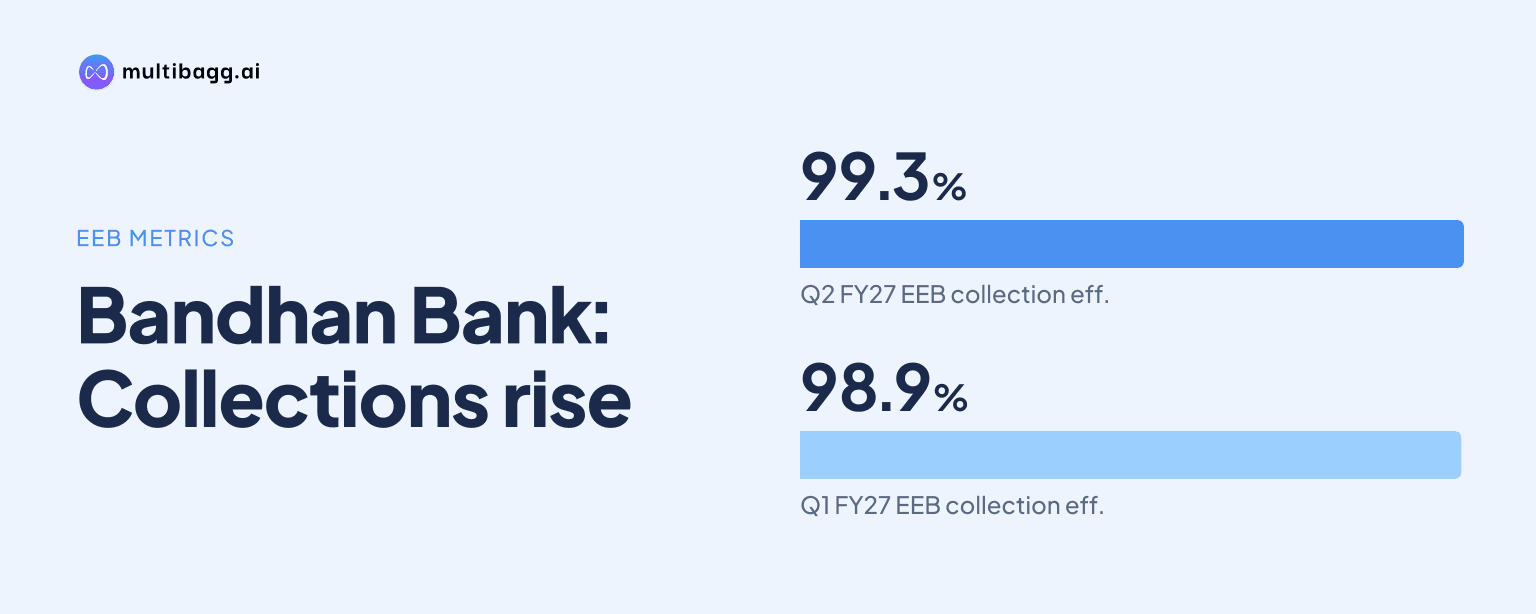
Bandhan Bank said its EEB portfolio stopped contracting in Q2 FY27, as collection efficiency improved to 99.3% and the early-delinquency pool fell 17% sequentially to Rs 1,529 crore. The bank reported that EEB advances were broadly flat quarter-on-quarter and 1.7% higher than a year earlier at Rs 52,616 crore.
Know Bandhan Bank inside out
Results, valuation, peers and who's buying, in one view.
Has Bandhan Bank's EEB loan-book decline stopped?
Yes. Bandhan Bank said the decline in its EEB book had been arrested in Q2 FY27 after moderation over the preceding quarters, with the portfolio broadly stable sequentially and 1.7% higher year-on-year at Rs 52,616 crore on September 30, 2026. Management said it remained prudent in the segment but expected the book to return to a healthier growth path.
The stabilisation contrasts with faster expansion elsewhere in the loan book. Total gross advances reached about Rs 1.58 lakh crore, up 13.1% year-on-year and 1.8% sequentially, while non-EEB advances rose 19.8% year-on-year and accounted for 66.7% of total advances. EEB group lending represented 22% of advances, compared with 34% for wholesale banking, 22% for housing finance, 11% for small business and agriculture lending, and 11% for retail and other loans.
Management linked the expected recovery in EEB growth to improving asset-quality indicators and disbursement progress. In the question-and-answer session, the chief executive said Bandhan Bank was targeting EEB growth of about 8% to 10% in Q3 and Q4 FY27, despite external factors, after several quarters of book contraction. That is a management target, not a reported growth outcome.
How much did Bandhan Bank's EEB collections improve?
Bandhan Bank's EEB collection efficiency improved by 40 basis points quarter-on-quarter to 99.3% in Q2 FY27 from 98.9% in Q1 FY27. A basis point is one-hundredth of a percentage point. Bank-level collection efficiency, excluding non-performing assets, rose by 36 basis points to 99.4% during the quarter.
Early stress also reduced. The EEB days-past-due, or DPD, pool fell to 2.9% of the portfolio from 3.5% in Q1 FY27. In value terms, the pool declined by about 17% sequentially to Rs 1,529 crore from Rs 1,842 crore. This movement indicates that fewer EEB accounts were overdue before potentially becoming formal non-performing assets.
The collection improvement occurred alongside a cautious stance on fresh growth. Bandhan Bank said processing-fee income rose 30% year-on-year in Q2 FY27, supported by higher EEB disbursement volumes, while management said disbursements were broadly moving in line with its 8% to 10% EEB growth objective. The transcript did not disclose EEB disbursement amounts or a geographic breakdown of the collection improvement.
Got a follow-up? Ask IRIS
Are Bandhan Bank's EEB slippages improving too?
Underlying net slippages improved by about 14% sequentially in Q2 FY27 after adjusting for a Rs 119 crore asset reconstruction company recovery recorded in Q1 FY27. Gross slippages, which are fresh additions to non-performing assets before recoveries and upgrades, were Rs 1,125 crore in Q2, compared with Rs 1,079 crore in Q1, including Rs 655 crore of EEB slippages.
The improvement came from better resolution rather than a lower reported gross-slippage figure. Recoveries and upgrades rose to Rs 481 crore in Q2 FY27 from Rs 449 crore in Q1 FY27. The bank also wrote off about Rs 607 crore during the quarter, of which Rs 424 crore related to EEB.
At the bank level, gross non-performing assets were 3.1% and net non-performing assets were 0.9% at the end of Q2 FY27, both described by management as stable. The provision coverage ratio was 71.2%, or 74.3% after including provisions against security receipts. Those ratios place the EEB movement within the bank's wider credit portfolio, which includes faster-growing secured and non-EEB businesses.
What does the EEB turnaround mean for Bandhan Bank's loan mix?
Bandhan Bank's wider loan mix continued to move toward non-EEB and secured lending in Q2 FY27. The secured portfolio increased 18% year-on-year and made up 57.3% of total advances, up from 54.9% a year earlier. Retail assets grew 41.9% year-on-year, led by commercial vehicles, construction equipment, auto and gold loans, while wholesale banking expanded 31.6%.
This diversification means EEB's stabilisation is occurring within a larger balance sheet rather than as the sole engine of growth. Non-EEB advances grew 19.8% year-on-year, faster than the 13.1% growth in total advances, and EEB represented 22% of advances at September 30, 2026. The bank said the diversified mix provided multiple growth engines, but did not give separate credit-cost or delinquency ratios for every business line.
Funding also changed during the quarter. Deposits rose 9.2% year-on-year and 4.7% sequentially to about Rs 1.73 lakh crore, while the net credit-deposit ratio declined to 89.5% from around 92% in the preceding quarter. Bulk deposits increased by about Rs 4,300 crore sequentially as borrowings fell by about Rs 3,400 crore, a move management described as liquidity and funding-cost management rather than a shift in its long-term retail-deposit strategy.
Profitability improved while reported credit cost remained stable sequentially at 1.8%. Net interest margin, the difference between interest earned and interest paid relative to earning assets, was 6.1% in Q2 FY27 versus 6.2% in Q1. Profit after tax was Rs 622 crore, up 23.9% sequentially and 5.5 times year-on-year, while return on assets improved to 1.2% from 1.0% in the previous quarter.
Conclusion
Bandhan Bank's Q2 FY27 disclosures indicate that the immediate contraction in EEB has ended, supported by a 40-basis-point improvement in EEB collection efficiency and a Rs 313 crore sequential reduction in the DPD pool. At the same time, reported gross slippages increased to Rs 1,125 crore, so the improvement rests on stronger recoveries, upgrades and the adjusted net-slippage measure rather than on a lower gross-slippage total.
The next test is whether the bank delivers management's stated 8% to 10% EEB growth in Q3 and Q4 FY27 while maintaining the 99.3% collection efficiency seen in Q2. Investors will also watch whether the DPD pool continues to fall, how Rs 424 crore of EEB write-offs affect the portfolio, and whether Bandhan Bank achieves its unchanged full-year loan-growth target of about 14%.