










Bandhan Bank expects retail ROA positive in 2-3 quarters
Key highlights
- Bandhan Bank expects retail businesses started about two years ago to become ROA-positive within two to three quarters.
- EEB accounts for around 33% of Bandhan Bank's loan mix under its one-third diversification framework.
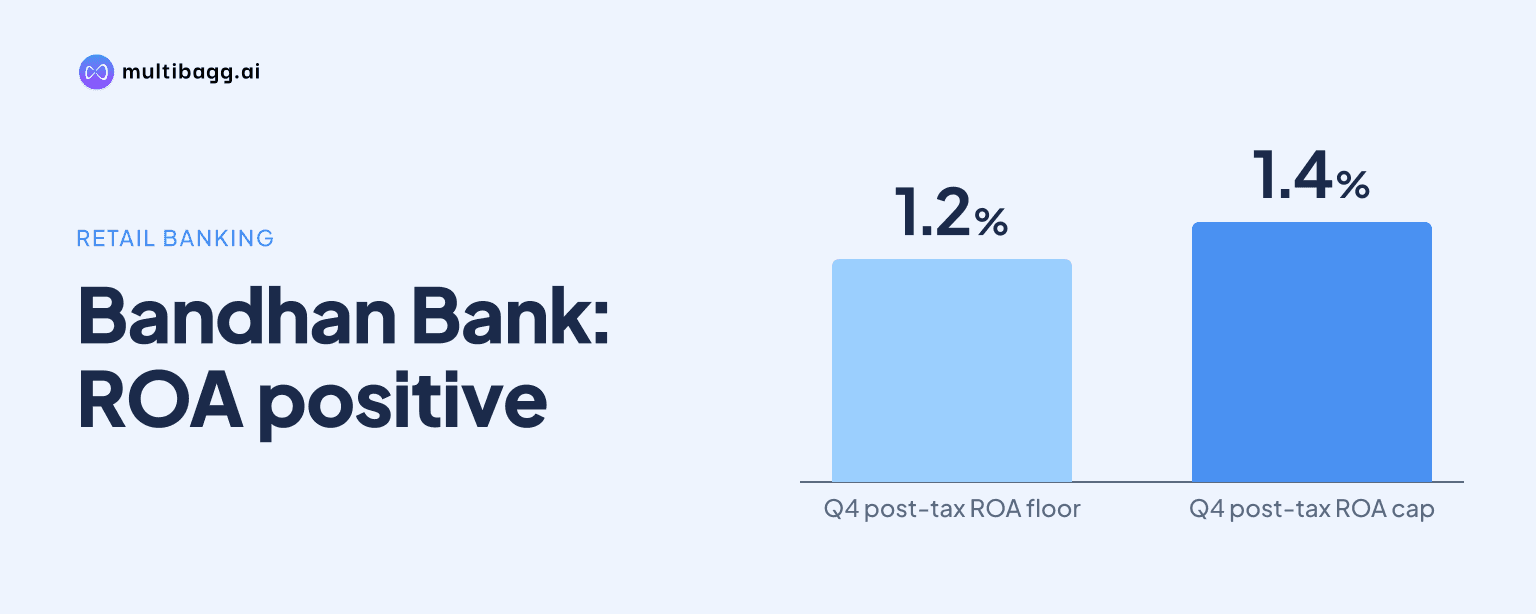
- Bandhan Bank retained Q4 post-tax ROA guidance of 1.2% to 1.4%.
- A platform replacement generated almost Rs 50 crore of annual savings, or about Rs 12 crore per quarter, in Q2.
powered by IRIS
Bandhan Bank Limited expects its retail lending businesses, started about two years ago, to turn return on assets (ROA)-positive within another two to three quarters as loan-book scale reduces losses. Management said the businesses remain loss-making today, but negative ROA has narrowed quarter by quarter while the bank maintains a roughly one-third portfolio allocation to retail and housing.
Know Bandhan Bank inside out
Results, valuation, peers and who's buying, in one view.
When will Bandhan Bank's retail business become ROA-positive?
Bandhan Bank said its retail businesses may become ROA-positive in another two to three quarters. Management said these businesses were started only two years ago and are not yet profitable on an ROA basis, although losses and negative ROA are gradually declining as the businesses gain scale.
Some individual retail products remain subscale, with loan books of about Rs 2,000 crore to Rs 3,000 crore, according to the analyst's question. Management did not disclose the current retail ROA or the loan-book size needed for break-even. Its stated mechanism is that higher scale should improve profitability, and it said this improvement is visible quarter by quarter.
The position contrasts with the segment management calls EEB, which it said has historically generated good ROA and continues to do so. Management also said wholesale banking's higher ROA is supporting the bank-wide result, whereas the newer retail businesses are still moving out of their initial loss phase. That comparison shows the near-term profitability cost of building a more diversified loan portfolio.
Why is Bandhan Bank maintaining a one-third loan mix?
Bandhan Bank is maintaining a broad one-third allocation each to EEB, wholesale banking, and retail plus housing finance. Management said EEB's share has declined from a much higher level to around 33%, while faster wholesale growth has compensated for that change in the mix.
Management said it had outlined the diversification strategy after its current chief executive joined because excessive dependence on one segment created risk during events such as COVID. It said the broad 33%-33%-33% distribution has now been achieved and that it intends to retain it rather than return to a portfolio more concentrated in EEB.
Wholesale banking is part of the ROA plan because management said its higher ROA is helping overall returns. The bank is seeking to lift wholesale ROA by expanding fee income, rather than relying only on interest income, through product launches. Management also said processing charges in EEB were raised by 25 basis points in February, supporting fee income as disbursements increase.
The 52% variable-rate portion includes 49% linked to the repo rate and 3% linked to the marginal cost of funds-based lending rate, or MCLR. Management said a 25-basis-point rate change, once transmitted to repo-linked loans, would add about 10 to 11 basis points. It also said it has no current plan to raise microfinance rates, leaving that portfolio unaffected by such action.
Got a follow-up? Ask IRIS
What is Bandhan Bank changing in housing finance?
Bandhan Bank expects a better housing-finance growth trajectory from Q4 after changes to the operation affected business through Q2 and may continue to affect it for one further quarter. Management said the housing business required a different structure and controls after the acquisition of Gruh Finance, which had operated as a non-banking financial company.
The bank began the changes around October and implemented them by April or May. It converted housing-finance centres into branches, brought them under branch banking, and separated onboarding, underwriting and operations. Management said the transition disrupted business as teams adapted, but also brought issues to the surface that have since been addressed.
Management acknowledged that Bandhan Bank should have performed much better in home loans. The transcript does not provide a housing-finance disbursement figure, growth target or separate ROA. Its disclosed near-term milestone is management's expectation of good housing growth from Q4, which would support the retail-and-housing third of the intended loan mix.
What could lift Bandhan Bank's ROA by Q4?
Bandhan Bank retained its Q4 post-tax ROA guidance of 1.2% to 1.4%, with management saying it has already achieved 1.2% and is working toward the upper end. The illustrative path assumes net interest margin, or NIM, remains around 6.1% to 6.2%, other income grows, operating expenses remain contained and credit cost improves modestly.
Management said a 6.1% to 6.2% NIM would translate into net interest income of around 5.8% of total assets. Other income is expected to contribute about 1.5% of assets, taking total income to about 7.3%. With operating expenses at around 4.2% of assets, operating profit would be about 3.1% of assets under this framework.
The upper-end scenario assumes credit cost falls to around 1.7% from 1.8%, leaving provisions at about 1.2% of assets and producing pre-tax ROA of around 1.9%. Management did not change its longer-term aspiration of 1.6% to 1.8% ROA, saying performance above its guidance would move the bank closer to that range.
Cost control is also part of the calculation. Bandhan Bank retained operating-expense guidance of 4.2% of total assets after replacing a major platform or system generated savings of almost Rs 50 crore annually, or about Rs 12 crore per quarter, in Q2. Management said technology investment would continue, while employee costs were not expected to rise further through Q4.
Conclusion
Bandhan Bank's two-to-three-quarter retail ROA timeline is central to its portfolio strategy. EEB remains the established higher-ROA segment, wholesale is intended to add fee-led returns, and retail and housing are expected to move beyond scale-related losses. EEB's share has already fallen to around 33%, matching management's balanced three-part loan-mix plan.
The next disclosed milestones are the expected Q4 improvement in housing-finance growth and progress within the 1.2% to 1.4% Q4 post-tax ROA range. Management's framework depends on NIM holding around 6.1% to 6.2%, credit cost improving from 1.8% toward 1.7%, and retail businesses reaching positive ROA within the indicated two to three quarters.