










Bata plans H2 FY27 global products after missing sneaker trend
Key highlights
- Bata reported 7.5% turnover growth in 2QFY27, its fourth consecutive quarter of positive growth.
- Management said new product lines are expected largely in H2 FY27 to address the missed sneakerisation trend.
- Bata said product availability reached 1.33 times the prior-year level, while stock turn exceeded 2.6 times.
- Reported gross margin improved about 8 to 10 basis points from 1QFY27 to 2QFY27.
powered by IRIS
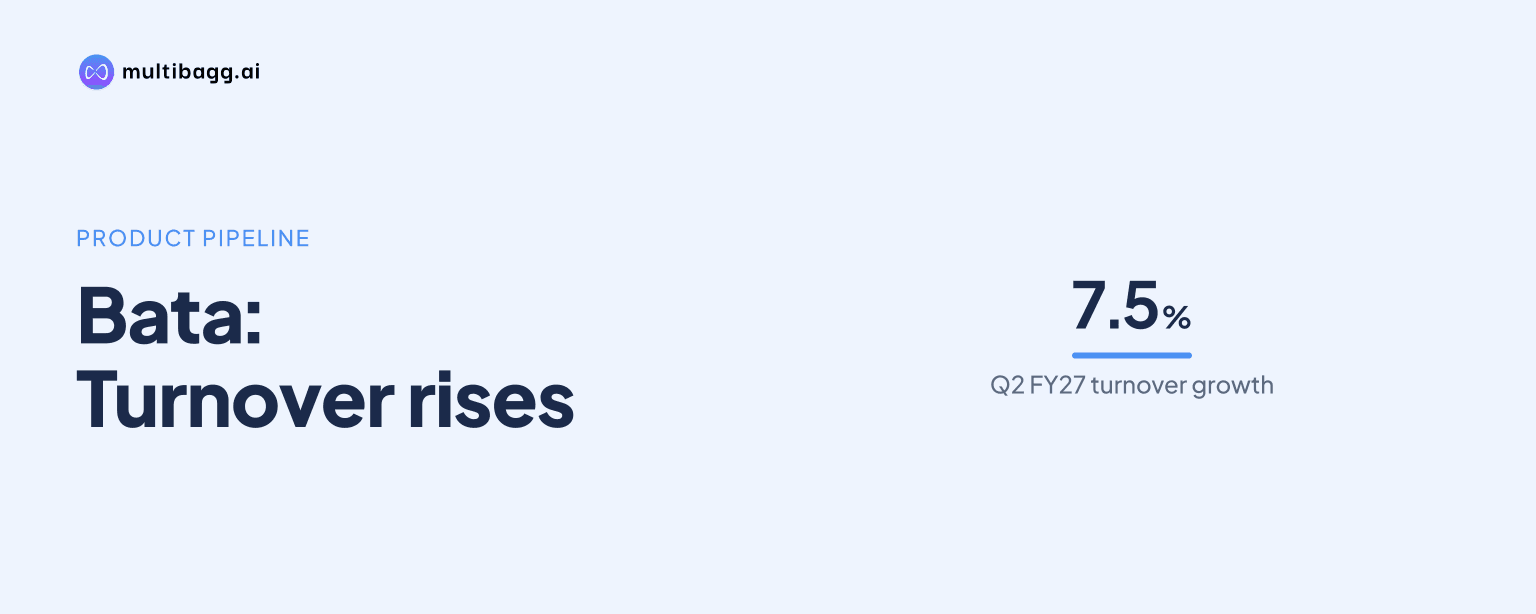
Bata India Limited said global product lines planned largely for the second half of FY27 are intended to address its missed sneakerisation trend and rebuild youth relevance, after turnover increased 7.5% in 2QFY27. Management expects the assortment to support volume and average selling price growth while protecting gross margin.
Know Bata India inside out
Results, valuation, peers and who's buying, in one view.
Why did Bata miss the sneakerisation trend?
Bata said it did not move quickly enough into sneakerisation as consumer preferences shifted, leaving its sneaker contribution below the level management wants. Managing Director and Chief Executive Officer Sanjay Rao described this as a product-line gap rather than evidence that consumers had rejected the brand after products were offered. He said nimbler competitors entered the market while Bata did not respond in an agile way to the trend.
The gap matters because Bata acknowledged that the brand is not always a first choice for younger consumers. Rao, who had spent 72 days in the role by the November 4, 2026 call, said he saw the need to make Bata relevant to every generation. He said global product lines, price points and designs reviewed within the Bata group were intended to align with trends young consumers see through global media.
When will Bata launch its new global products?
Bata expects new product lines to arrive largely in H2 FY27, although management did not provide a precise launch date or disclose the brands, categories or number of products involved. Rao said the products were in the pipeline and that he was confident the assortment would make stores more attractive, including for younger shoppers.
Management framed the launch as part of a broader focus on franchising, premiumisation and casualisation. The immediate emphasis is on Bata and Hush Puppies, the two brands where management said it sees significant traction. Rao said he could provide more detail on sneaker brands with the next quarterly results, leaving the current sneaker sales contribution undisclosed.
Bata expects the H2 FY27 products to help increase volume as well as average selling price, or ASP. That matters because 2QFY27 growth was largely led by ASP rather than unit sales. Management said ASP increased about 5% to 6%, while volume grew only marginally, reflecting higher sales from premium brands including Floatz and Hush Puppies and a greater share of fresh inventory.
What changed in Bata’s 2QFY27 sales performance?
Bata reported 7.5% turnover growth in 2QFY27, its fourth consecutive quarter of positive growth, with positive like-for-like sales growth and positive store footfalls. The company did not disclose an exact like-for-like figure, but said it was in the good single digits. Management also said the festive calendar shifted meaningful buying, including e-commerce events, from 2QFY27 into the third quarter.
The mix of growth changed between price and volume. In 2QFY27, higher price points performed better and made growth largely ASP-led. Management expects e-commerce events in the subsequent quarter to contribute more volume because that channel typically carries lower-ASP products at higher unit volumes. It also said price increases would begin to have a greater effect from the next quarter because Bata generally holds five to six months of inventory.
Availability and store presentation were two operating measures management linked to the improved sales trajectory. Product availability was 1.33 times the prior-year level, while store clutter was 0.71 times the level of two years earlier for the same period. Bata said stock turn exceeded 2.6 times, store freshness was above 90%, and aged inventory was close to 5%.
Got a follow-up? Ask IRIS
How is Bata protecting margins during the product reset?
Bata said it is seeking to protect gross margins through higher sales of fresh inventory, fewer markdowns and calibrated pricing, while remaining cautious because commodity and currency volatility continues. Reported gross margin improved by about 8 to 10 basis points from 1QFY27 to 2QFY27. A basis point is one-hundredth of a percentage point.
Management said a comparable channel mix would have produced gross-margin expansion of about 70 to 80 basis points, but the reported increase was lower because franchise, distribution and e-commerce channels carry lower gross margins. It described each of those businesses as profitable and improving year on year. Bata is expanding franchise stores while retaining selective opportunities for company-owned and company-operated, or COCO, stores.
The channel strategy is intended to extend reach without deliberately cannibalising existing stores. Bata said it was targeting double-digit new-store openings in the coming year, rather than triple-digit additions, and would also relocate stores to commercially better locations and renovate outlets. Management cited double-digit growth in franchise and industrial and distribution channels during the quarter, while e-commerce grew despite deferred orders from selected business-to-business partners.
Can Bata meet its Reignite India 2030 turnover ambition?
Bata’s stated ambition is to double India turnover by 2030, implying management’s aim for mid-single-digit to double-digit growth across the next four years. Management said it is preparing a detailed year-by-year plan, but did not provide annual turnover targets, profit targets or a target margin for FY27. Bata also did not answer an analyst’s question on whether profit could grow faster than turnover over that period.
Rao said the 7.5% growth rate in 2QFY27 represented improving momentum after three preceding quarters of growth, but the longer-term target depends on execution across product, distribution and brand relevance. Management also said it is seeking to use global capabilities, including supply-chain consolidation and product development, following changes in global leadership that began in early 2025.
Bata’s marketing approach is another part of the reset. Advertising spending increased by more than 4% in the first half, alongside higher overall reach and website hits. Rather than committing to a stated advertising-spend ratio, management said it was rightsizing expenditure, prioritising return on investment and community building. Bata cited about 45 million annual store visitors as an existing advantage for rebuilding relevance.
Conclusion
Bata’s strategy reset centres on correcting a missed sneakerisation opportunity with global product lines, while using improved availability, fresher inventory and franchise expansion to sustain sales momentum. The 2QFY27 result showed 7.5% turnover growth, but the mix was primarily higher ASP rather than materially higher volumes, making the H2 FY27 product introduction important to management’s volume-growth case.
The next evidence point is the H2 FY27 rollout of the new product lines and management’s promised future detail on sneaker brands. Investors can also watch whether festive and e-commerce activity shifts growth toward units in 3QFY27, whether the five-to-six-month inventory cycle allows pricing actions to take effect, and how progress fits Bata’s plan to double India turnover by 2030.