










Bata India keeps 2030 turnover target, seeks higher profits
Key highlights
- Bata India retained its ambition to double India turnover by 2030.
- Management said it is internally seeking profit growth above the doubling of turnover.
- Bata India reported 7.5% growth in the latest quarter and its fourth consecutive quarter of positive growth.
- Fresh sales reached an all-time high of about 84% to 85%, according to management.
powered by IRIS
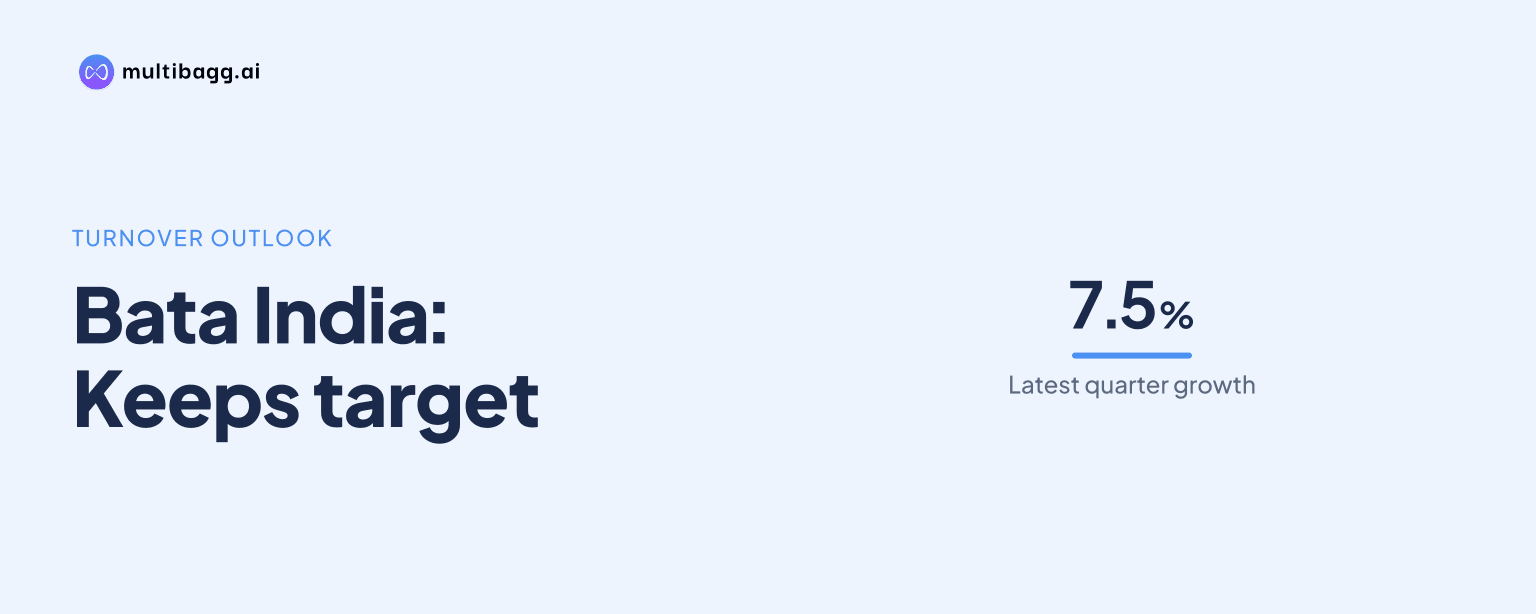
On November 4, 2026, Bata India Limited retained its ambition to double India turnover by 2030 and said it is internally seeking profit growth above that level, after reporting 7.5% growth in the latest quarter discussed. Management did not disclose a numerical 2030 profit target, citing exchange-rate and global-volatility risks.
Know Bata India inside out
Results, valuation, peers and who's buying, in one view.
What is Bata India's 2030 turnover target?
Bata India's stated ambition is to double India turnover by 2030. Management said it is working on a detailed year-by-year plan and described the required path over the next four years as mid-single-digit to double-digit growth, while confirming that the turnover objective has not changed.
The target follows a period that management acknowledged had produced low historical compound annual growth rates, or CAGR. In contrast, Bata India said the latest quarter delivered 7.5% growth and marked its fourth consecutive quarter of positive growth, with like-for-like, or LFL, growth as a principal contributor.
Management described the mid-teens figure as an endeavour, not formal financial guidance. Amit Aggarwal said the direction reflected the potential management sees in the Indian market, while Sanjay Rao linked the 2030 objective to improving Bata India's relevance across consumer groups.
Does Bata India expect profit to grow faster than turnover?
Bata India said it is internally looking for profit growth above the doubling of turnover, but it has not issued a numerical earnings forecast. Asked whether profit would merely double or exceed the turnover target, Rao said management was looking at something higher so that the business could continue funding investments and growth.
Management's minimum position was that profit should at least double alongside the doubling of turnover by 2030. Rao said Bata India would be able to provide better guidance over time, while identifying exchange rates and global volatility as external factors that limit predictability across the four-year period.
This is an aspiration for sustainable and profitable growth rather than a disclosed margin, profit-after-tax or annual earnings target. The November 4 transcript provides no base-year turnover, profit figure, profit margin or annual profit-growth schedule, so it does not support calculating a 2030 profit amount.
What could drive Bata India's turnover growth?
Bata India is relying on new products, higher average selling prices, or ASP, and broader channel reach to pursue its 2030 target. Rao said the business had not moved with enough agility as the market shifted toward sneakerization, describing the gap as internally addressable because Bata India lacked the required product line.
Management expects new product lines to arrive largely in the second half of FY27, or H2 FY27, and said these products should improve appeal to younger consumers. Bata India identified Bata and Hush Puppies as two brands showing significant traction, while saying sneaker contribution remains below the level management wants.
Fresh inventory is another operating lever cited by management. Fresh sales had reached an all-time high of about 84% to 85%, and Aggarwal said selling newer inventory with fewer markdowns was helping gross margin. Fewer markdowns can improve the profitability of sales without relying solely on price increases.
Management also expects a festival-calendar shift to influence volume trends. It said e-commerce events and a significant share of festive demand had shifted into the third quarter, while e-commerce usually carries lower-ASP products and higher volumes; this was why management expected volume gains to become clearer in the subsequent quarter.
Got a follow-up? Ask IRIS
How do stores and channels support Bata India's plan?
Bata India is putting greater emphasis on franchise expansion while selectively pursuing company-operated store opportunities. Rao said the company expects double-digit, rather than triple-digit, new store openings in the coming year, targeting locations with consumer traction where it lacks a presence.
Management said it does not intend to cannibalise existing stores. The store programme includes opportunistic openings, relocations to commercially better sites and renovations, while Bata India continues to support its existing company store network and places more emphasis on franchisees.
Channel mix may support overall profitability even where it reduces reported gross margin. Management said distribution, e-commerce and franchise operations carry lower gross margins than other channels, but that all three are profitable and are improving their profitability year on year.
In the latest quarter, reported gross margin improved by about 8 to 10 basis points, where one basis point equals one-hundredth of a percentage point. Management said gross-margin expansion on a comparable channel mix would have been about 70 to 80 basis points, but higher contribution from lower-gross-margin distribution, e-commerce and franchise channels diluted the reported result.
What risks could affect Bata India's 2030 target?
Commodity and currency volatility are the main risks management identified for margins and the 2030 plan. Aggarwal said Bata India remained cautious on gross-margin expansion because both factors remained volatile, even as the company reduced inefficiencies, sold fresh inventory and used calibrated price increases where appropriate.
Rao separately identified exchange rates and global volatility as external constraints outside Bata India's direct control. He said Bata India largely manufactures in India and caters to India, but management did not quantify the potential effect of those risks on turnover, sourcing costs, profits or the 2030 timetable.
Management expects ASP to provide support, but said margins would remain range-bound because channel mix can create slight changes. Franchise expansion may improve profitability at the business level, according to management, yet the associated sales mix may continue to limit the gross-margin improvement visible in reported results.
Conclusion
Bata India has retained a clear 2030 direction: double India turnover and seek profit growth above that level. The 7.5% latest-quarter growth, four consecutive quarters of positive growth and fresh-sales level of about 84% to 85% are the operating evidence management cited, rather than a new quantified profit forecast.
The next developments to watch are the H2 FY27 rollout of new product lines, including products aimed at younger consumers, and double-digit store openings planned for the coming year. Management also needs to show whether lower markdowns, calibrated pricing and channel expansion can manage commodity, currency and global-volatility pressures while keeping margins range-bound.