










Beardsell Q2 FY27 Profit Rises 138% as Karad Capex Is Approved
Key highlights
- Beardsell reported Q2 FY27 consolidated revenue of ₹79.68 crore, up 12.2% year on year.
- Q2 FY27 consolidated net profit rose 138.0% year on year to ₹4.88 crore.
- Operating margin improved to 11.1% in Q2 FY27 from 8.4% a year earlier.
- Beardsell approved ₹24 crore to add 600,000 square metres of annual Karad capacity by March 31, 2027.
powered by IRIS
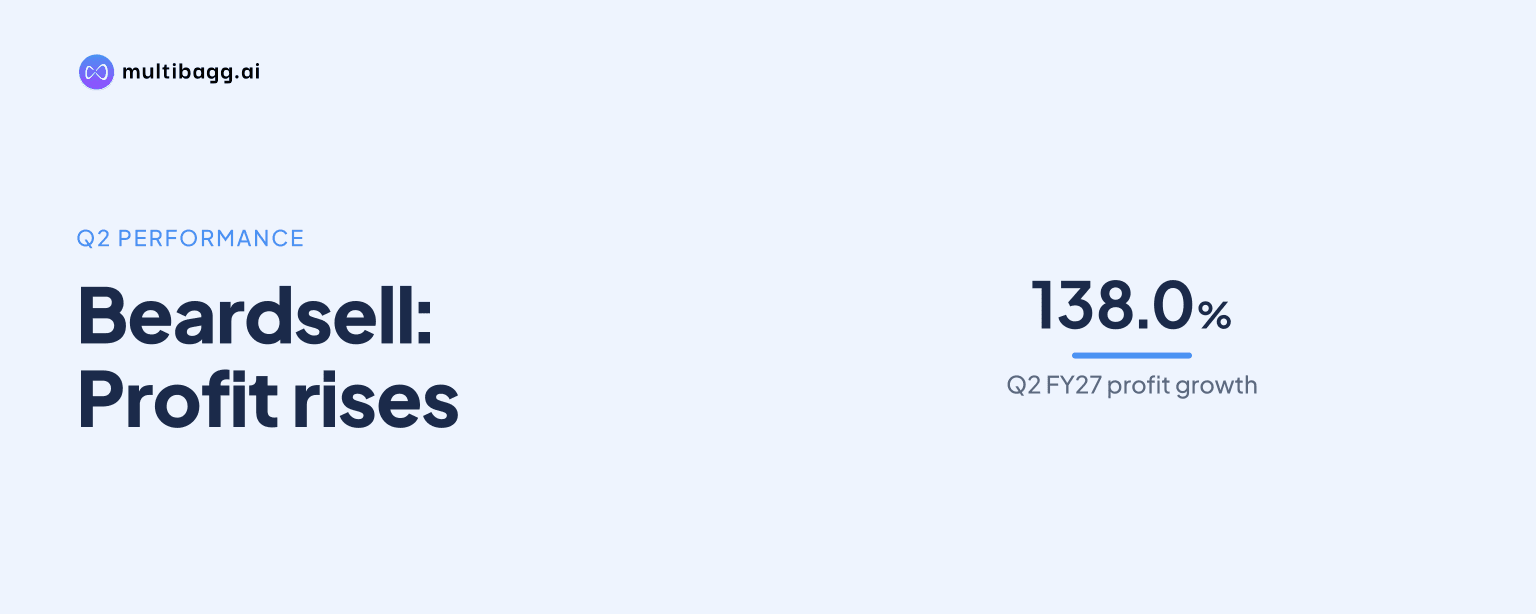
Beardsell Limited reported Q2 FY27 consolidated net profit of ₹4.88 crore, up 138.0% year on year, while its board approved a ₹24 crore modernisation and expansion project at its Karad factory in Maharashtra. The project is scheduled to add 600,000 square metres of annual capacity by March 31, 2027.
Know Beardsell inside out
Results, valuation, peers and who's buying, in one view.
What did Beardsell report for Q2 FY27?
Beardsell reported consolidated revenue from operations of ₹79.68 crore for the quarter ended September 30, 2026, compared with ₹71.01 crore in Q2 FY26. Revenue increased 12.2% year on year and 10.4% sequentially from ₹72 crore in Q1 FY27.
Net profit rose to ₹4.88 crore from ₹2.05 crore a year earlier. The reported year-on-year increase was 138.0%, while profit was also higher than the ₹2 crore reported in the preceding quarter. Basic earnings per share increased to ₹1.24 from ₹0.52 in Q2 FY26.
Operating performance improved faster than revenue during the quarter. Operating profit, measured as EBITDA, was reported at about ₹9 crore, against about ₹6 crore a year earlier. The operating margin expanded to 11.1% from 8.4%, an improvement of 2.7 percentage points.
Profit before tax was ₹7 crore, compared with ₹4 crore in Q2 FY26. The company also reported a sharp sequential improvement, with profit before tax rising from ₹2 crore in Q1 FY27. These results indicate that the margin improvement contributed materially to the increase in quarterly profit.
What has Beardsell approved at the Karad factory?
Beardsell has approved the modernisation and expansion of its manufacturing facility at Karad, Maharashtra, with an estimated capital expenditure of ₹24 crore. The company plans to fund the project through a combination of debt and internal accruals.
The Karad facility currently has annual production capacity of around 240,000 square metres and was operating at 50% peak utilisation, according to the disclosed proposal. The approved project will add 600,000 square metres of annual capacity using a modern machine.
The additional capacity is targeted for completion by March 31, 2027. The disclosed rationale is to meet increasing demand, improve production efficiency and benefit from operational economies of scale. The filing does not provide a revenue contribution estimate, expected utilisation level after commissioning, or a detailed project-wise financing break-up.
The scale of the planned addition is notable relative to the existing Karad capacity. The proposed incremental capacity of 600,000 square metres a year is 2.5 times the current 240,000 square metres annual capacity. Actual financial benefits will depend on commissioning, demand conditions and the ramp-up of production.
Why does the Karad capacity plan matter?
The Karad project matters because it combines a substantial capacity addition with equipment modernisation. Capacity expansion can support higher volumes, while newer machinery may improve production efficiency if the project is delivered within the stated timeline and cost estimate.
The current 50% peak utilisation at the existing plant provides important context. Beardsell has stated that the investment is intended to meet increasing demand, but the available disclosure does not state whether existing capacity is constrained across all products, customer segments or operating periods.
The approved expenditure also follows a quarter in which revenue and profitability increased year on year. Revenue grew by ₹8.67 crore from Q2 FY26, while net profit increased by ₹2.83 crore. The improvement in operating margin from 8.4% to 11.1% was a key element of the earnings performance.
For investors, the expansion creates a clear capital-allocation item to track through March 2027. The company has disclosed the overall capex amount and funding sources, but has not disclosed a phased spending schedule or a separate debt amount for the project.
Got a follow-up? Ask IRIS
What do the half-year figures and cash flow indicate?
Beardsell reported consolidated revenue of ₹35.14 crore for the half year ended September 30, 2026, compared with ₹25.69 crore in the corresponding prior-year period. Consolidated profit after tax for the half year was ₹6.54 crore, compared with ₹5.28 crore a year earlier.
The company reported negative cash from operations of ₹0.03 crore for the consolidated half year. Separately, the standalone disclosure stated net cash used in operations of ₹0.58 crore for the half year, while standalone profit before tax was ₹8.79 crore.
Cash generation is relevant because the Karad project will be financed partly through debt and partly through internal accruals. Negative operating cash flow in the disclosed period does not by itself determine the project’s financing outcome, but it makes future cash conversion, working-capital movement and borrowing levels important metrics to monitor.
The financial statements for the September 30, 2026 period received unmodified limited-review opinions. The consolidated numbers include subsidiary Sarovar Insulation Pvt Ltd and controlled entity Saideep Polytherm, as stated in the company’s disclosure.
How could the results and expansion affect investors?
Beardsell’s quarterly numbers show higher revenue, stronger operating margin and a more than doubling of net profit from Q2 FY26. The combination of 12.2% revenue growth and 138.0% net-profit growth indicates that the quarter’s earnings growth was supported by improved profitability as well as higher sales.
The ₹24 crore Karad investment introduces execution and financing considerations. Debt funding can increase financial obligations, while internal funding depends on the company’s ability to generate and retain cash. The source material does not provide debt levels, interest-cost guidance, projected returns or any share-price movement linked to the announcement.
The expansion could alter Beardsell’s operating capacity after it is completed, but the company has not provided a forecast for revenue, profit, utilisation or market share following commissioning. As a result, the disclosed facts support tracking project progress and cash flow rather than drawing conclusions on future earnings.
Conclusion
Beardsell delivered stronger Q2 FY27 financial performance, with consolidated revenue of ₹79.68 crore, EBITDA margin of 11.1% and net profit of ₹4.88 crore. Alongside the earnings improvement, the board approved ₹24 crore for the Karad modernisation and expansion project, which is designed to add 600,000 square metres of annual capacity.
The next disclosed milestone is the targeted completion of the additional Karad capacity by March 31, 2027. Investors can monitor the timing of capex spending, use of debt and internal accruals, operating cash flow, and progress in plant commissioning as the project moves forward.