










Jainik Power Cables H1 FY27 Profit Rises 17.4% to ₹7.24 Crore
Key highlights
- Jainik Power Cables reported H1 FY27 net profit of ₹7.24 crore, up 17.4% year on year.
- H1 FY27 revenue from operations declined 7.7% to ₹170.36 crore.
- Net margin widened to 4.25% from 3.34% in H1 FY26.
- The company allotted 30 lakh warrants at ₹151.50 each, representing potential proceeds of ₹45.45 crore.
powered by IRIS
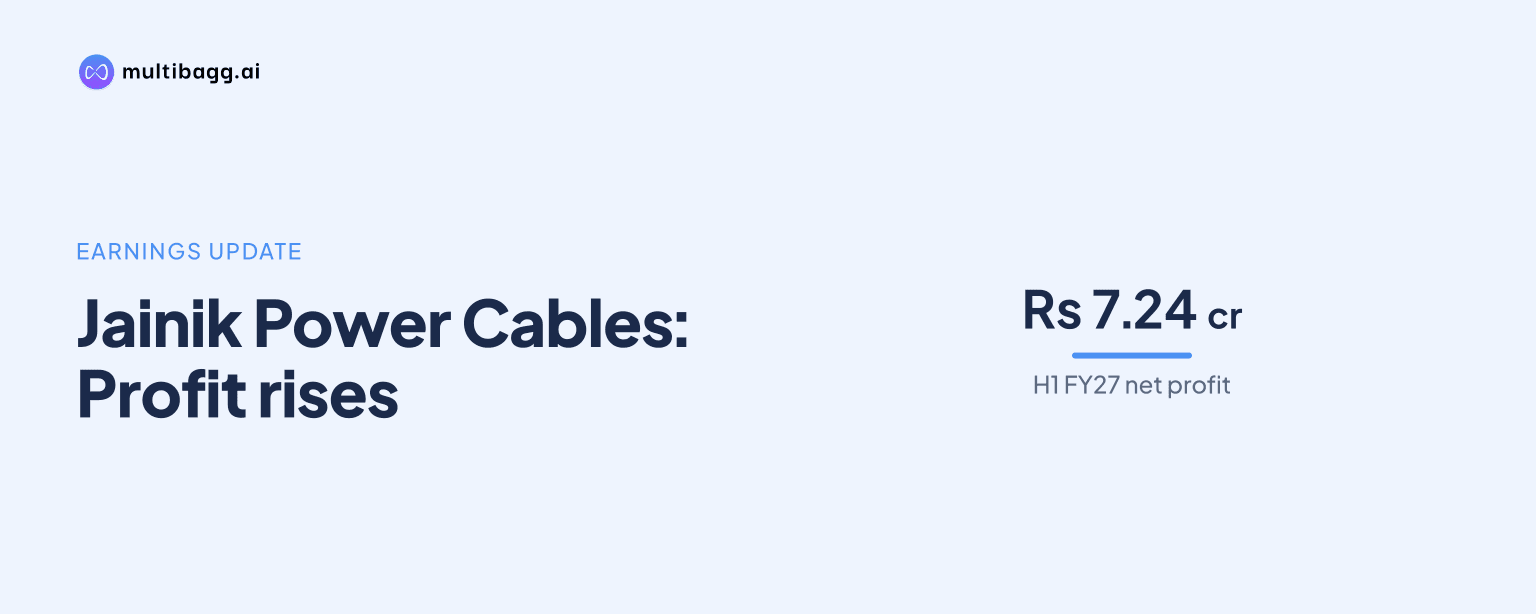
Jainik Power Cables Limited reported H1 FY27 net profit of ₹7.24 crore, up 17.4% year on year, even as revenue from operations fell 7.7% to ₹170.36 crore for the half year ended 30 September 2026. The improvement was reflected in a net margin of 4.25%, compared with 3.34% a year earlier.
Know Jainik Power Cables inside out
Results, valuation, peers and who's buying, in one view.
What did Jainik Power Cables report for H1 FY27?
Jainik Power Cables reported a profit after tax of ₹7.24 crore for H1 FY27, against ₹6.17 crore in H1 FY26. Revenue from operations declined to ₹170.36 crore from ₹184.58 crore in the corresponding half of the previous financial year.
The Sonipat-based manufacturer produces aluminium wire rods, conductors and power cables. Its board approved the unaudited standalone financial results on 14 November 2026, and the company filed the results with the National Stock Exchange on the same day.
Profit before tax rose to ₹9.69 crore from ₹8.24 crore despite the fall in revenue. Other income increased to ₹0.93 crore from ₹0.37 crore, while the reported net margin expanded by 91 basis points to 4.25%.
The half-year revenue was also below the ₹208.91 crore reported in H2 FY26. This comparison indicates that the company entered FY27 with a lower sales run rate than it recorded in the second half of the previous year.
Why did profit rise despite lower revenue?
Profit rose because lower material costs and higher other income more than offset the decline in revenue and increases in depreciation and finance costs. Cost of material consumed fell to ₹165.00 crore from ₹177.88 crore, a reduction of ₹12.88 crore from the year-earlier period.
The reduction in material cost was larger than the ₹14.22 crore decline in revenue on an absolute basis, helping preserve profitability. The company’s reported operating margin was 5.7% in H1 FY27, compared with 4.4% in H1 FY26, according to the results summary.
Some costs increased during the period. Depreciation and amortisation rose to ₹1.59 crore from ₹0.49 crore, while finance cost increased to ₹0.87 crore from ₹0.57 crore. These movements are relevant because they partly moderated the benefit from the improvement in material costs.
The results statement does not provide a detailed management explanation for the sales decline or the change in cost structure. Therefore, the reported numbers establish margin expansion during the half year but do not independently confirm whether the trend will continue.
Got a follow-up? Ask IRIS
What do the results show about Jainik Power Cables' operations?
The results show that Jainik Power Cables improved profitability per rupee of revenue during H1 FY27, while its sales remained below both the year-earlier half and H2 FY26. The company operates in the aluminium wire rod, conductor and power-cable segments, which are linked to demand from power-sector and infrastructure activity.
For FY26, Jainik Power Cables reported revenue of ₹393.48 crore and net profit of ₹14.02 crore. H1 FY27 revenue of ₹170.36 crore represents less than half of the previous full-year revenue, while H1 profit of ₹7.24 crore is slightly above half of FY26 profit.
The company also reported that fixed assets rose to ₹20.07 crore as of September 2026, compared with ₹6.81 crore in March 2026, following commissioning of new capacity. Higher depreciation in the H1 results is consistent with a larger fixed-asset base, although the results do not specify the revenue contribution from the commissioned capacity.
At the same time, working-capital requirements increased. Receivables stood at ₹102.32 crore as of September 2026, compared with ₹57.52 crore at March 2026, while short-term borrowings were ₹40.63 crore compared with ₹5.85 crore. These balance-sheet movements are material for investors assessing cash conversion and financing needs.
How is Jainik Power Cables funding working capital and capacity?
Jainik Power Cables has raised part of its planned preferential capital through convertible warrants and reported using the funds received for working capital and corporate purposes. The company allotted 30 lakh convertible warrants at ₹151.50 each, representing a total potential issue size of ₹45.45 crore.
As of 30 September 2026, the company had received ₹11.36 crore from the warrant allotment and said the amount had been fully utilised for working capital and corporate purposes. The balance amount, if received upon conversion under the warrant terms, would add further equity capital, but conversion is not stated as completed in the provided results information.
The combination of higher receivables, inventory of ₹36.40 crore versus ₹31.35 crore in March 2026, and greater short-term borrowing points to a more demanding working-capital cycle. The warrant proceeds provide one identified funding source, while the reported short-term debt increase shows that borrowings were also used during the period.
For shareholders, the warrants have two separate implications. They provide a potential source of capital for operations and investment, but their eventual conversion would increase the number of shares outstanding. The company’s H1 FY27 earnings per share was ₹5.05, compared with ₹4.98 in H1 FY26.
Conclusion
Jainik Power Cables delivered higher H1 FY27 profit despite lower revenue, supported by a reduction in material costs, higher other income and wider margins. Profit before tax rose to ₹9.69 crore and net profit reached ₹7.24 crore, while the company also recorded increased depreciation, finance costs and working-capital funding needs.
Investors will next watch whether revenue recovers from the ₹170.36 crore recorded in the first half, whether receivables and short-term borrowings moderate, and how the company progresses with the remaining potential proceeds from its ₹45.45 crore convertible-warrant issue.