










BEL targets larger drone orders after start-up partnerships
Key highlights
- BEL is working closely with six to eight start-ups on drone technologies.
- BEL said its drone orders this year are in the Rs 50 crore to Rs 100 crore range.
- Management hopes to receive at least one or two bigger drone orders next year.
- BEL has supplied high-end counter-drone systems for three to four years and reported foreign leads after demonstrations.
powered by IRIS
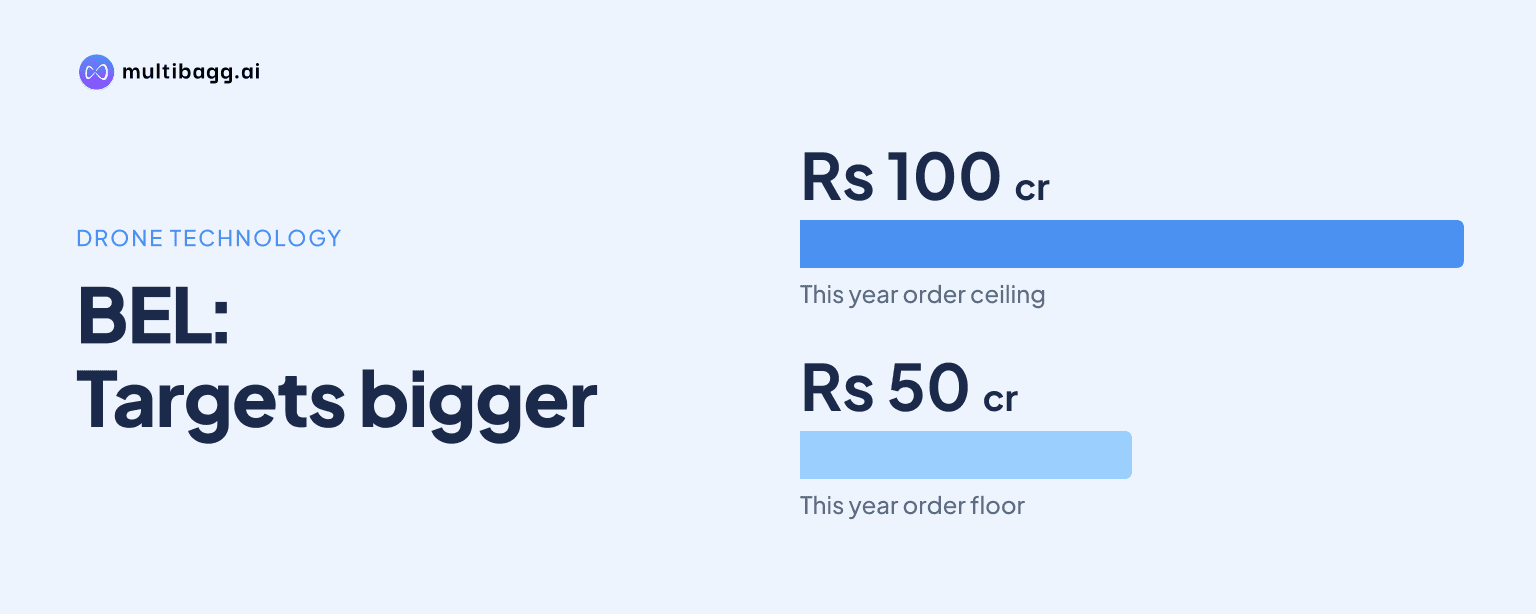
Bharat Electronics Limited said it is targeting one or two larger drone orders next year after winning drone contracts in the Rs 50 crore to Rs 100 crore range this year and building ties with six to eight start-ups. BEL also said completed counter-drone demonstrations have produced export leads from foreign countries.
Know Bharat Electronics inside out
Results, valuation, peers and who's buying, in one view.
How large are BEL's current drone orders and prospective awards?
BEL said the drone orders it has received this year are in the Rs 50 crore to Rs 100 crore range, while management hopes to secure at least one or two bigger orders next year. The company has started bidding for drone programmes, but it did not disclose the aggregate value, customers, product mix or delivery schedules of the orders already won.
Management contrasted the current contracts with a one- to two-year time frame for larger opportunities. It said the Rs 50 crore to Rs 100 crore range was not large enough to warrant detailed discussion on the investor call, but cited six to eight major leads and tie-ups with start-ups as the basis for its expectation of bigger awards. The source does not quantify the value of those prospective contracts.
The opportunity covers several applications rather than a single announced procurement programme. Management referred to surveillance drones, kamikaze drones, logistics drones, drone-catching drones and drone-versus-drone systems, as well as drones with ranges above 1,000 kilometres and 2,000 kilometres. This range means the potential order flow depends on separate requirements across multiple missions.
BEL said demand includes hundreds of drone use cases, with different systems needed for different operational purposes. Its stated approach is to develop reliable solutions that can operate in forward areas and jamming environments, rather than solely market early-stage drone technology. The company did not provide a drone revenue target or a value for its addressable opportunity.
Which drone partnerships is BEL building?
BEL is working closely with six to eight start-ups while also pursuing in-house drone programmes. Management said the start-ups have developed good initial technologies, but those technologies need dependable supply chains, hardening and operational robustness before they can be used in demanding deployment environments.
The partnerships therefore extend beyond sourcing products from start-ups. BEL said it is working to make drone systems reliable and trustworthy, including for forward-area and jamming-area conditions. That process combines start-up technology with BEL's own programmes, although management did not state how development responsibilities or commercial economics are divided among the partners.
The difference between present orders and the larger opportunities management expects is material. Current drone wins are in the Rs 50 crore to Rs 100 crore range, whereas the hoped-for orders next year have no disclosed value. Management's confidence rests on its six to eight leads and tie-ups, but those relationships have not yet been identified as signed larger contracts.
BEL also acknowledged substantial participation by private companies and start-ups in the drone market. Management said there is room for multiple companies because requirements differ across surveillance, logistics, long-range and other applications. Its competitive plan is to bid with systems strengthened by supply-chain development and hardening, rather than claim an exclusive position in any drone category.
Got a follow-up? Ask IRIS
What is BEL doing in counter-drone systems and exports?
BEL said it has established itself as a supplier of high-end counter-drone systems over the past three to four years and has generated foreign leads after successful demonstrations. Management said development and trials of its counter-drone solutions had been completed, but it did not name the countries, values, prospective customers or expected timing of any export order.
The counter-drone offering includes hard-kill options, meaning systems intended to physically defeat a drone. BEL said it is adding microwave directed-energy weapon capability, or DEW, through its own in-house efforts and work involving the Defence Research and Development Organisation, or DRDO. Management presented the DEW addition as an expansion of its hard-kill capability.
Management described its demonstrated solutions as unique at a global level and cost-effective, which are management assessments rather than disclosed commercial outcomes. The reported facts are that demonstrations and trials were concluded and that they produced leads from some foreign countries. The source does not say whether those leads have moved to formal bids, negotiations or contracts.
Counter-drone has a more established operating history than BEL's disclosed drone order base. The company said it has supplied high-end counter-drone systems for three to four years, while its drone activity has produced a few current-year orders in the Rs 50 crore to Rs 100 crore range. However, neither business has a disclosed revenue target, and no counter-drone export order was announced.
Why are drones and counter-drones priorities for BEL?
BEL ranks drones and counter-drones as its second most focused area after missiles, arms and ammunition. Management linked this focus to demand for drones, counter-drones and missiles, while noting that many private-sector companies and start-ups are active in drone products.
The business strategy combines product development with commercial conversion. BEL is working with six to eight start-ups, developing systems in-house, making products robust for operational conditions and bidding for contracts. On the counter-drone side, it is seeking to turn completed foreign demonstrations into export orders and to add microwave DEW capability through its work with DRDO.
Management also said BEL may launch a few products during a research and development-related event. It did not identify the products, give an event date or state whether the launches would relate to drones, counter-drones or another defence segment. That leaves the product roadmap and its commercial contribution undisclosed.
The company has identified drone and counter-drone as focused businesses, but the maturity of the two activities differs. Drone partnerships have produced initial contracts in the Rs 50 crore to Rs 100 crore range and management expects bigger awards next year. Counter-drone systems have been supplied for three to four years and have reached overseas demonstration and trial stages, but export conversion remains unresolved.
Conclusion
BEL's disclosed drone business has moved from development into bidding and initial order wins, with contracts in the Rs 50 crore to Rs 100 crore range. Its next growth step depends on converting six to eight start-up relationships and associated leads into one or two larger orders. In parallel, its counter-drone activity has a longer supply record and foreign leads following demonstrations, but no announced export contract.
The next developments to watch are whether BEL receives the larger drone orders management hopes to secure next year, whether counter-drone leads produce export orders, and what products it may launch at its research and development-related event. Management has not disclosed potential order values, customers, delivery periods or a drone and counter-drone revenue target.