










BEL says QRSAM readiness can speed post-award execution
Key highlights
- BEL expects a Rs 30,000 crore QRSAM order, but did not disclose a signed award.
- More than 200 MSME partners could receive roughly 70% of QRSAM work.
- BEL said partners have invested in QT and FOPM preparation before order award.
- BEL reported 26% revenue growth and is seeking to advance deliveries by 1 or 2 months.
powered by IRIS
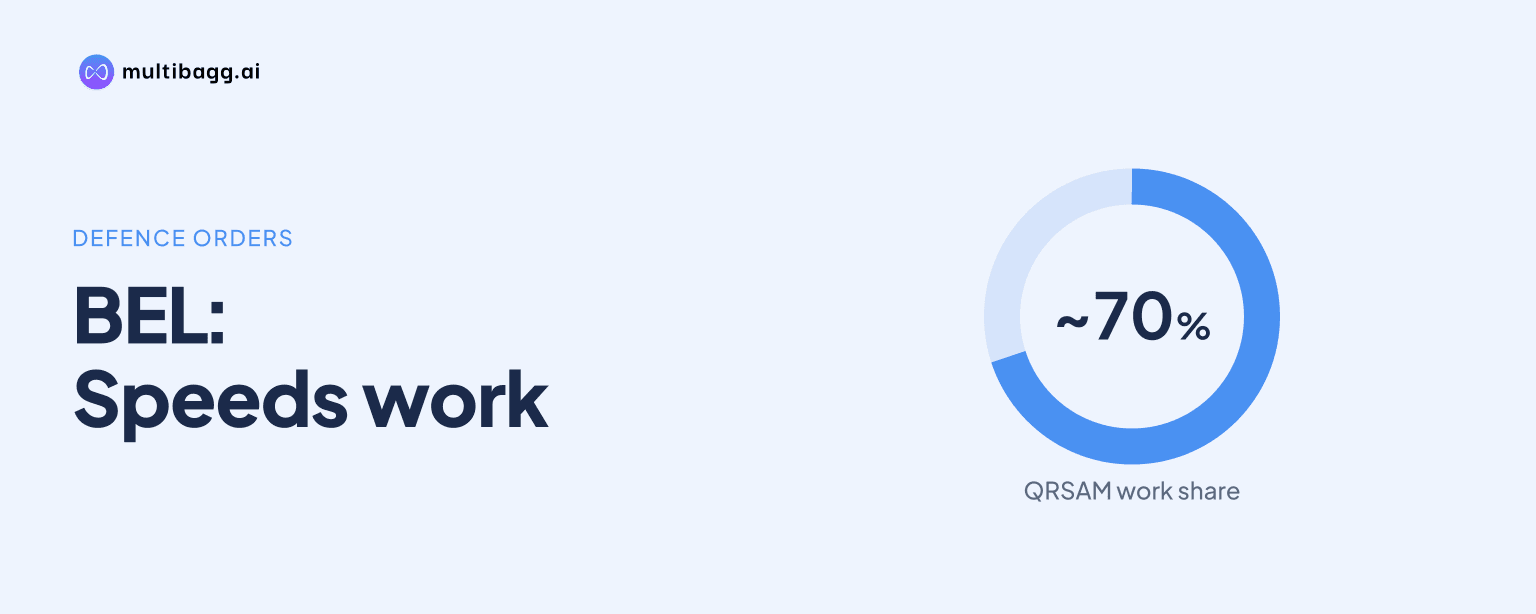
BEL says advance qualification and first-of-production-model work could help it execute the expected Rs 30,000 crore QRSAM order faster after award, despite a contracting delay. Management said more than 200 micro, small and medium enterprises, or MSMEs, could receive roughly 70% of the work and have already made investments for production readiness.
Know Bharat Electronics inside out
Results, valuation, peers and who's buying, in one view.
How will BEL execute the QRSAM order?
BEL expects to distribute roughly 70% of the anticipated Rs 30,000 crore Quick Reaction Surface to Air Missile, or QRSAM, order among more than 200 MSME partners. Management said the programme includes support from public-sector suppliers, larger private companies such as L&T, and smaller MSME vendors, describing the arrangement as a public-private partnership model.
The stated allocation indicates that suppliers would undertake a majority of the programme’s work by value if the order is awarded at the expected Rs 30,000 crore level. BEL did not disclose the work packages assigned to individual partners, the share for larger private suppliers, the components to be made internally, or an annual production schedule for QRSAM.
BEL said supplier participation is not limited to activity after contract award. Management stated that its partners, including the more than 200 expected MSMEs, have made reasonably good investments on their own side. That preparation is intended to support the first-of-production-model, or FOPM, realisation ahead of time rather than wait for every production activity to begin after the order is placed.
What preparation has BEL completed before award?
BEL said it has taken advance action on qualification work, referred to as QT, and on FOPM realisation with its supply-chain partners. Management identified this advance work as the main mechanism for offsetting a delay of a few months in receipt of the QRSAM order, although it did not quantify BEL’s investment, supplier investment, or the time that could be saved.
The company said FOPM means first-of-production-model realisation, and that partners are investing to complete this stage ahead of time. Management did not state whether a FOPM has already been completed, how many units are involved, or when serial production could begin. Its position was that prior qualification and production-model work should reduce the gap between award and execution.
This readiness plan sits alongside BEL’s wider delivery programme. Management said it has started tracking an on-time delivery score and is attempting to bring committed deliveries forward by 1 or 2 months. BEL’s stated aim is to bring its execution track record close to 100% as early as possible, but it did not disclose the current score or a target date for reaching that level.
Got a follow-up? Ask IRIS
Why does BEL expect faster execution after the order?
BEL attributes its execution approach to faster delivery action and an effort to make output more uniform across quarters, after reporting 26% revenue growth despite what an analyst described as a tough base. Management said it wants to avoid concentrating output in the final quarter and instead produce more evenly during the year.
The company said it is seeking to move delivery commitments 1 or 2 months earlier, rather than allowing them to slip beyond the original dates. For QRSAM, management’s expectation is that advance QT and FOPM action will help prevent the order-acquisition delay from becoming an equivalent production delay. It did not provide a first-delivery date, revenue-recognition schedule, or completion timeline for the programme.
BEL contrasted the QRSAM delay with its broader backlog and order prospects. Management said it had an order book of more than Rs 68,000 crore and hoped to receive more than Rs 55,000 crore of orders before the financial year-end. It said the focus is on executing available orders as much as possible, rather than deferring production activity while awaiting large new awards.
The 26% revenue-growth reference and the more than Rs 68,000 crore order book show that management is linking QRSAM readiness to an existing push for steadier execution. However, BEL has not disclosed a separate QRSAM production capacity, the likely annual value of deliveries, or the extent to which QRSAM would overlap with other programmes in its factories and supply chain.
What is delaying the QRSAM award and could its value change?
BEL said the QRSAM delay reflects the size and complexity of the project documentation, not a newly identified manufacturing issue. Management said it had been highly optimistic about an award by March in the prior year, but internally recognised in January and February that the process could spill over and that August or September was the minimum likely timing.
Management said large orders require decision-makers to consider projects individually and remained hopeful of a positive surprise in the next years. It did not name the approving authority, provide a decision date, or say that the order was assured. The transcript does not state that a formal sanction has been issued or that BEL has received a signed QRSAM contract.
BEL is still expecting an order of Rs 30,000 crore. When asked whether the order could increase because the Rs 30,000 crore figure had been discussed more than a year earlier, management said government processes generally do not provide escalation for delays of 1 to 1.5 years.
Management said that, if cleared, perhaps 6 months of escalation would be positive news, but it is not building that into its stated expectation. The Rs 30,000 crore figure therefore remains management’s expected order value, rather than a revised contract amount. The unresolved issues are the award date, final value and any escalation decision.
Conclusion
BEL’s disclosed QRSAM execution model combines an expected Rs 30,000 crore order, more than 200 MSME partners and a roughly 70% supplier work share with advance QT and FOPM activity. Management is arguing that supplier investment and earlier production preparation can compress the post-award execution period, while its broader delivery programme seeks more even quarterly output and commitments advanced by 1 or 2 months.
The next development to watch is whether the QRSAM order is approved at the Rs 30,000 crore value and whether any escalation is granted. After an award, the operational test will be whether BEL converts the disclosed QT and FOPM preparation into deliveries consistent with management’s aim of moving commitments forward and bringing its execution track record close to 100% as early as possible.