










BEL says current seeker capacity exceeds 1,000 units annually
Key highlights
- BEL said combined RF and IR seeker capacity exceeds 1,000 units a year.
- Management said BEL can scale seeker capacity two-to-threefold if demand requires it.
- BEL said seekers typically account for 20% to 30% of a missile’s cost.
- BEL said it works on Akash, Astra and other seeker programmes, but not BrahMos currently.
powered by IRIS
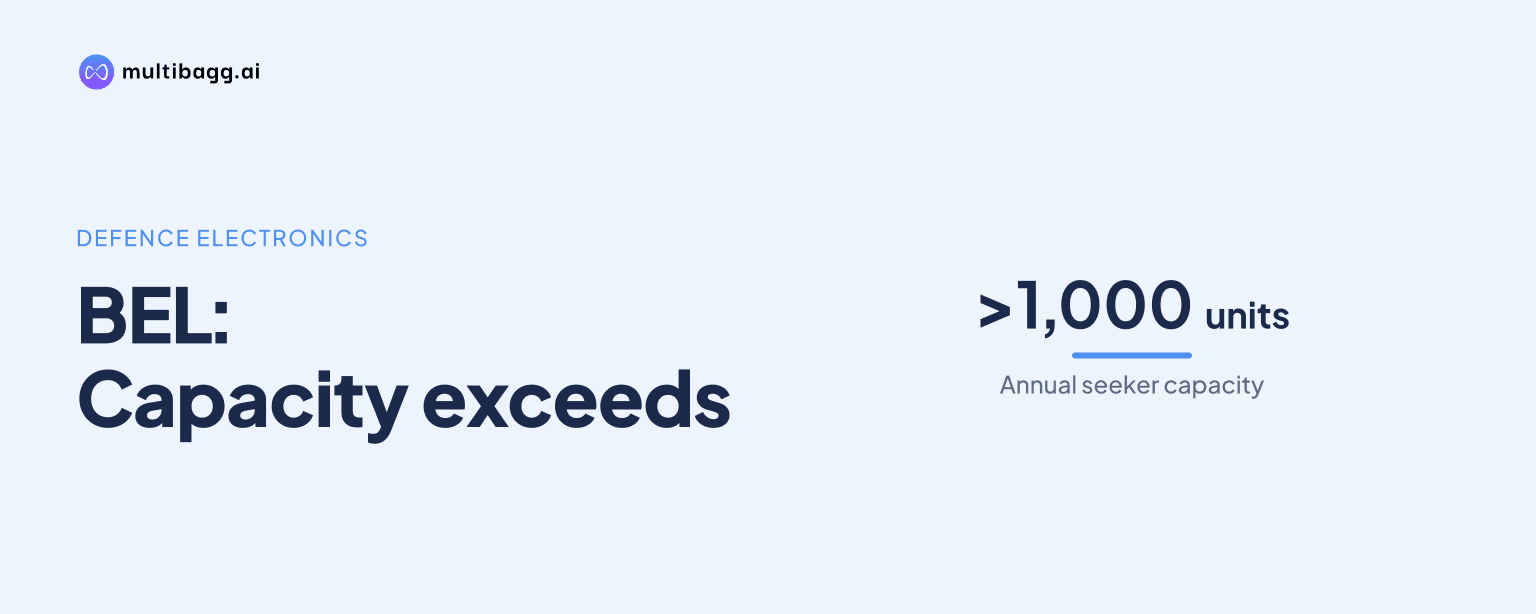
Bharat Electronics Limited said its current combined capacity for radio-frequency and infrared missile seekers exceeds 1,000 units annually and can scale two-to-threefold if demand requires. BEL said its existing radar and infrared-sensor infrastructure can be converted quickly for seeker production, while seekers typically represent 20% to 30% of missile cost.
Know Bharat Electronics inside out
Results, valuation, peers and who's buying, in one view.
What seeker capacity does BEL have today?
BEL can currently manufacture more than 1,000 combined radio-frequency, or RF, and infrared, or IR, seekers a year. Chairman and Managing Director Manoj Jain described this as capacity that BEL can deliver “easily” now, rather than a future target contingent on a new production line or a new factory.
Management said capacity could be scaled two-to-threefold if requirements increase. BEL did not disclose a time frame, capital-expenditure amount, split between RF and IR output, or programme-specific allocation for such an expansion. The statement is therefore a manufacturing-readiness assessment rather than an order forecast or sales guidance.
BEL linked this flexibility to technology and equipment already used in adjoining electronics categories. Jain said an RF seeker is technically similar to a radar, while an IR seeker is comparable to an IR camera. Management said its large infrastructure base for radars and IR-based sensors can be converted quickly to seeker requirements.
How could BEL scale seeker output two-to-threefold?
BEL said it sees no infrastructure bottleneck for either RF or IR seeker programmes at the current level of more than 1,000 units a year. Its stated ability to scale rests on radar-related capabilities for RF seekers and IR-sensor capabilities for IR seekers, rather than on a disclosed plan to build a separate high-volume seeker facility.
The company’s IR manufacturing base includes a new factory at Nimmaluru, near Machilipatnam. Management described the site as having Industry 4.0-compliant infrastructure for IR seeker manufacturing, but did not state its standalone capacity, investment cost, commissioning date or share of BEL’s combined seeker capacity.
The broader electro-optical and infrared, or EOIR, supply chain still includes one unresolved technology area. BEL said it has strength in signal processing and optics, but that the detector is not fully under its control. Management said progress has been made on the basic detector and that it is addressing the challenge jointly with the Defence Research and Development Organisation, or DRDO.
Got a follow-up? Ask IRIS
Which missile seeker programmes does BEL serve?
BEL said it works on seeker programmes for Akash, Astra and other missiles, but does not currently supply the seeker for BrahMos. This distinction limits the disclosed scope of its existing missile-seeker work, even as management said BEL understands the technology relevant to a BrahMos seeker.
Management said it had proactively started developing the BrahMos-related seeker because seeker designs differ by frequency band, size and specifications across programmes. BEL did not disclose the development stage, a production timeline, order value or expected volumes for its work related to BrahMos.
BEL operates across the two main seeker categories, RF and IR. For anti-tank guided missiles, or ATGMs, Jain said IR seekers are typically used. He said BEL has developed substantial IR seeker design capability, although its first IR seekers were based on DRDO designs.
BEL described its seeker role as covering three formats: DRDO-designed seekers, DRDO-designed seekers upgraded by BEL, and BEL’s own seeker designs. Management said system engineering and certain critical components had been developed by BEL over time, giving the company confidence to pursue end-to-end seeker development.
Why are seekers important to BEL’s missile business?
BEL said seekers typically account for 20% to 30% of missile cost, or seeker business equal to roughly 0.2 to 0.3 times the underlying missile business. Management presented this as an indicative relationship across missile programmes, not as a disclosed price, margin, order-book value or revenue forecast.
The company said missile and drone requirements are substantial in India and abroad, and that modern missiles require seekers. BEL did not quantify domestic demand, export demand, customer programmes or potential order conversion, so the comments do not establish a specific revenue opportunity.
BEL’s stated strategy is to expand its role in both RF and IR seekers from DRDO-originated work into upgraded and internally designed products. This combines its existing roles in Akash, Astra and other programmes with development work intended to broaden its participation in future seeker requirements.
Management also connected EOIR capabilities with applications in seekers, cameras, drones and other systems. BEL said its control of signal processing and optics supports multiple solutions, but detector development remains an important dependency being addressed with DRDO.
Conclusion
BEL’s stated capacity of more than 1,000 RF and IR seekers annually gives it a current manufacturing base in a subsystem that management says can represent 20% to 30% of missile cost. The company’s disclosed participation in Akash, Astra and other programmes, alongside its Nimmaluru IR facility, indicates that its seeker work spans manufacturing, upgrades and in-house design development.
The next issues to watch are progress in BEL’s own RF and IR seeker designs, any production-order timeline for BrahMos-related seeker work, and the resolution of detector technology challenges with DRDO. Management has said it can scale capacity two-to-threefold if requirements arise, but it has not disclosed the demand trigger, investment requirement or date for that expansion.