










Berger: Pricing Drove 10% Decorative Growth in Q2 FY27
Key highlights
- Berger reported 10% decorative value growth in Q2 FY27, driven by price increases.
- Berger's standalone volume growth was 3.0% in Q2 FY27 versus 5.6% in H1 FY27.
- Putty, Textures and Enamel declined in Q2 FY27 as price-sensitive categories.
- Standalone PBDIT fell 4.4% to Rs 297.54 crore in Q2 FY27 despite 11.9% income growth.
powered by IRIS
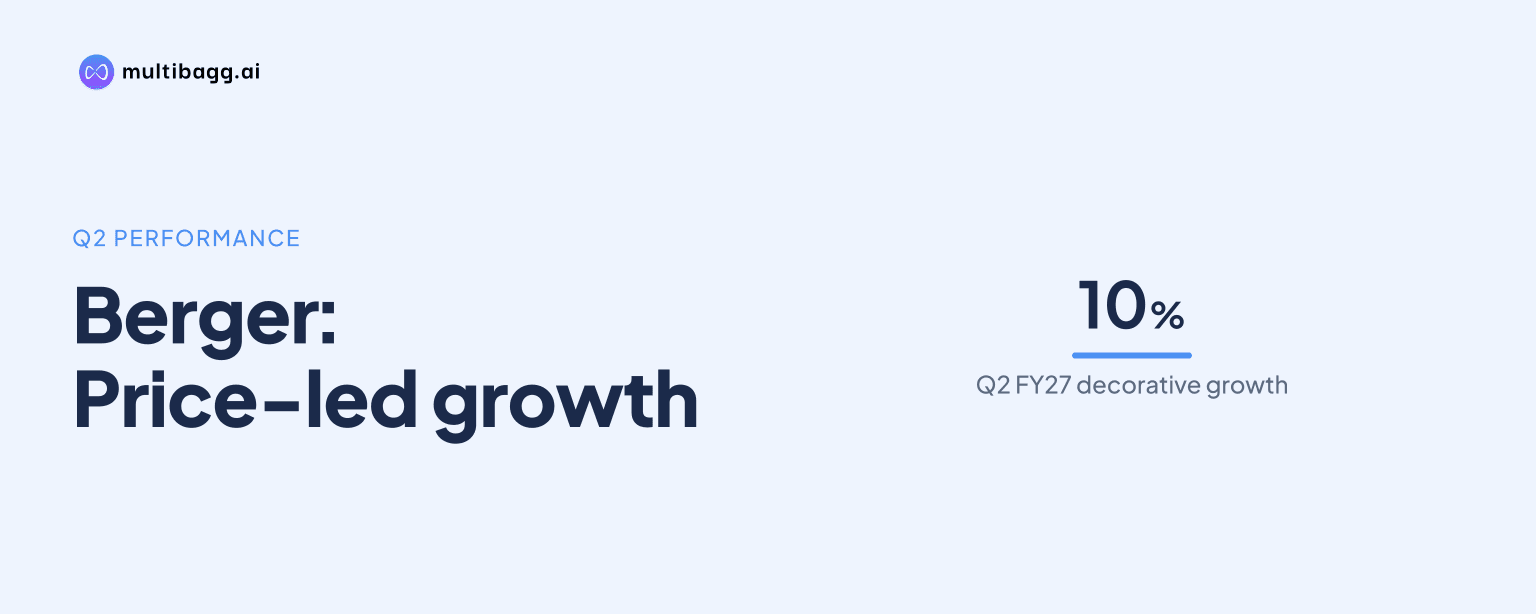
Berger Paints India Limited recorded 10% decorative value growth in Q2 FY27, principally from price increases, while decorative volumes moderated as a later Diwali shifted festive demand into Q3 and extended rain disrupted eastern markets. Standalone operating income increased 11.9% year on year to Rs 2,750.06 crore.
Know Berger Paints India inside out
Results, valuation, peers and who's buying, in one view.
Why did Berger's decorative sales grow 10% in Q2 FY27?
Berger's decorative business grew 10% in value in Q2 FY27 because of price increases, according to management. The company separately said volume growth moderated during the quarter, making the disclosed 10% a value-growth measure rather than a reported decorative-volume growth rate.
The decorative performance was lower than Berger's 11.9% increase in standalone total income from operations in Q2 FY27. Standalone operating income rose to Rs 2,750.06 crore from Rs 2,458.47 crore in Q2 FY26, while company-wide standalone volume growth was 3.0%. Berger did not disclose a decorative-only volume figure, so the 3.0% metric should not be treated as one.
The difference between decorative value growth of 10% and total operating-income growth of 11.9% also shows that the presentation reports these as separate measures. Berger identified pricing as the driver of decorative growth but did not quantify the effect of pricing, mix changes or individual product categories on the 10% result.
What slowed Berger's decorative demand in Q2 FY27?
A later Diwali moderated Berger's decorative volume growth in Q2 FY27 because festive demand moved into Q3. Management identified the festival timing as a reason for slower volumes, but did not quantify the demand deferred from the September-quarter period.
Extended rain in eastern markets was a second constraint cited by Berger for Q2 FY27. The presentation gives no regional sales number, weather duration or volume estimate, so it cannot establish the financial size of the eastern-market disruption. It does show that weather and the Diwali timing occurred alongside the reported moderation in decorative volumes.
The broader standalone comparison shows slower volume momentum in Q2 than in the first half. Standalone volume growth was 3.0% in Q2 FY27, versus 5.6% in H1 FY27, while value growth was 11.9% in the quarter and 12.3% in the half year. Value growth therefore stayed close to the first-half rate even as the company-wide volume growth rate was lower in Q2.
Which Berger decorative categories performed differently?
Berger said differentiated products outperformed in Q2 FY27, while Putty, Textures and Enamel declined. Management described the three declining categories as price-sensitive, linking their weaker trend to parts of the market more exposed to price changes.
Wood Coatings recorded double-digit value growth in Q2 FY27, according to Berger. Management also identified DampShield as a key growth driver. The company did not disclose sales, volumes, growth percentages or margins for either Wood Coatings or DampShield, limiting a numerical comparison with the named declining categories.
Berger also cited a conscious mix improvement as volumes moderated in Q2 FY27. A change in sales mix can alter the relationship between value and volume, particularly where differentiated products perform better than price-sensitive categories. However, the presentation does not assign a numerical contribution from mix improvement to the 10% decorative value gain.
Got a follow-up? Ask IRIS
How did Berger support decorative demand and distribution?
Berger invested in advertising and promotion in Q2 FY27 to support the RangBanaRahe campaign, which management said was intended to strengthen brand visibility and consumer engagement. The presentation does not state the advertising and promotion amount or link the campaign to a quantified sales result.
Berger reported a retail store network of more than 2,000 as of H1 FY27 and more than 4,800 tinting machines as of H1 FY27. It also reported more than 2,700 tinting machines during Q2. These figures describe the company's distribution and colour-tinting capability, rather than store productivity, machine utilisation or a direct driver of the quarter's 10% decorative value growth.
The reach measures accompanied 12.3% growth in standalone operating income for H1 FY27. Income rose to Rs 5,976.74 crore from Rs 5,321.09 crore in H1 FY26. Berger did not provide an H1 FY27 decorative value-growth figure, so the first-half total cannot be reconciled directly with Q2 decorative growth.
How did Q2 FY27 growth affect Berger's profitability?
Berger's Q2 FY27 income growth did not result in higher standalone profit before depreciation, interest and tax, excluding other income, or PBDIT. PBDIT fell 4.4% to Rs 297.54 crore from Rs 311.19 crore a year earlier, while its share of operating income declined to 10.8% from 12.7%.
Material cost increased to 63.4% of operating income in Q2 FY27 from 60.4% in Q2 FY26. Employee cost was 6.7% of income, compared with 7.4%, while other expenses were 19.2%, compared with 19.5%. These are standalone company measures and are not decorative-business cost or margin disclosures.
Standalone profit after tax fell 7.3% to Rs 163.31 crore in Q2 FY27 from Rs 176.25 crore in Q2 FY26. The first-half pattern differed: H1 FY27 PBDIT increased 6.1% to Rs 859.76 crore and profit after tax rose 13.2% to Rs 531.99 crore. The comparison shows that the second-quarter profitability outcome was lower than the cumulative first-half trend.
Conclusion
Berger's Q2 FY27 disclosure distinguishes price-led decorative sales growth from underlying demand conditions. Pricing produced 10% decorative value growth, but later festive timing, eastern-market rain and declines in Putty, Textures and Enamel coincided with moderated volumes. Selected differentiated offerings, including Wood Coatings and DampShield, moved differently from the price-sensitive categories.
The next disclosed development to watch is whether festive demand shifted into Q3 converts into decorative volumes. Management's RangBanaRahe campaign and its network of more than 2,000 stores and more than 4,800 tinting machines are the stated support measures, while the duration of pressure in price-sensitive categories and the effect of eastern weather remain unresolved in the presentation.