










Berger Paints India Limited Q2 margin falls as pricing lags
Key highlights
- Berger Paints' consolidated Q2 FY27 PBDIT margin was 11.6%, versus 12.5% in Q2 FY26.
- Material cost represented 60.7% of Q2 FY27 income, up from 58.4% a year earlier.
- Berger Paints reported 10% decorative value growth in Q2 FY27, while later Diwali demand shifted into Q3.
- Automotive Coatings outperformed in Q2 FY27, and General Industrial delivered double-digit volume growth.
powered by IRIS
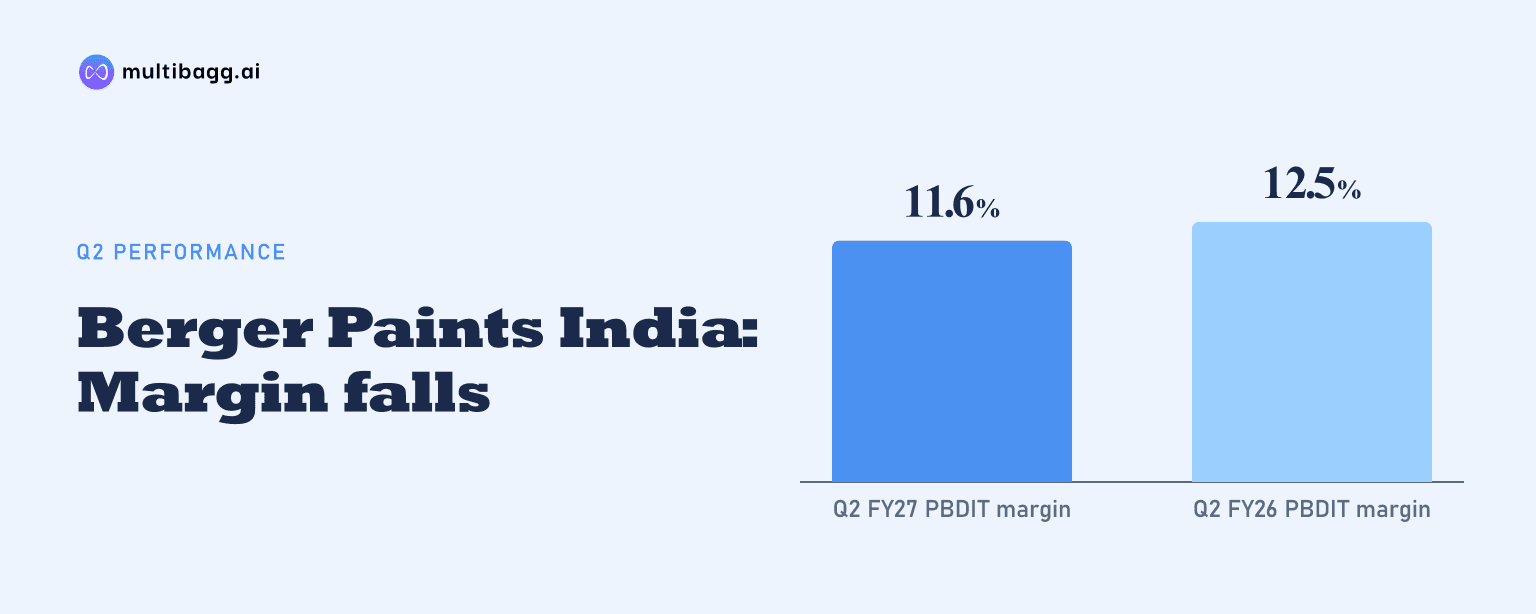
Berger Paints India Limited reported a consolidated profit before depreciation, interest and tax (PBDIT) margin of 11.6% in Q2 FY27, down from 12.5% in Q2 FY26, as industrial price increases were not fully passed on in time amid raw-material inflation. The update does not identify liquidation of high-cost inventory as a margin factor.
Know Berger Paints India inside out
Results, valuation, peers and who's buying, in one view.
Why were Berger Paints' industrial margins under pressure in Q2 FY27?
Berger Paints said industrial margins were under pressure in Q2 FY27 because steep price hikes could not be fully passed on to customers in a timely manner. Pricing across industrial segments partly offset raw-material (RM) inflation, but management said that it did not fully remove the input-cost impact.
The presentation identifies a pass-through timing gap rather than a broad, unspecified inflation effect. Berger Paints reported robust high-double-digit volume and value growth in industrial coatings during Q2 FY27 despite steep price increases, but it did not disclose the rate of RM inflation, the size of price hikes or industrial segment margins.
The supplied Q2 FY27 update does not state that high-cost inventory was liquidated or that inventory carried a separate cost effect. It provides no inventory value, write-down or reconciliation linking inventory to the 11.6% consolidated PBDIT margin, so an inventory-based explanation is not supported by this presentation.
How did Berger Paints' Q2 FY27 margins compare with other periods?
Berger Paints' consolidated PBDIT margin declined by 0.9 percentage points year on year to 11.6% in Q2 FY27 from 12.5% in Q2 FY26. PBDIT still rose 5.2%, but this was slower than the 13.2% increase in total income from operations, indicating that revenue growth did not translate into the same rate of operating-profit growth.
Material cost accounted for 60.7% of Q2 FY27 consolidated income, compared with 58.4% in Q2 FY26, an increase of 2.3 percentage points. Employee cost fell to 7.9% of income from 8.7%, while other expenses declined to 19.9% from 20.4%, but those movements did not prevent the PBDIT-margin decline.
The first-half, or H1, FY27 figures cover six months and are not a like-for-like comparison with a single quarter. They nevertheless show that Q2 consolidated gross margin of 39.3% was below the H1 figure of 40.1%, while standalone PBDIT margin of 10.8% was below the H1 level of 14.4%.
Which industrial segments supported Berger Paints' Q2 FY27 growth?
Berger Paints said Automotive Coatings outperformed in Q2 FY27, supported by buoyant demand in the two-wheeler segment. The company did not publish Automotive Coatings revenue, growth rate or margin, but identified the business as a contributor to the industrial division's high-double-digit volume and value growth.
General Industrial registered double-digit volume growth within its category in Q2 FY27, whereas Protective Coatings volumes remained stable. This created a mixed segment picture: Automotive Coatings outperformed, General Industrial expanded at a double-digit volume rate, and Protective Coatings did not record volume growth.
Pricing aided value growth across industrial segments and partly offset RM inflation, according to the update. However, Berger Paints did not disclose which industrial segment had the greatest exposure to delayed price pass-through or the largest contribution to the division's margin pressure.
Got a follow-up? Ask IRIS
What happened in Berger Paints' decorative business during Q2 FY27?
Berger Paints reported 10% decorative value growth in Q2 FY27, driven by price increases, while extended rain affected eastern markets. Volume growth moderated because a later Diwali shifted festive demand into Q3 and because the company pursued a conscious mix improvement.
Putty, Textures and Enamel declined during Q2 FY27 as price-sensitive categories, while differentiated products outperformed. Wood Coatings recorded strong double-digit value growth, providing a contrast with the declines in the price-sensitive categories, although the presentation did not provide their individual sales values.
Berger Paints launched its Rang Bana Rahe campaign in Q2 FY27 and said it made strategic investments in advertising and promotion (A&P) to build brand visibility and consumer engagement. As of H1 FY27, its retail-store network exceeded 2,000 and its tinting-machine base exceeded 4,800, including more than 2,700 during Q2.
What does Berger Paints' Q2 FY27 result show about profit conversion?
Berger Paints reported 13.2% growth in total income from operations in Q2 FY27, while PBDIT and profit after tax (PAT) each increased 5.2%. PAT margin fell to 6.8% from 7.3% in Q2 FY26, and profit from operation before interest margin declined to 8.2% from 9.0%.
The movement in profit margins is consistent with the disclosed increase in material-cost share and management's explanation of incomplete industrial price pass-through. Berger Paints reported Q2 FY27 consolidated gross margin of 39.3% and standalone gross margin of 36.6%, but did not provide an industrial PBDIT figure or a quantified bridge from RM inflation to realised pricing.
The update also does not say whether the industrial pricing gap was resolved during Q2 FY27. Its evidence supports the finding that industrial pricing timing and higher material-cost share coincided with lower consolidated margins, but it does not quantify the weight of each factor.
Conclusion
Berger Paints combined 13.2% growth in Q2 FY27 consolidated income from operations with a decline in consolidated PBDIT margin to 11.6% from 12.5% a year earlier. Management attributed industrial margin pressure to price increases not being fully passed through in time amid RM inflation, while the presentation does not support an explanation based on high-cost inventory liquidation.
The next disclosed item to watch is Q3 FY27, because Berger Paints said a later Diwali shifted festive demand from Q2 into that quarter. The company also disclosed stepped-up A&P behind the Q2 FY27 Rang Bana Rahe campaign, while price-sensitive Putty, Textures and Enamel categories had declined in the quarter.