










Birlasoft says FY28 growth hinges on stronger H2 deal signings
Key highlights
- Birlasoft said H1 deal signings rose 15% year on year, but management said order-book performance remained below expectations.
- Birlasoft said Q2 revenue improved after Q1 growth of 0.3% and was in line with management expectations.
- Birlasoft said salary increments reduced margin by about 170 basis points quarter on quarter.
- Birlasoft said machine-written code increased 10% in Q2 through Agentic AI use with human involvement.
powered by IRIS
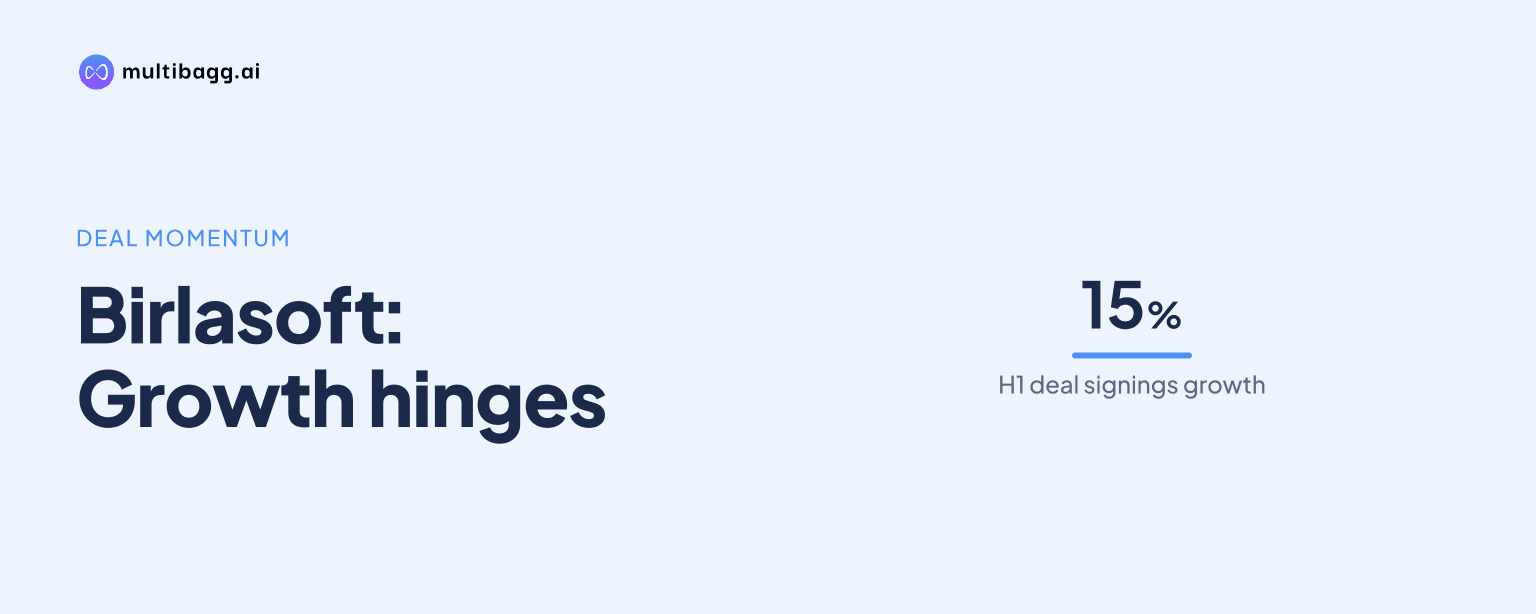
Birlasoft Limited said on October 28, 2026 that FY28 growth will depend on stronger H2 deal signings, because management said its order book remains inadequate despite H1 signings rising 15% year on year and Q2 revenue improving from Q1 growth of 0.3%.
Know Birlasoft inside out
Results, valuation, peers and who's buying, in one view.
Has Birlasoft turned the corner on growth?
No, Birlasoft said it has not turned the corner because order bookings remain below the level management considers necessary to secure future growth. Chief Executive Officer and Managing Director Angan Guha said the company had delivered meaningful growth after almost six quarters, but its order book was not in line with management expectations.
The distinction is between current delivery and the supply of work for later periods. Birlasoft said Q2 revenue was in line with management expectations and was relatively strong after Q1 growth of 0.3%. Management attributed the improvement to project ramp-ups and execution, rather than a shift towards short-duration work, while maintaining its focus on long-term and annuity-style deals.
Birlasoft said it can undertake projects lasting 11, 12 or 18 months, but it does not pursue short-term projects as a process. The Q2 benefit came from execution capability and ramp-ups, management said. That means the improved quarter did not remove the need to build a larger order book for FY28 and subsequent quarters.
H1 deal signings rose 15% year on year, but management still described the Q2 signing outcome as soft. Birlasoft said several deals moved into Q3 and Q4 rather than being lost. The timing shift reduced signings reported in Q2 and left management dissatisfied with the order-book result despite the H1 increase.
Why does Birlasoft make FY28 growth conditional on H2?
Birlasoft said FY28 could look better if it converts a stronger pipeline and AI-related client discussions into H2 signings. Guha said growth beyond H2 depends on signing performance in H2, not only on the better Q2 revenue trajectory or management's expectation that H2 will outperform H1.
Management's stated mechanism is that signings build the order book and revenue follows from that order book. Birlasoft said its pipeline was steady and had risen slightly, while AI-related discussions formed a growing part of the pipeline. However, the company gave no target for H2 bookings, conversion or FY28 revenue and reiterated that it does not provide guidance.
New commercial leadership is another factor in the timing. Birlasoft said the leadership hiring programme begun a couple of quarters earlier was almost complete, and that all leaders it set out to hire were on board by the October 28 call. Management said these leaders need a couple of quarters to settle in and become productive, limiting certainty over a material Q3 improvement in net-new deals.
Birlasoft also said sales employee numbers had increased while support staff had been rationalised. About 90% of the relevant investment work was complete, according to management, covering sales, service-line leadership and capability building. The company did not disclose the number of additional sales employees, but said the investments were intended to create a more consistent dealmaking rhythm.
Can Birlasoft deliver its strongest Q4 this year?
Birlasoft said Q4 could be its strongest quarter of the year if it executes its order book through January or February and avoids client shocks. Management said Q4 is typically renewal-heavy and that discussions on renewals were under way, supporting its view that H2 should be better than H1.
This is a conditional expectation rather than formal guidance. Guha said management was more confident about H2 based on information available on October 28, 2026, but unexpected client developments had caused sharp Q4 declines in FY25 and FY26. At the time of the call, management said client conversations did not point to another sharp Q4 decline.
Birlasoft expects Q3 furloughs to be in the same range as the prior fiscal year. In banking, financial services and insurance, or BFSI, management expects Q3 to be slightly soft because of furloughs, before structural growth resumes from Q4. The projected H2 improvement therefore includes a seasonally softer third quarter before the renewal-heavy final quarter.
The Energy and Utilities, or E&U, business is expected to recover over the next two to three quarters after a client ramp-down. Birlasoft described the event as one-time rather than structural, but did not disclose the revenue involved or specify a recovery quarter. Management also said manufacturing, particularly discrete manufacturing, was directionally improving as new-logo conversations increased.
Got a follow-up? Ask IRIS
What do margins and AI investment mean for the plan?
Birlasoft said it aims to remain at or about a 15% steady-state margin while investing in sales and service-line capabilities. Management said salary increments reduced margin by about 170 basis points quarter on quarter, with one basis point equal to one-hundredth of a percentage point, while sales and capability investment also reduced margin.
Operating efficiencies and improved revenue quality partly offset those pressures. Management linked revenue quality to the trimming of tail accounts in the prior financial year and changes to its revenue model. Birlasoft expects to catch up over the next couple of quarters and negate the effect of wage increases, although it also expects seasonal revenue patterns to cause short-term movement.
AI is part of both the efficiency programme and the sales pipeline, according to management. Birlasoft said machine-written code increased 10% in Q2 through use of Agentic AI with human involvement. Management said the resulting efficiency supports margins, but that margin improvement is being reinvested in sales and capabilities rather than retained solely as a profit benefit.
Birlasoft said advanced AI services have a higher offshore intensity than on-site work, while all service lines, including data, digital, enterprise resource planning and infrastructure, are AI-infused. The company said it is not building its own data centres. It also said AI-related work is creating client discussions and pipeline, but did not disclose AI-services revenue or its share of total sales.
How are frameworks and client concentration supporting revenue?
Birlasoft said Q2 growth was partly supported by master services agreements, or MSAs, and a land-and-expand approach in newer accounts. These frameworks allow the company to establish a client relationship before expanding work, but management said the agreements must ultimately convert into revenue.
The company said deal sizes are becoming larger as it moves forward, which is one reason for additional sales and capability investment. Management nevertheless said the job was only half complete because Birlasoft still needs larger deal wins. It said more frameworks and MSAs alone do not resolve the order-book shortfall.
Birlasoft said its top five, top 10 and top 20 client groups all grew in line with company growth. The top 20 clients accounted for 70% of revenue, according to an analyst on the call, while management said its exit from non-profitable accounts had been completed. Birlasoft said it now sees expansion opportunities across its 209 or 210 active client relationships.
Management is also seeking new logos after cutting a number of accounts over the past 24 to 36 months. That expansion effort sits alongside work to convert AI opportunities, renewals and deferred Q2 deals. The company said its stronger pipeline was encouraging, but did not quantify potential contract values or the expected timing of revenue conversion.
Conclusion
Birlasoft's improved Q2 execution and 15% H1 signing growth do not yet establish a durable turnaround, according to management. The company sees momentum in MSAs, larger deal opportunities, offshore AI work and conversations in manufacturing and BFSI, but it still considers order booking insufficient to support confidence in FY28 without stronger H2 conversion.
The next evidence will be Q3 and Q4 deal conversion, including deals deferred from Q2, and whether sales leaders hired by October 28, 2026 become productive after their stated couple-of-quarter settling period. Management also identified execution of the order book through January or February, Q4 renewals, normal furlough levels and the absence of client shocks as conditions for its expectation of the year's strongest quarter.