










Birlasoft holds 15.2% EBITDA margin despite 170-basis-point hit
Key highlights
- Birlasoft reported a 15.2% EBITDA margin on Q2 FY27 revenue of Rs 1,416.2 crore.
- The July 2026 compensation revision reduced Q2 FY27 margin by about 170 basis points sequentially.
- Manufacturing grew 5.2%, BFSI 3.6% and Life Sciences & Services 2.1% quarter on quarter in Q2 FY27.
- First-half FY27 deal signings increased 15% year on year, although management said more order bookings are needed.
powered by IRIS
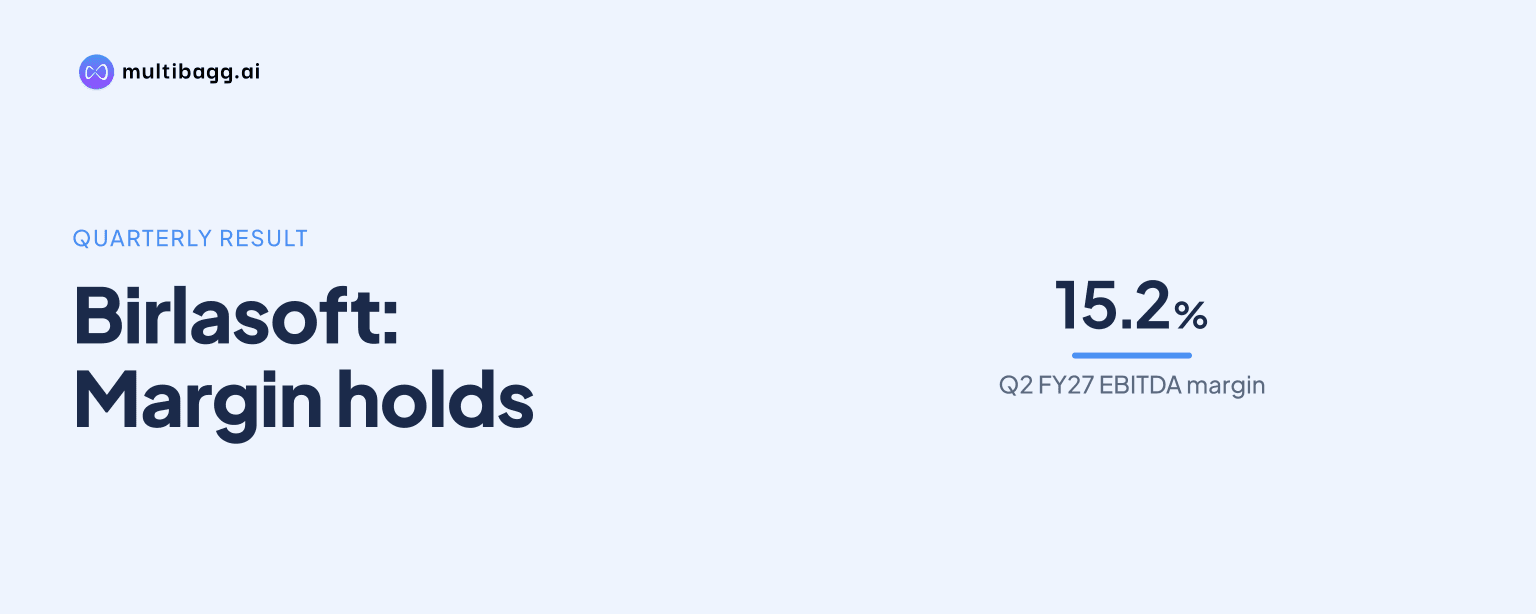
Birlasoft Limited reported a 15.2% earnings before interest, tax, depreciation and amortisation, or EBITDA, margin in Q2 FY27 despite a 170-basis-point sequential impact from its July 2026 compensation revision. Management said operational efficiencies and improved revenue quality partly offset wage and capability-investment costs, and that it expects to negate the wage effect over the next couple of quarters.
Know Birlasoft inside out
Results, valuation, peers and who's buying, in one view.
How did Birlasoft maintain a 15.2% EBITDA margin in Q2 FY27?
Birlasoft maintained a 15.2% EBITDA margin in Q2 FY27, reporting EBITDA of Rs 215.3 crore on revenue of Rs 1,416.2 crore. Revenue increased 2.7% sequentially in rupee terms, while the organisation-wide compensation revision took effect in July 2026. Management said the result remained within the margin range indicated in the preceding quarter.
Growth was spread across several verticals, although not all businesses moved in the same direction. Manufacturing revenue rose 5.2% quarter on quarter, banking, financial services and insurance, or BFSI, increased 3.6%, and Life Sciences & Services grew 2.1%. Energy & Utilities, or E&U, remained soft after a European client reduced work, while Digital & Data grew 3.4% and enterprise resource planning, or ERP, rose 2.9%.
Birlasoft reported profit after tax of Rs 159.6 crore and an effective tax rate of 29% in Q2 FY27. Collections brought days sales outstanding to a two-year best of 51 days as of 30 September 2026. These collection measures do not directly determine EBITDA margin, but they accompanied the quarter's higher revenue and profitability.
What offset Birlasoft's 170-basis-point wage increase?
Birlasoft said operating efficiencies and higher-quality revenue partly offset the 170-basis-point margin impact of salary increments, where 100 basis points equal one percentage point. Chief Financial Officer Chandrasekar Thyagarajan said these offsets did not fully neutralise either the pay increase or spending on sales and service-line capabilities.
The efficiency programme includes changes in the delivery model that management has pursued for more than four quarters. Birlasoft said its offshore contribution has increased through efforts to improve client value and revenue quality, and management expects that delivery improvement to continue. The call did not quantify the offshore mix or identify its standalone contribution to Q2 FY27 margin.
Management also attributed the revenue-quality improvement to the removal of negative and tail accounts during the previous financial year. Chief Executive Officer and Managing Director Angan Guha said the exit from negative accounts was complete, shifting the focus to sales, pipeline and order-book growth. Birlasoft said its annuity business is increasing, but did not disclose its revenue share or a prior-period amount.
Can Birlasoft sustain EBITDA margin at about 15%?
Birlasoft's stated steady-state endeavour is to remain at or about a 15% EBITDA margin, with management expecting to catch up over the next couple of quarters and negate the wage-increase effect. This was management commentary rather than formal guidance, as Birlasoft said it does not provide quarterly guidance.
The Q2 FY27 outcome shows the balance management is seeking to preserve. The 15.2% margin was delivered after the 170-basis-point impact from the July 2026 salary revision and while Birlasoft was investing in sales and service-line capabilities. Thyagarajan said seasonality could produce small margin movements, but described the 15% area as the company's operating objective.
Artificial intelligence, or AI, productivity is one mechanism management expects to support margins. Guha said around one-third of Birlasoft's code was generated using agentic AI tools, up from almost 25% a few months earlier, and that machine-written code rose by 10% during Q2. Management said the efficiencies help margins, although it plans to reinvest resulting gains in sales and capability building.
Got a follow-up? Ask IRIS
What could affect Birlasoft's H2 FY27 margin performance?
Birlasoft expects H2 FY27 financial performance to be better than H1, but management expects Q3 to include furloughs, fewer working days and the holiday season. As of 28 October 2026, management expected furloughs to be in the same range as the previous year, while noting that customer conditions could change over the following 30 days.
Q2 FY27 revenue growth was in line with management expectations and compared with 0.3% growth in Q1 FY27. Management said certain expected deals were pushed into Q3 and Q4 rather than lost, contributing to a softer Q2 order-book outcome. First-half deal signings rose 15% year on year, but Guha said Birlasoft needed more signings to support future quarters.
Investment remains a counterweight to immediate margin expansion. Birlasoft is adding sales capacity and building capabilities, and management said new sales hires generally need a couple of quarters to produce results. It also cited reinvestment in technology infrastructure and office refurbishment as causes of higher depreciation and amortisation, which management expects to stabilise over time.
How does Birlasoft's revenue mix affect the margin outlook?
Birlasoft's margin outlook depends partly on continuing growth in Manufacturing, BFSI and Life Sciences & Services while managing the E&U client ramp-down. Those three growth verticals rose between 2.1% and 5.2% sequentially in Q2 FY27, whereas E&U was affected by reduced work at one European customer. Management said it did not expect further downside from that issue, but did not anticipate a near-term recovery.
Advanced AI services have a higher offshore intensity than onsite delivery, according to Guha, though he said location is becoming less important as contracts focus increasingly on outcomes. Birlasoft has redesigned engineering workflows for more than 20 top service offerings with an AI-first approach. It also said human-in-the-loop controls remain in place for security, governance, quality and reliability.
Management said it is prioritising longer-term and annuity-oriented work over short-duration projects. Guha said Q2 FY27 growth resulted from client ramp-ups and execution rather than an intentional focus on short-term contracts. Birlasoft said Q4 includes a seasonal concentration of renewals and that discussions are under way, but it disclosed no quantified renewal target or margin forecast.
Conclusion
Birlasoft delivered a 15.2% EBITDA margin in Q2 FY27 despite a 170-basis-point hit from the July 2026 compensation revision. Sequential growth in Manufacturing, BFSI, Life Sciences & Services, Digital & Data and ERP, together with operating efficiencies and better revenue quality, partly absorbed higher employee costs and continuing capability investment.
The next test is whether Birlasoft can turn delayed deals, its H2 sales pipeline and Q4 renewals into revenue while navigating Q3 furloughs. Management expects H2 FY27 financial performance to exceed H1 and aims to negate the wage impact in the next couple of quarters, but execution on order bookings and ongoing sales investment will shape the outcome.