










Black Box sets ₹18,000 crore FY30 revenue aspiration with M&A
Key highlights
- Black Box aspires to ₹18,000 crore of FY30 revenue, compared with ₹6,322 crore in FY26.
- The FY30 plan assigns about ₹12,000 crore to organic growth and ₹6,000 crore to acquisitions.
- 2S Inovações Tecnológicas contributed ₹177 crore of revenue in H1 FY27.
- Black Box guided for FY27 revenue of ₹7,800 crore to ₹8,000 crore, representing 23% to 27% growth from FY26.
powered by IRIS
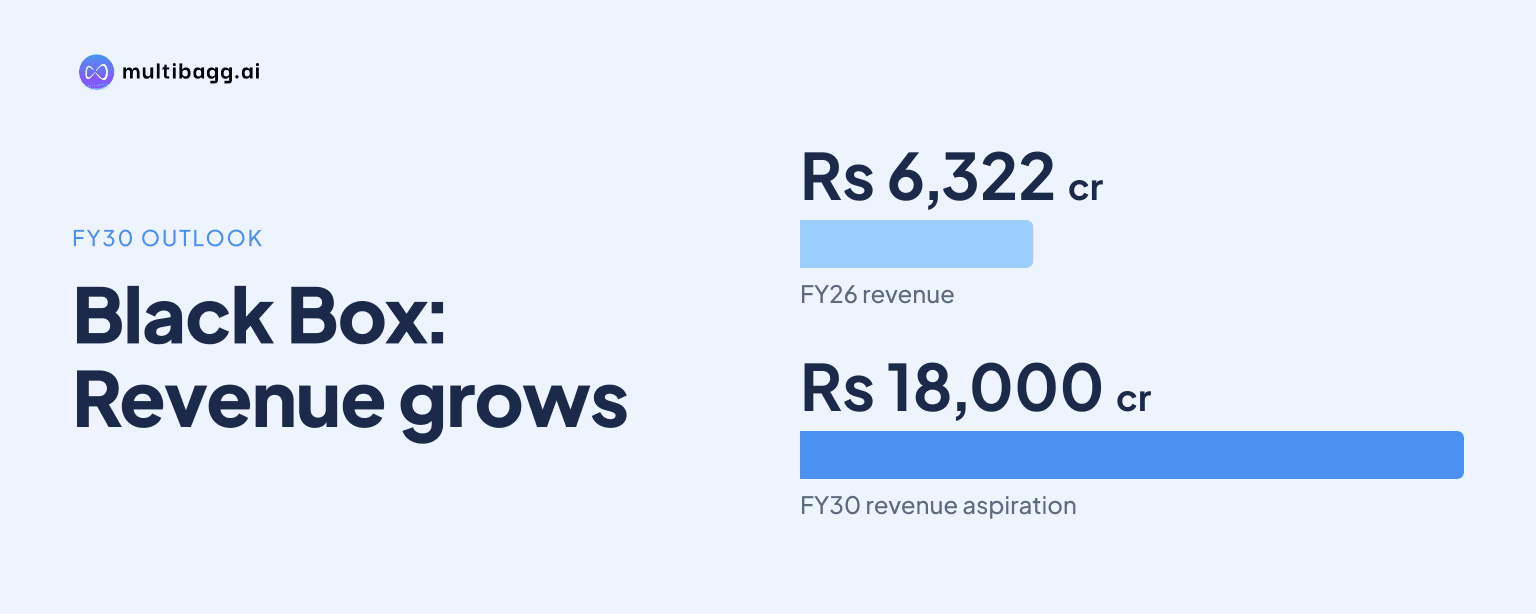
Black Box aspires to ₹18,000 crore of revenue by FY30, comprising about ₹12,000 crore of organic revenue and ₹6,000 crore from acquisitions, compared with ₹6,322 crore in FY26. The acquisition component represents one-third of the stated FY30 aspiration, while the organic plan calls for about 17% compound annual growth.
Know Black Box inside out
Results, valuation, peers and who's buying, in one view.
What is Black Box’s FY30 revenue aspiration?
Black Box’s FY30 revenue aspiration is ₹18,000 crore, with about ₹12,000 crore expected from organic growth and ₹6,000 crore intended from acquisitions. The presentation describes this as an aspiration, supported by organic execution and backlog conversion alongside an inorganic expansion programme.
The FY26 starting point was ₹6,322 crore of organic revenue, making the FY30 organic objective about ₹5,678 crore higher over the period. The total FY30 aspiration is ₹11,678 crore above FY26 revenue, although Black Box has not disclosed annual revenue milestones beyond its FY27 guidance.
Black Box uses an exchange rate of ₹90 to one US dollar in presenting its FY30 goal, which it also expresses as about ₹18,000 crore. Its disclosed FY27 revenue guidance of ₹7,800 crore to ₹8,000 crore is the nearer-term financial benchmark, compared with ₹3,655 crore reported in H1 FY27.
How does Black Box plan to reach ₹12,000 crore organically?
Black Box plans to approximately double organic revenue to about ₹12,000 crore by FY30 from ₹6,322 crore in FY26, implying about 17% compound annual growth. Management identifies growing backlog, longer-duration high-value contracts and sustained order inflows as the sources of multi-year revenue visibility for this plan.
The operational plan includes seeking multi-million-dollar deal wins with large hyperscalers building artificial-intelligence campuses. Black Box also plans to expand Fortune 500 account relationships through multi-solution selling and higher managed-services attachment rates, without assigning revenue targets to individual customers, services or regions.
Geographically, Black Box intends to double down on India, scale across Europe and accelerate rest-of-world growth. It also cites stronger delivery discipline on strategic programmes, leadership capability and workforce retention as execution measures supporting backlog conversion and larger contract delivery.
FY27 guidance places the first disclosed annual marker below the FY30 endpoint. Management guided for FY27 revenue of ₹7,800 crore to ₹8,000 crore, representing 23% to 27% growth from ₹6,322 crore in FY26, while H1 FY27 revenue of ₹3,655 crore was 58% of the FY26 total.
How will acquisitions contribute ₹6,000 crore of revenue?
Black Box intends acquisitions to contribute about ₹6,000 crore of FY30 revenue through an “acquire, scale, transform” approach. The company says it will identify sub-optimal-margin businesses, acquire complementary operations, scale customer relationships or geographies, and execute synergies and transformation after closing.
The Brazil-based acquisition of 2S Inovações Tecnológicas contributed ₹177 crore of revenue in H1 FY27. Black Box describes that acquired business as having about ₹450 crore of revenue at the presentation’s stated exchange rate of ₹90 to one US dollar, and says it has identified a healthy pipeline of opportunities without naming future targets or transaction values.
The acquisition framework targets capability expansion in cloud, data centres, cybersecurity and the internet of things, plus geographic expansion in the United States, Europe and Asia-Pacific. Black Box also says it may exit non-strategic, low-margin revenue segments and simplify capital, financial and tax structures as part of the transformation process.
Balance-sheet changes provide context for the first half of FY27 but are not specifically attributed by Black Box to the Brazil acquisition. Goodwill increased to ₹963 crore at September 2026 from ₹381 crore at March 2026, other intangible assets rose to ₹150 crore from ₹92 crore, and total borrowings were ₹1,211 crore versus ₹823 crore.
Got a follow-up? Ask IRIS
What does FY27 guidance say about Black Box’s revenue visibility?
Black Box’s FY27 guidance calls for year-end order backlog of ₹11,700 crore to ₹12,600 crore and order bookings of ₹11,925 crore to ₹13,050 crore, using the presentation’s ₹90-to-one-dollar exchange rate. Management says the backlog and bookings outlook implies multi-year visibility, but does not disclose how much of backlog is scheduled to convert into FY27 or FY30 revenue.
At H1 FY27, order backlog was equivalent to ₹9,396 crore, compared with ₹7,128 crore in FY26. H1 FY27 order bookings were equivalent to ₹5,733 crore, against ₹9,027 crore in FY26, while the full-year booking guidance implies 32% to 45% growth over FY26.
Management guided for an EBITDA margin of 9.3% to 9.4% in FY27, compared with 9.0% in FY26 and 9.2% in H1 FY27. Its FY27 EBITDA growth guidance of 27% to 32% is above the 23% to 27% revenue-growth range, while PAT guidance implies 38% to 50% growth; these are guidance ranges, not reported full-year results.
What cash-flow and balance-sheet changes accompany the plan?
Black Box reported net cash from operating activities of ₹115 crore in H1 FY27, up from ₹97 crore in H1 FY26. Net cash used in investing activities increased to ₹276 crore from ₹18 crore, while financing activities generated ₹229 crore in H1 FY27 against an outflow of ₹18 crore a year earlier.
Cash and cash equivalents ended H1 FY27 at ₹596 crore, compared with ₹275 crore at the end of H1 FY26, and the presentation marks both interim periods as not annualised. At September 2026, contract assets were ₹562 crore versus ₹280 crore at March 2026, while current contract liabilities increased to ₹844 crore from ₹535 crore.
Conclusion
Black Box’s FY30 aspiration combines about ₹12,000 crore of organic revenue, based on backlog conversion, hyperscaler projects, major-account selling and geographic expansion, with ₹6,000 crore intended from acquisitions. The ₹177 crore H1 FY27 revenue contribution from 2S Inovações Tecnológicas demonstrates an initial inorganic contribution, but most acquisition-led revenue in the plan depends on future transactions and subsequent transformation.
The next disclosed milestone is management’s FY27 guidance of ₹7,800 crore to ₹8,000 crore in revenue, ₹11,700 crore to ₹12,600 crore in order backlog and ₹725 crore to ₹750 crore in EBITDA. Progress in order bookings, backlog growth, acquisition execution and the guided 9.3% to 9.4% EBITDA margin will indicate whether Black Box is advancing toward its FY30 aspiration.