










Black Box restores 9% EBITDA margin but cash conversion lags
Key highlights
- Black Box increased EBITDA margin from 4.3% in FY23 to 9.0% in FY26.
- Black Box reported PAT of Rs 218 crore in FY26, compared with Rs 24 crore in FY23.
- Black Box recorded a Rs 342 crore working-capital outflow in FY26 and Rs 551 crore in FY25.
- Black Box trade receivables rose from Rs 567 crore at March 2025 to Rs 1,153 crore at March 2026.
powered by IRIS
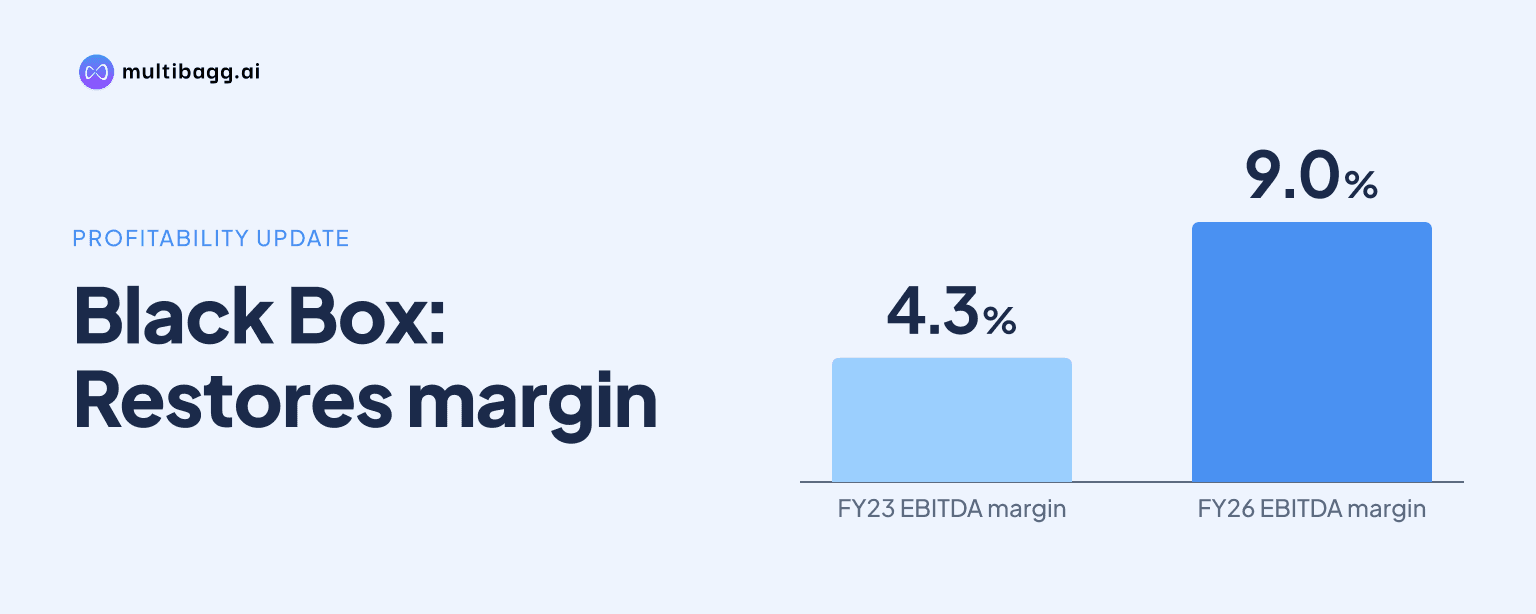
Black Box Limited rebuilt profitability after FY23, raising EBITDA margin from 4.3% to 9.0% and profit after tax from Rs 24 crore to Rs 218 crore by FY26. However, Black Box reported a Rs 342 crore working-capital outflow in FY26, limiting net cash from operating activities to Rs 84 crore.
Know Black Box inside out
Results, valuation, peers and who's buying, in one view.
How did Black Box rebuild margins after FY23?
Black Box lifted EBITDA margin to 9.0% in FY26 from 4.3% in FY23, while EBITDA increased from Rs 269 crore to Rs 570 crore. Revenue moved from Rs 6,288 crore in FY23 to Rs 6,322 crore in FY26, after declining to Rs 6,282 crore in FY24 and Rs 5,967 crore in FY25.
The recovery coincided with higher gross margin and contained other expenses. Gross margin rose from 26.1% in FY23 to 27.3% in FY24, 30.1% in FY25 and 30.5% in FY26, taking gross profit from Rs 1,640 crore to Rs 1,930 crore. Total other expenses were Rs 1,360 crore in FY26, compared with Rs 1,370 crore in FY23.
EBITDA, or earnings before interest, tax, depreciation and amortisation, had fallen from Rs 352 crore in FY21 to Rs 260 crore in FY22 before rising through FY26. The presentation reports a 43% compound annual growth rate for EBITDA from FY19 to FY26, compared with a 19% compound annual growth rate for revenue over that period.
What changed in Black Box profitability below EBITDA?
Black Box increased profit after tax, or PAT, to Rs 218 crore in FY26 from Rs 24 crore in FY23, and PAT margin rose to 3.4% from 0.4%. PAT was Rs 205 crore in FY25, while its margin was 3.4% in both FY25 and FY26 as FY26 revenue increased.
Earnings before interest and tax, or EBIT, increased from Rs 204 crore in FY23 to Rs 460 crore in FY26, and EBIT margin rose from 3.2% to 7.3%. Depreciation increased from Rs 107 crore to Rs 116 crore over the same period, showing that the improvement in EBITDA was retained after depreciation.
Finance cost rose to Rs 158 crore in FY26 from Rs 111 crore in FY23, while exceptional losses increased to Rs 63 crore from Rs 52 crore. Even so, profit before tax rose from Rs 29 crore to Rs 239 crore, and tax expense increased from Rs 6 crore to Rs 22 crore.
The longer record includes losses of Rs 79 crore in FY19 and Rs 80 crore in FY20, followed by PAT of Rs 78 crore in FY21. Basic earnings per share were Rs 1.42 in FY23, Rs 12.16 in FY25 and Rs 12.78 in FY26.
Got a follow-up? Ask IRIS
Why has Black Box cash conversion lagged profits?
Black Box’s reported operating cash has lagged operating profit because working-capital changes were outflows in every year from FY21 through FY26. The outflow was Rs 282 crore in FY23, Rs 301 crore in FY24, Rs 551 crore in FY25 and Rs 342 crore in FY26.
In FY26, operating profit before working-capital changes was Rs 453 crore, but cash generated from operations was Rs 111 crore after the Rs 342 crore working-capital outflow. Reported net cash from operating activities was Rs 84 crore, compared with Rs 129 crore in FY24, negative Rs 88 crore in FY25 and Rs 13 crore in FY23.
The contrast was most pronounced in FY25. Operating profit before working-capital changes was Rs 466 crore, but the Rs 551 crore working-capital outflow resulted in negative Rs 85 crore of cash generated from operations and negative Rs 88 crore of net cash from operating activities.
Trade receivables increased to Rs 1,153 crore at March 2026 from Rs 567 crore at March 2025. Inventories rose from Rs 210 crore to Rs 323 crore, while contract assets increased from Rs 219 crore to Rs 280 crore. These balance-sheet movements occurred alongside the FY26 working-capital outflow, although the presentation does not allocate the cash-flow change to individual balance-sheet lines.
How did Black Box’s balance sheet change during the recovery?
Black Box increased total equity to Rs 1,287 crore at March 2026 from Rs 296 crore at March 2023, while total assets increased to Rs 4,294 crore from Rs 3,002 crore. Other equity rose from Rs 262 crore to Rs 1,251 crore, and balance-sheet cash and cash equivalents increased from Rs 210 crore to Rs 540 crore.
The presentation states that Black Box raised Rs 386 crore through a preferential issue, with 25% raised in FY25 and 75% raised at the end of March 2026 under regulatory timelines. Management says the late-March FY26 raising contributed to a decline in return on equity, or ROE, and return on capital employed, or ROCE, during FY26.
ROE declined to 21.3% in FY26 from 33.0% in FY25, while ROCE declined to 23.8% from 35.2%. The presentation states that the company’s target level is above 27%, without specifying whether that target applies separately to ROE and ROCE.
Non-current borrowings increased from Rs 305 crore at March 2023 to Rs 797 crore at March 2026, while current borrowings declined from Rs 47 crore to Rs 30 crore. The cash-flow statement recorded Rs 197 crore of net cash from financing activities in FY26 and Rs 192 crore in FY25, while Black Box describes its model as low capital expenditure.
Conclusion
Black Box’s historical financials show a material recovery in profitability after FY23. Gross margin increased by 4.4 percentage points to 30.5% in FY26, EBITDA margin rose by 4.7 percentage points to 9.0%, and PAT reached Rs 218 crore. The cash-flow record, however, shows that rising operating profit has not consistently translated into operating cash because working capital absorbed Rs 342 crore in FY26 and Rs 551 crore in FY25.
The next disclosed markers are management’s target level above 27% for returns and the effects of the Rs 386 crore preferential issue, of which 75% was raised at the end of March 2026. Readers can also watch whether trade receivables, which reached Rs 1,153 crore at March 2026, and other working-capital balances moderate sufficiently to improve reported operating cash generation.