










Black Box says hyperscale work supports 10% margin goal
Key highlights
- Black Box said hyperscaler gross margins range from 20% to 25%, averaging about 22%-23%.
- Equipment usually accounts for only about 2%-4% of large Black Box hyperscaler contract value.
- Black Box said enterprise material margins are 12%-18%, compared with service margins of 22%-30%.
- Management expects cash conversion to improve from roughly 35%-36% in H1 FY27 by the exit of Q4.
powered by IRIS
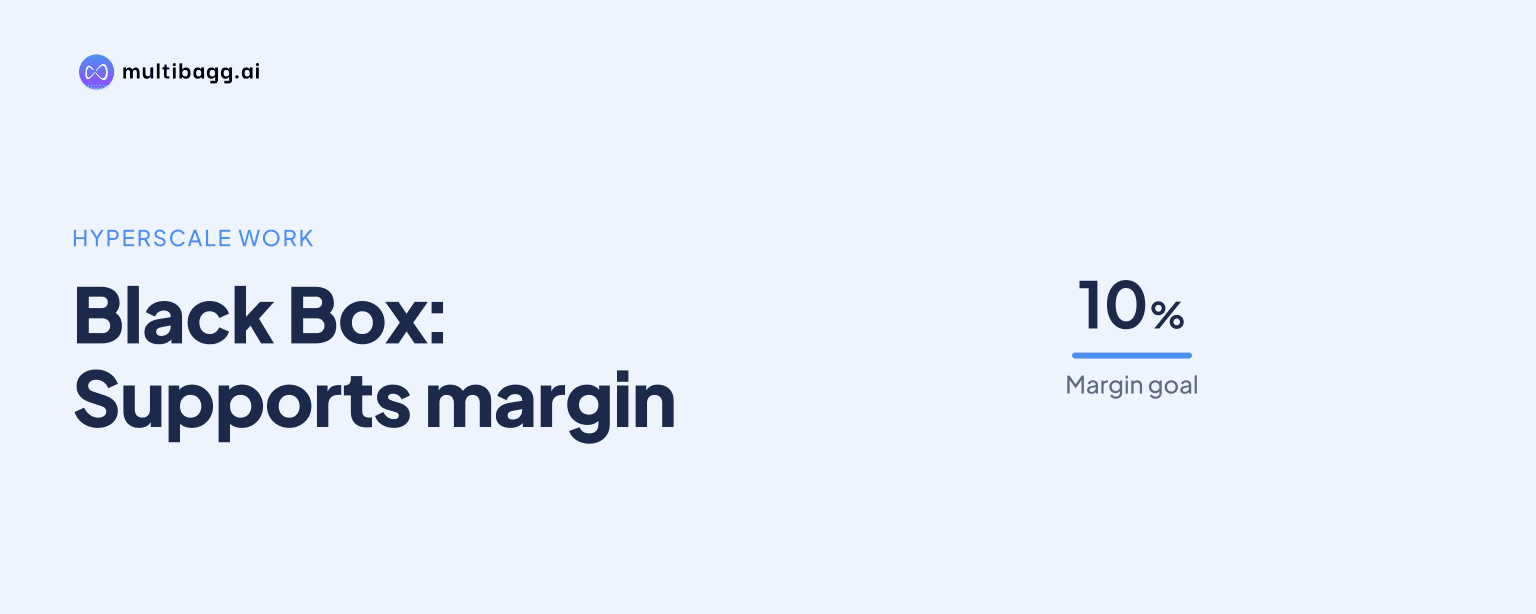
On its earnings call, Black Box said large hyperscaler contracts are services-led, with 20%-25% gross margins averaging 22%-23%, and management said lower selling, general and administrative (SG&A) expense per unit of revenue at scale keeps this work aligned with its 10% earnings before interest, tax, depreciation and amortisation (EBITDA) margin objective.
Know Black Box inside out
Results, valuation, peers and who's buying, in one view.
Why are Black Box hyperscaler contracts mainly services-led?
Black Box said large data-centre and hyperscaler orders generally exclude material and equipment from its scope because customers procure those items directly. Its role is mainly to provide trained manpower and execute the agreed work, meaning supplies such as last-mile delivery material usually account for only about 2%-4% of a large contract's value.
That structure limits the direct effect of equipment-price movements on the economics of major hyperscaler contracts. In response to an analyst's question about cost of goods sold and inventory, management said equipment is normally not part of its bill of material on large data-centre orders, leaving labour, mobilisation and execution as the principal commercial inputs.
Black Box distinguished this model from parts of its enterprise project business. Enterprise customers may buy equipment through partners including CommScope, Cisco and Juniper alongside services, while managed services and time-and-materials work remain services-led. That mix gives enterprise projects a different gross-margin composition from a large hyperscaler engagement.
What gross margins does Black Box earn on hyperscale work?
Black Box said hyperscale gross margins range from 20% to 25%, averaging about 22%-23%, depending on the work performed. Management said margins can be slightly lower at scale, but described the resulting work as accretive to its stated 10% operating-margin objective after considering the cost to serve.
The enterprise mix has different component margins when a project includes both equipment and services. Management said material margins normally range from 12% to 18%, while service margins range from 22% to 30%, depending on the service. A project quotation incorporates the combined bill of material unless a customer asks for a separate breakdown.
The comparison shows why lower equipment margins do not necessarily change the overall project outcome. Black Box said enterprise projects containing partner-supplied hardware have a lower margin spread, but the blend remains consistent because services form part of the project. By contrast, the 20%-25% hyperscaler range is largely a service-execution outcome with limited equipment content.
How can lower gross margins still support Black Box's EBITDA target?
Black Box said scale is the key mechanism: as hyperscale revenue rises, SG&A costs are amortised over a larger revenue base. Management therefore said hyperscale work remains accretive to the 10% EBITDA-margin goal despite gross margins averaging about 22%-23%.
Management said it evaluates deals by whether they can deliver an operating margin of 10% or more, rather than by customer category alone. The company uses fixed-price contracts when scope is defined, time-and-materials, or T&M, arrangements for work such as audits and quality assessments, and cost-plus structures for greenfield projects with uncertain scopes.
For fixed-price work, Black Box said a clear customer scope permits a fixed price and a fixed margin, while changes to scope lead to a change order. Cost-plus arrangements apply when neither party can precisely determine the final scope at the outset. Management said the mix of T&M, fixed-price and cost-plus work is designed to remain within its stated gross-margin and operating-margin framework.
Got a follow-up? Ask IRIS
What does Black Box expect as hyperscale projects scale up?
Black Box said it is mobilising a recently announced hyperscaler account and expects execution to create opportunities for adjacent work. Management described its data-centre plan as going deeper and wider through larger projects, more sites and more engagements with existing customers, while pursuing newer hyperscalers and work in other geographies.
The company said it had hired about 300 people since its previous update and was looking to reach about 700 hires by the end of the fiscal year, a period of roughly four months. Management said it did not see a slowdown in the order backlog under execution and expected to hire more in the second half than in the first half to mobilise that order bank.
Black Box also linked its margin objective to organic scale and acquisition timing. Management is guiding for a 10% margin, while saying organic operations should be between 10% and 12% by FY30. It added that acquisitions of lower-margin businesses for transformation could affect the result depending on their size and timing, although the 10% guidance incorporates its acquisition thesis.
How is Black Box expecting cash conversion to change?
Black Box said cash conversion is affected during the early phase of large projects, when customer payment terms may be 60 days but the first payment can arrive only after 90-105 days. Mobilisation, reconciliation and customer-system setup delay the normal billing cycle even as delivery costs begin.
Management referred to an operating-cash-to-EBITDA ratio of about 35%-36% in the first half of FY27 and said it expected substantial improvement by the exit of the fourth quarter. It expects backlog revenue to ramp and said that after another quarter to one-and-a-half quarters, the level of incremental investment should decline as projects enter regular execution.
Conclusion
Black Box's contract-economics explanation centres on service execution rather than equipment resale. Hyperscaler work has a stated 20%-25% gross-margin range, compared with 12%-18% material margins and 22%-30% service margins in enterprise projects that can include hardware. Management's case for its 10% EBITDA-margin objective rests on scaling revenue while spreading SG&A costs across a larger base.
The next measures to watch are mobilisation, hiring and conversion of the order backlog into revenue through the fourth quarter. Management expects cash conversion to improve from the roughly 35%-36% H1 FY27 level as projects move into normal billing cycles, while its 10%-12% organic margin expectation by FY30 remains subject to scale and the timing and profile of acquisitions.