










Blue Jet expands advanced intermediates as FY26 revenue rebounds
Key highlights
- Blue Jet's contrast-media intermediates revenue rose 22.6% to Rs 495.1 crore in FY26.
- Contrast media contributed 52.5% of Blue Jet's FY26 revenue, its largest product-category share.
- Blue Jet says it progressed from a key starting intermediate in 2000 to 19 additional advanced intermediates by FY26.
- The global contrast-media intermediates market is projected to rise from US$1.07 billion in 2024 to US$1.558 billion in 2029.
powered by IRIS
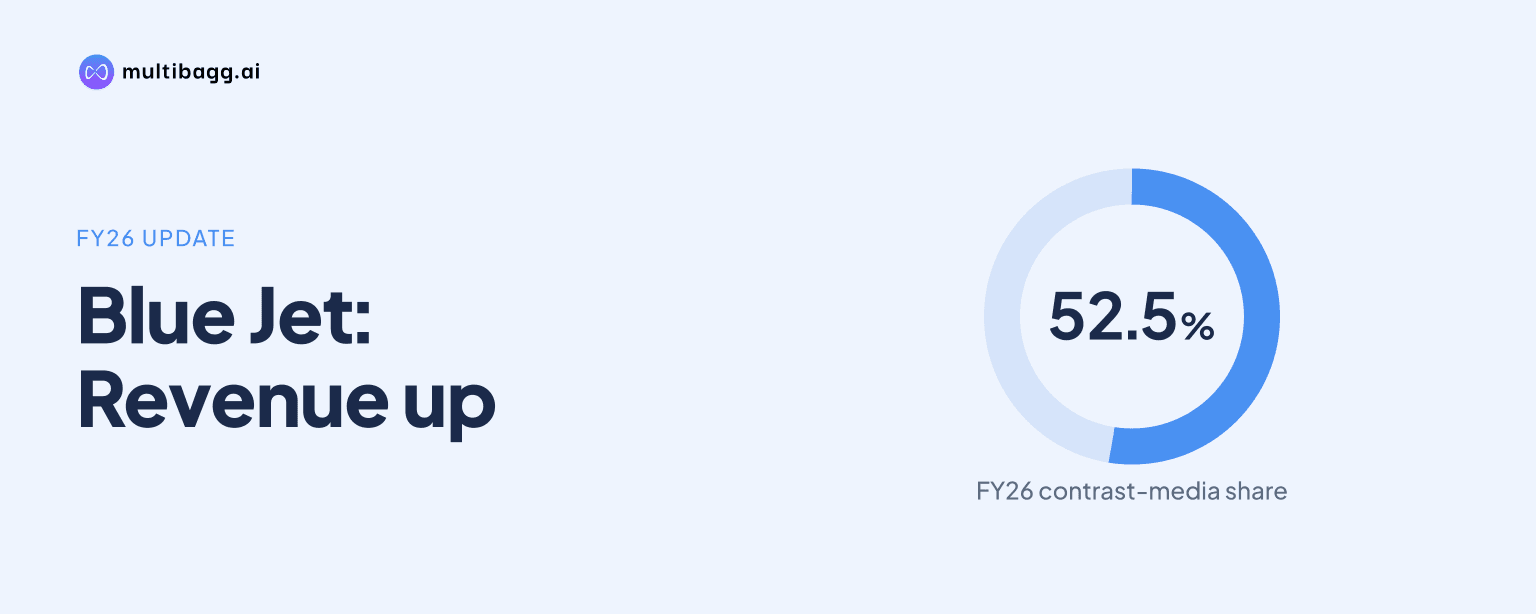
Blue Jet Healthcare expanded its contrast-media intermediate offering in FY26, when category revenue rose 22.6% to Rs 495.1 crore and represented 52.5% of total revenue. Blue Jet says it has progressed from supplying a key starting intermediate in 2000 to 19 additional advanced intermediates by FY26, targeting more business from existing qualified customers.
Know Blue Jet Healthcare inside out
Results, valuation, peers and who's buying, in one view.
How is Blue Jet expanding in contrast-media intermediates?
Blue Jet is expanding from a key starting intermediate into functionally critical advanced contrast-media intermediates. The company says this progression began with a building-block product in 2000 and reached 19 additional advanced intermediates by FY26. Its FY26 portfolio summary separately lists 19 commercialized products in contrast media, compared with four in high-intensity sweeteners and 28 in pharma intermediates and active pharmaceutical ingredients, or APIs.
The stated mechanism is product development and process optimisation through in-house research and development, or R&D. Blue Jet says it selects molecules where customers are considering outsourcing or alternate sourcing at the next advanced-intermediate stage. Management identifies greater wallet share, higher realisation and profitability per unit, and movement up the value chain as intended benefits, but gives no quantified target for these outcomes.
Blue Jet also describes direct relationships lasting four to 27 years with three of the top four contrast-media manufacturers. It says it regularly supplies a key starting intermediate and several advanced intermediates, creating an opportunity to offer additional production stages to customers whose products have already been qualified, approved and validated.
What did Blue Jet's contrast-media revenue do in FY26?
Blue Jet's contrast-media intermediates revenue rose to Rs 495.1 crore in FY26 from Rs 403.9 crore in FY25, an increase of Rs 91.2 crore or 22.6%. The recovery followed a decline from Rs 507 crore in FY23 to Rs 479.9 crore in FY24 and Rs 403.9 crore in FY25. The company reports a 0.9% compound annual growth rate, or CAGR, for FY22 to FY26.
Contrast media was Blue Jet's largest reported product category in FY26, contributing 52.5% of revenue. Pharma intermediates and APIs contributed 31.6%, while high-intensity sweeteners contributed 13.9%. In comparison, sweetener revenue declined from Rs 133.5 crore in FY25 to Rs 131.4 crore in FY26.
H1 FY27 contrast-media revenue was Rs 260.9 crore, against Rs 495.1 crore for the full FY26 period. The presentation does not disclose a year-on-year H1 comparison, a category margin, sales volumes or a FY27 category target. As a result, FY26 is the latest full-year measure of the category's reported performance.
Why does Blue Jet's customer concentration matter?
Blue Jet operates in a concentrated contrast-media formulation market, where the four leading companies collectively held about 75% of global sales in each cited period from June 2019 to June 2023. In 2024, GE Healthcare held 28% of the formulation market, Bracco Imaging held 20%, Bayer held 17% and Guerbet held 11%.
This concentration makes customer qualification and supply relationships central to Blue Jet's strategy. The company says it has medium- to long-term customer supply contracts and that about 70% of total sales were backed by contracted sales volumes for FY21, FY22, FY23 and the three months ended the first quarter of 2023. It does not give a comparable contracted-sales proportion for FY26.
The end market is also concentrated by imaging type. Iodinated agents used in X-ray and computed tomography, or CT, accounted for 74% of 2024 contrast-media formulation revenue. Gadolinium agents used in magnetic resonance imaging, or MRI, accounted for 24%, while microbubble ultrasound agents accounted for 2%.
Got a follow-up? Ask IRIS
What barriers does Blue Jet cite for advanced intermediates?
Blue Jet cites strict internal standards for impurity and product-feature profiles, long-term supply arrangements and customer relationship stickiness as barriers for vendors of key intermediates. Its stated position includes more than two decades of experience, complex-chemistry capabilities and direct relationships of four to 27 years with three of the largest contrast-media manufacturers.
Blue Jet reported more than 75% of India's exports of 5-Amino-N, N'-bis (2,3-dihydroxypropyl) isophthalamide in each of FY20, FY21 and FY22. This is a measure for one selected contrast-media intermediate and Indian exports, rather than a measure of Blue Jet's global market share or a FY26 export share.
The company says its products are qualified, approved and validated, while its R&D supports product development and process optimisation. It does not disclose switching costs, qualification timelines or the cost of developing an advanced intermediate. Its disclosed plan is to improve chemistry capabilities with customers that seek outsourcing or alternate sourcing opportunities.
How large is Blue Jet's contrast-media market opportunity?
The presentation projects the global contrast-media intermediates market to rise from US$1.07 billion in 2024 to US$1.558 billion in 2029, an increase of US$488 million. The global contrast-media formulation market is projected to increase from US$6.7 billion in 2024 to US$9.5 billion in 2029.
The broader medical-imaging market is projected to rise from US$52.8 billion in 2024 to US$72 billion in 2029. The presentation links this industry outlook to demographic change, healthcare spending, lifestyle diseases, early diagnosis and preventive healthcare. It notes that the population aged 65 years and above was estimated to increase from 6.9% of the global total in 2000 to 10.4% by 2025.
These industry forecasts are not Blue Jet revenue guidance or a market-share target. They describe the demand environment in which Blue Jet is seeking to broaden its advanced-intermediate offering, while FY26 contrast-media revenue of Rs 495.1 crore shows the category's current scale within the company.
Conclusion
Blue Jet's contrast-media strategy combines a starting-intermediate position established in 2000 with R&D, process optimisation and customer qualification to broaden its advanced-intermediate range. The category recovered by 22.6% in FY26 to Rs 495.1 crore and remained the company's largest product category, although its reported FY22-FY26 CAGR was 0.9%.
The next disclosed measure to watch is whether H1 FY27 revenue of Rs 260.9 crore converts into full-year growth. Blue Jet's stated plan also makes future disclosures on additional advanced intermediates, customer outsourcing or alternate-sourcing programmes, contracted volumes and category profitability relevant indicators of execution.