










Blue Jet pharma revenue exceeds full FY26 total in H1 FY27
Key highlights
- Blue Jet reported Rs 304.3 crore of pharma intermediates and APIs revenue in H1 FY27, above Rs 297.8 crore in FY26.
- Blue Jet’s pharma intermediates and APIs revenue was Rs 462.2 crore in FY25 before falling to Rs 297.8 crore in FY26.
- Blue Jet is supplying patented-drug intermediates for 4 APIs, including 2 oncology APIs.
- Blue Jet reports more than 40 pharma customers in India and 16 internationally.
powered by IRIS
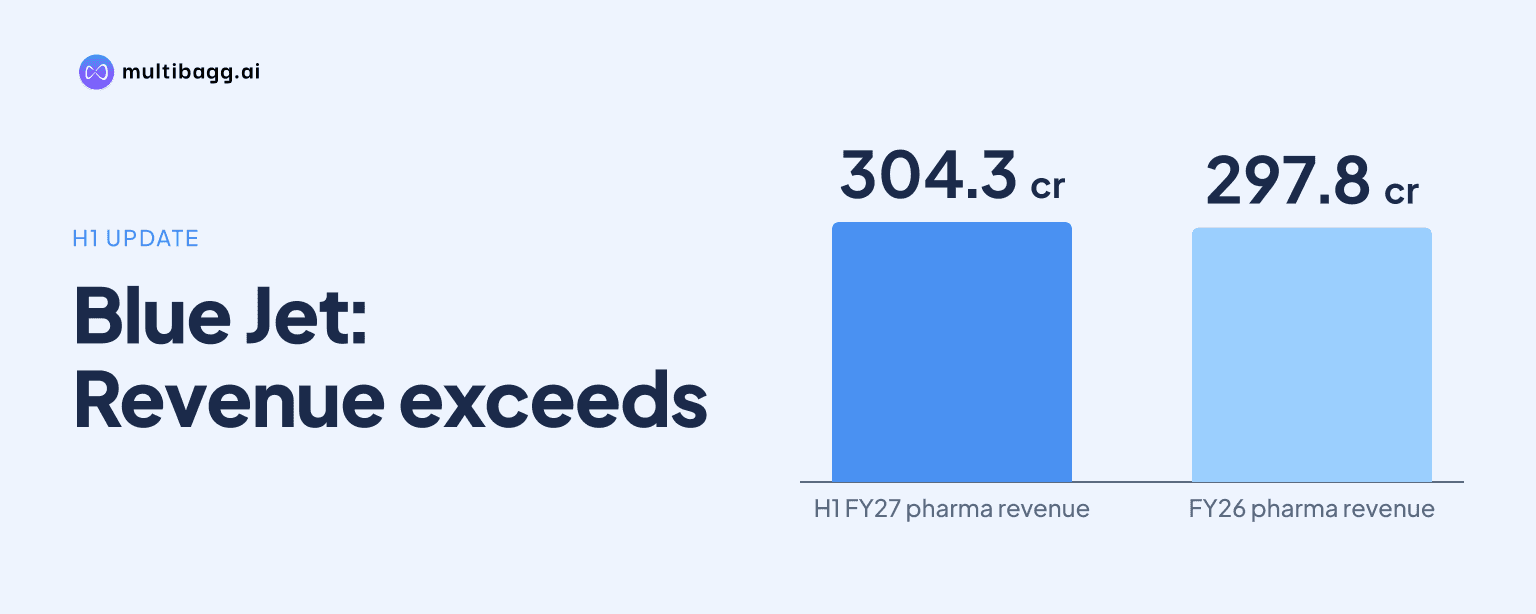
Blue Jet reported Rs 304.3 crore of pharma intermediates and active pharmaceutical ingredients, or APIs, revenue in H1 FY27, exceeding its Rs 297.8 crore total for FY26 by Rs 6.5 crore. The six-month result followed a decline from Rs 462.2 crore in FY25 and reflects the category’s renewed sales momentum.
Know Blue Jet Healthcare inside out
Results, valuation, peers and who's buying, in one view.
Why did Blue Jet pharma revenue exceed FY26 in six months?
Blue Jet’s pharma intermediates and APIs revenue reached Rs 304.3 crore in H1 FY27, above the Rs 297.8 crore reported for all of FY26. The presentation does not identify the products, customer contracts, volumes or pricing that produced the increase, so the reported result establishes a revenue rebound but not its individual drivers.
Blue Jet states a 64.0% compound annual growth rate for the category, although annual sales have varied materially. Revenue fell by Rs 7.2 crore between FY22 and FY23, rose by Rs 60.7 crore in FY24, then increased by Rs 367.5 crore to Rs 462.2 crore in FY25 before declining by Rs 164.4 crore in FY26. H1 FY27 exceeded FY26, but remains Rs 157.9 crore below the FY25 full-year figure.
Blue Jet says it began manufacturing pharma intermediates about two decades ago by leveraging relationships formed through its high-intensity sweeteners business. The category focuses on higher-value intermediates and APIs for chronic therapeutic areas and import substitution, with cardiovascular system, oncology and central nervous system therapies identified as the relevant areas.
What is Blue Jet’s pharma intermediates strategy?
Blue Jet’s strategy is to provide contract development and manufacturing organisation, or CDMO, services in three niche areas: investigational new drugs and new chemical entities, drugs that remain under patent, and genericised drugs that are still niche. For investigational new drugs and new chemical entities, or NCEs, Blue Jet develops advanced intermediates for molecules undergoing trials for United States Food and Drug Administration approvals.
For patented medicines, Blue Jet says it offers advanced intermediates to innovator companies for four APIs that remain under patent. These include two oncology APIs, one cardiovascular-system API and one central-nervous-system API. The presentation characterises this as work for innovators rather than a disclosed portfolio of finished medicines.
The third niche is advanced intermediates for chronic-illness therapies after genericisation, supplied to several large generic pharmaceutical companies. Blue Jet says it offers multiple intermediates in this segment, but does not disclose product count, category revenue, customer concentration or margins for these genericised-drug programmes.
Blue Jet reports more than 40 pharma customers in India and 16 internationally across Europe, North America, South America and Asia. Its customers include innovator pharmaceutical companies and multinational generic pharmaceutical companies. The company says technology transfer is typical in collaborations with innovators, a mechanism it says can reduce development risk.
Got a follow-up? Ask IRIS
How does the CDMO market support Blue Jet’s focus?
Blue Jet positions its pharma category around increased outsourcing of intermediate and API manufacturing. The presentation says outsourcing can support an asset-light model for venture-capital-backed start-ups, while customers seek cost advantages and supply-chain efficiencies. It also cites attempts by global API and formulations companies to reduce dependence on China.
The presentation forecasts 14.0% compound annual growth for the Indian CDMO market between 2024 and 2029F, compared with 12.3% between 2019 and 2024. It forecasts 8.1% annual growth for the global CDMO market from 2024 to 2029F, against 6.9% in 2019 to 2024. These are market estimates, not Blue Jet revenue guidance or a market-share target.
India’s research and development cost is indexed at 25% of United States cost and its manufacturing cost at 45% in the presentation’s 2024 comparison, with the United States indexed at 100% for both. China is indexed at 40% for research and development and 38% for manufacturing. The relative comparison does not disclose Blue Jet’s own cost base, prices or profitability.
For NCE intermediate supply, the presentation says CDMO selection can depend on a supplier’s record in the relevant chemistry and therapeutic area. It says competitive cost is not the most important criterion in such arrangements, citing project confidentiality, novel chemistry and custom-development needs as reasons customers may seek close partnerships.
How does Blue Jet pharma revenue compare with sweeteners?
Blue Jet’s pharma intermediates and APIs revenue was Rs 304.3 crore in H1 FY27, compared with Rs 67.4 crore from high-intensity sweeteners. Pharma revenue was therefore Rs 236.9 crore higher than sweetener revenue in the six-month period. In FY26, the corresponding figures were Rs 297.8 crore and Rs 131.4 crore, respectively.
High-intensity sweetener revenue declined from Rs 175.9 crore in FY23 to Rs 128.2 crore in FY24, then measured Rs 133.5 crore in FY25 and Rs 131.4 crore in FY26. The presentation gives sweeteners a negative 4.4% compound annual growth rate, compared with the 64.0% rate stated for pharma intermediates and APIs.
Blue Jet says its sweeteners business serves more than 300 customers globally, while pharma serves more than 40 Indian and 16 international customers. Sweetener applications include tabletop products, oral care, beverages, confectionery, pharmaceutical products, food supplements and animal feed. Pharma’s stated differentiation rests on innovator relationships, process research, analytical research, chemistry capabilities and product quality.
Conclusion
Blue Jet’s H1 FY27 pharma intermediates and APIs revenue of Rs 304.3 crore surpassed its Rs 297.8 crore full-year FY26 total, reversing the direction seen after the category declined from Rs 462.2 crore in FY25. The sales result sits alongside a strategy focused on investigational molecules, four patented APIs and niche genericised chronic-therapy intermediates.
The next reported milestone is full-year FY27 revenue against the Rs 462.2 crore recorded in FY25, as Blue Jet gives no FY27 category revenue target or product-level sales split. Execution of its disclosed NCE trial work, patented-drug API projects and niche generic programmes will also determine whether the H1 FY27 revenue level is sustained.