










Blue Jet’s Q2 gross margin falls on West Asia input costs
Key highlights
- Blue Jet reported Q2 FY27 operating revenue of Rs 375 crore, up 28% sequentially.
- Blue Jet’s Q2 FY27 gross margin was 49%, down four percentage points sequentially.
- Blue Jet’s H1 FY27 revenue rose 29% year on year to Rs 669 crore while gross margin declined three percentage points to 51%.
- Selected customer price increases are expected to begin from Q3 FY27, subject to contract-specific negotiations.
powered by IRIS
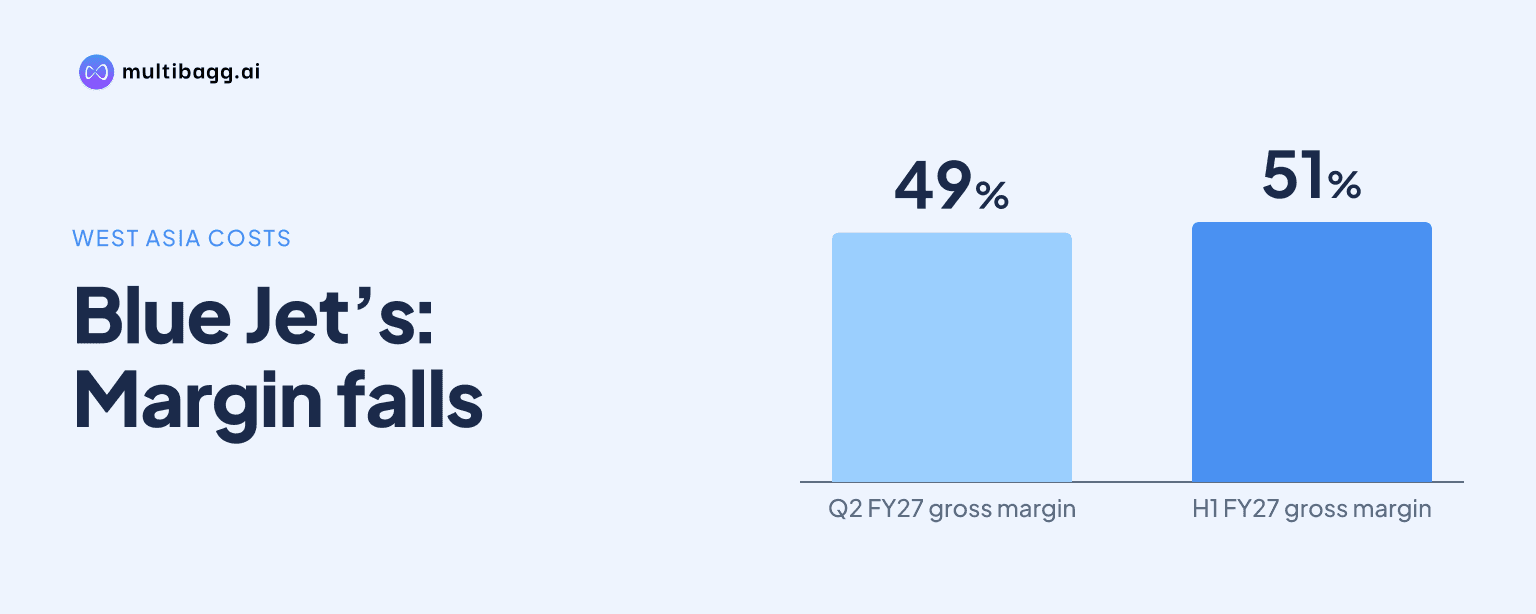
Blue Jet Healthcare reported a Q2 FY27 gross margin of 49%, down four percentage points sequentially, as higher West Asia-linked costs for reagents, solvents and catalysts reached production costs before customer price revisions. Operating revenue rose 28% sequentially to Rs 375 crore, while selected revised prices are expected to take effect from Q3 FY27.
Know Blue Jet Healthcare inside out
Results, valuation, peers and who's buying, in one view.
Why did Blue Jet’s gross margin decline in Q2 FY27?
Blue Jet’s Q2 FY27 gross margin declined because prices of raw materials, including reagents, solvents and catalysts, rose following disruption in West Asia. The company reported a 49% gross margin, four percentage points below the previous quarter, and said the effect varied by product based on the inputs procured and the pricing terms in each customer contract.
The timing of purchases, inventory consumption and in-transit stock determined when higher input costs entered the Q2 FY27 cost base. This means the margin impact did not reflect only current purchasing costs: it also reflected when inventory bought at higher prices was consumed in manufacturing.
The decline came despite a 28% sequential rise in Q2 FY27 operating revenue to Rs 375 crore. Contrast media grew 25% sequentially and pharmaceutical intermediates and active pharmaceutical ingredients, or PI/API, grew 52%, while artificial sweeteners declined 30%, making product mix another factor in the reported 49% gross margin.
How is Blue Jet recovering higher input costs?
Blue Jet is reviewing selling-price increases contract by contract, with revised prices for certain selected customers expected to take effect from Q3 FY27. Management did not say that all cost inflation would be recovered, instead noting that the result depends on the input used in a product and the pricing terms agreed with each customer.
Management said in Q2 FY27 that contract development and manufacturing organisation, or CDMO, businesses can pass through some raw-material cost increases, but cannot fully pass through every increase in reagents and solvents. Blue Jet is therefore evaluating how much of the higher cost it can absorb and how much it can charge to customers.
The company expects customer price increases to have a positive effect on gross-margin percentage in coming quarters, but cited three variables: changes in input costs, product mix and the date on which each revised customer price becomes effective. The lag before Q3 FY27 price revisions take effect can keep pressure on margin even after costs have increased.
What do Blue Jet’s half-year results show?
Blue Jet’s H1 FY27 gross margin was 51%, down three percentage points from H1 FY26, extending the Q2 FY27 margin pressure into the first half. Revenue nevertheless rose 29% year on year to Rs 669 crore, led by 47% growth in contrast media and 19% growth in PI/API, while artificial sweetener revenue declined 2%.
Absolute profit increased despite the percentage-margin decline. Q2 FY27 earnings before interest, tax, depreciation and amortisation, or EBITDA, were Rs 119 crore, equal to 32% of operating revenue and one percentage point below the prior quarter; profit after tax was Rs 103 crore, or 27% of total income, unchanged sequentially.
For H1 FY27, EBITDA was Rs 217 crore, or 32% of operating income, down two percentage points from H1 FY26. Profit after tax was Rs 181 crore, or 27% of total income and down one percentage point year on year; management attributed the marginal reduction in profitability ratios to headcount additions and certain logistics costs, alongside the input-cost issue discussed for Q2.
Got a follow-up? Ask IRIS
Which segments affected Blue Jet’s Q2 FY27 mix?
Blue Jet’s Q2 FY27 mix shifted as PI/API revenue grew 52% sequentially, contrast media grew 25%, and artificial sweeteners declined 30%. Management said the gross-margin impact differs product by product because input sourcing and customer pricing arrangements are not uniform across the three businesses.
Management described contrast media as reasonably constant from a production perspective and said existing volumes were being sustained in Q2 FY27. It attributed the segment’s momentum to a combination of molecules rather than a single product, and did not disclose product-level revenue because of customer confidentiality.
In PI/API, management said commercial supplies of oncology and central nervous system products were included in Q2 FY27. It also said the quarter’s PI/API growth came from both the existing portfolio and new products, but did not quantify their individual revenue or volume contributions.
What could determine Blue Jet’s margin from here?
Blue Jet said selected Q3 FY27 customer price increases could support gross margin, but did not provide a target or identify the Q2 FY27 level of 49% as a floor. Management said the outcome will remain dependent on crude-linked prices for chemicals and solvents, as well as mix and contract-specific price adjustments.
Management said it could not estimate whether crude prices had peaked or bottomed, or predict the resulting movement in linked chemical prices. It said the current level would be a reasonable estimate if crude remains at that level, making commodity-price movement an unresolved determinant of margin rather than company guidance.
Longer term, Mahad Unit 3 is intended to provide backward integration for a strategically critical contrast-media key starting material, or KSM. The facility remained on track to start in the second half of the year, after approximately Rs 250 crore of capital expenditure had been incurred to date, and management said the project should strengthen cost competitiveness and supply security.
Conclusion
Blue Jet combined 28% sequential Q2 FY27 operating-revenue growth to Rs 375 crore with a four-percentage-point gross-margin decline to 49%, illustrating the effect of higher West Asia-linked input costs before customer pricing resets. The H1 FY27 figures show the same balance: revenue increased 29% to Rs 669 crore while gross margin declined three percentage points to 51%.
The next item to watch is the impact of selected customer price increases planned from Q3 FY27, alongside crude-linked chemical prices and the product mix between contrast media, PI/API and artificial sweeteners. Management also said Mahad Unit 3 remains on schedule for the second half of the year, while the Rs 800 crore qualified institutional placement is planned for phased deployment over the next three years for capital expenditure, working capital and general corporate purposes.