










Bluspring projects ₹4,700 crore-plus FY27 revenue growth
Key highlights
- Bluspring estimates FY27 revenue of more than Rs 4,700 crore, versus Rs 3,304 crore in FY26.
- Smart Infra, Energy and Engineering is estimated to rise to 36% of FY27 sales from 19% in FY26.
- Bluspring reported a 4.7% EBITDA margin in H1 FY27, compared with 3.7% in FY25 and FY26.
- Bluspring’s 2030 targets include revenue of about Rs 6,000 crore to Rs 7,400 crore and a 6% EBITDA margin.
powered by IRIS
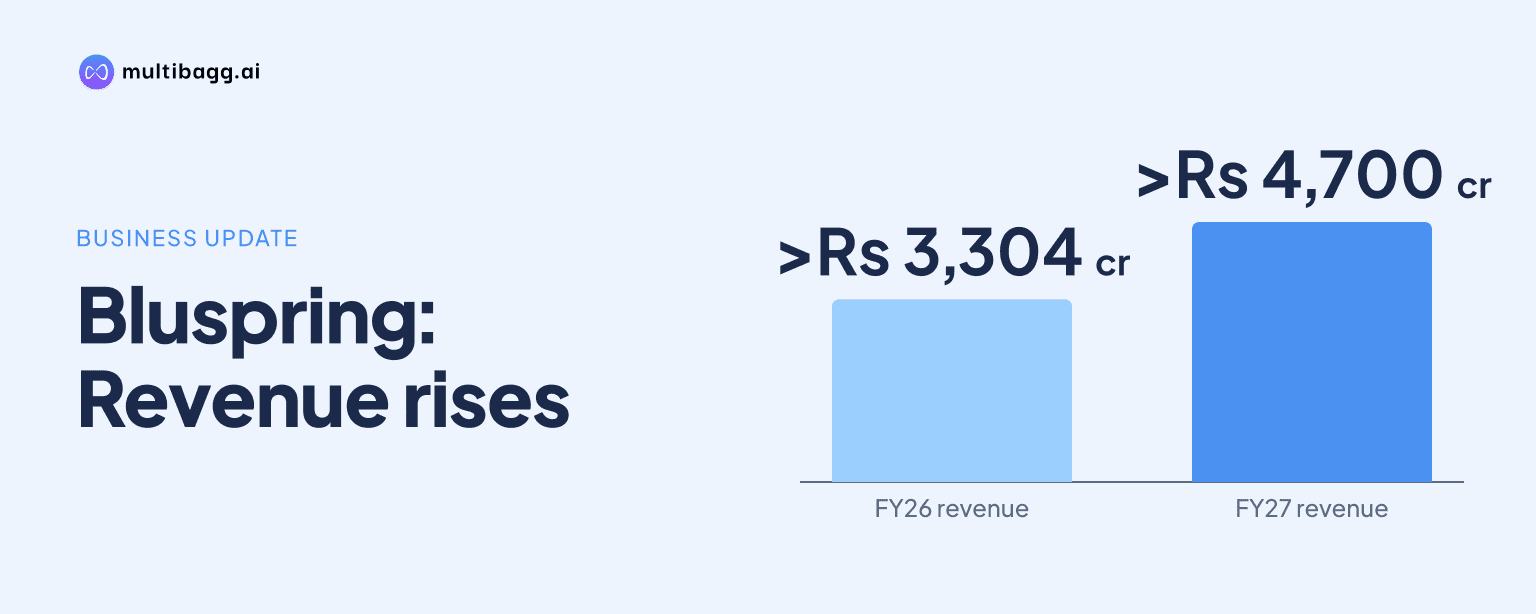
Bluspring projects FY27 revenue of more than Rs 4,700 crore, following Rs 3,304 crore in FY26, while Smart Infra, Energy and Engineering is estimated to account for 36% of sales, up from 19%. Management links this mix change to acquisitions, cross-selling and a shift towards integrated energy and industrial services.
Know Bluspring Enterprises inside out
Results, valuation, peers and who's buying, in one view.
How fast does Bluspring expect revenue to grow in FY27?
Bluspring expects FY27 revenue to exceed Rs 4,700 crore, compared with Rs 3,304 crore in FY26 and Rs 2,969 crore in FY25. Based on the lower end of its estimate, this represents at least Rs 1,396 crore of additional revenue versus FY26. Revenue rose by Rs 335 crore between FY25 and FY26, making the indicated FY27 increase larger than the previous year’s reported increase.
The FY27 estimate forms part of targets announced during Bluspring’s demerger in Q1 FY26. Management set a 2030 revenue target of about Rs 6,000 crore to Rs 7,400 crore, described as growth at three times gross domestic product, or GDP. The presentation identifies FY26 revenue of Rs 3,304 crore and the FY27 estimate above Rs 4,700 crore as progress towards that range. All stated target and progress figures exclude foundit.
FY27 E means FY27 estimated. The presentation does not provide a quarterly revenue split, an organic-versus-acquired revenue split, or separate revenue guidance for its business verticals. It therefore supports a company-wide FY27 revenue outlook, rather than a precise estimate for Smart Infra, Energy and Engineering, Facility and Food, or Security Solutions.
Why is Smart Infra, Energy and Engineering becoming more important?
Bluspring estimates that Smart Infra, Energy and Engineering will account for 36% of FY27 revenue, compared with 19% in FY26. That is a projected increase of 17 percentage points in the vertical’s share of sales. Bluspring describes Smart Infra, Energy and Engineering as its highest-margin vertical and says the rising contribution should aid margin expansion.
The expected mix shift coincides with lower sales shares for its other two reported categories. Facility and Food is estimated to represent 49% of FY27 revenue, down from 61% in FY26, while Security Solutions is estimated at 15%, down from 20%. These lower shares do not establish that either category’s revenue will decline, because Bluspring expects total revenue to rise above Rs 4,700 crore.
Bluspring lists facility management, food and hospitality, security solutions, smart infrastructure, energy and engineering in its service offering. The company presents this as a one-stop offer for energy and industrial customers. Its strategy is to move from manpower and service-level-agreement, or SLA, based services towards integrated client relationships that can include multiple service lines.
What is Bluspring’s plan for improving margins?
Bluspring’s stated plan is to build a higher-margin integrated-services model through inorganic expansion, cross-selling and international presence. The presentation describes three stages: manpower and SLA-based services; movement into higher-margin businesses through energy and aviation-catering acquisitions; and an integrated provider model that cross-sells services as a one-stop solution.
Management says each progression in this model deepens client integration and structurally enhances margins. The stated mechanism is a change in service mix towards Smart Infra, Energy and Engineering, combined with cross-selling facility management, food and hospitality, security and technical services to the same customer base. The presentation does not disclose an FY27 segment-level margin forecast.
Bluspring identifies STEAG Energy Services India in energy and industrials and LSG Sky Chefs India in food and aviation catering under inorganic growth. These businesses align with the energy and food areas cited in the strategy. The presentation does not disclose their purchase prices, closing dates, standalone revenue, profitability, integration costs or specific FY27 revenue contribution.
Got a follow-up? Ask IRIS
Is Bluspring already reporting higher profitability?
Bluspring reported an earnings before interest, tax, depreciation and amortisation, or EBITDA, margin of 4.7% in H1 FY27, compared with 3.7% in FY26 and 3.7% in FY25. The H1 FY27 figure was therefore 1.0 percentage point above the full-year margins reported in each of the preceding two fiscal years. It is the only interim EBITDA-margin figure shown in the presentation.
Bluspring’s 2030 EBITDA-margin target is 6%, announced during the Q1 FY26 demerger. The reported H1 FY27 margin of 4.7% was 1.3 percentage points below that target. Management presents the business-model pivot and a greater Smart Infra, Energy and Engineering revenue share as the route towards 6%, rather than giving a separate FY27 margin target.
The comparison is not like-for-like because FY25 and FY26 are full fiscal years while H1 FY27 covers the first half of FY27. The source does not disclose EBITDA in rupees, segment-level margins or the driver of the H1 FY27 margin movement. It does show an improved interim margin while Bluspring pursues the stated revenue-mix change.
What market opportunity does Bluspring identify for energy and industrial services?
Bluspring identifies higher Indian capital expenditure in power, metals and mining as the demand backdrop for its energy and industrial strategy. The presentation estimates power-sector capital expenditure at about Rs 23 lakh crore to Rs 26 lakh crore in FY26–30P, versus about Rs 12 lakh crore to Rs 13 lakh crore in FY21–25. Metals and mining capital expenditure is estimated at about Rs 7.5 lakh crore to Rs 9 lakh crore, compared with Rs 2.8 lakh crore to Rs 3.5 lakh crore previously.
The presentation shows peak power demand of 271 gigawatts, or GW, in FY27 year to date, compared with 250 GW in FY25, and projects 345 GW by FY30. It states that coal accounted for about 66% of demand in FY27 year to date and is projected to account for 55% in FY30. Bluspring links industrial asset creation and outsourcing to a longer runway for specialist service providers, without disclosing a market-share target.
The metals and mining data point to expanding industrial capacity, including 222 million tonnes of crude steel capacity in June 2026 and a stated path towards 300 million tonnes by 2030. Finished-steel exports rose 36% to 6.6 million tonnes in FY26. These data provide context for Bluspring’s industrial-services focus, but they are not a forecast of Bluspring revenue.
Conclusion
Bluspring’s strategy centres on increasing the contribution of Smart Infra, Energy and Engineering from 19% of sales in FY26 to an estimated 36% in FY27. Together with its revenue projection above Rs 4,700 crore and reported H1 FY27 EBITDA margin of 4.7%, the figures indicate that management expects both scale and business mix to change.
The next disclosed measures are delivery against the FY27 revenue estimate, movement towards the 6% EBITDA-margin target for 2030, and execution of the STEAG Energy Services India and LSG Sky Chefs India growth plans. Bluspring has set a 2030 revenue target of about Rs 6,000 crore to Rs 7,400 crore, while the source leaves undisclosed the acquisitions’ segment-level financial contribution and cross-selling outcomes.