










Bombay Dyeing starts THREE ICC revenue recognition at cost
Key highlights
- Bombay Dyeing began recognising THREE ICC revenue over time in the quarter ended September 30, 2026.
- Bombay Dyeing transferred Rs 180.73 crore into work-in-progress inventory during the half year ended September 30, 2026.
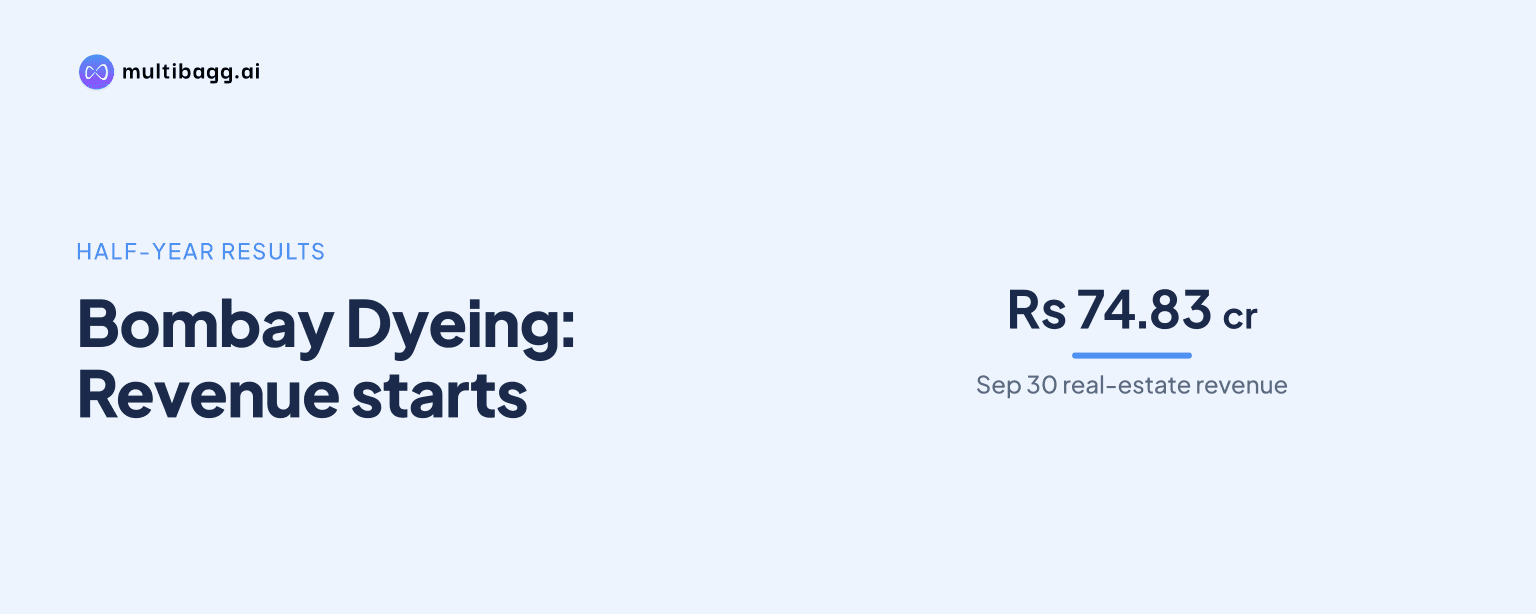
- Bombay Dyeing reported Rs 74.83 crore of real-estate segment revenue in the September 2026 half year, versus nil a year earlier.
- Bombay Dyeing’s real-estate segment reported a Rs 23.73 crore loss before tax and finance costs in the September 2026 half year.
powered by IRIS
The Bombay Dyeing and Manufacturing Company Limited began recognising THREE ICC revenue over time for the quarter ended September 30, 2026, but recorded it only to the extent of costs incurred because development had not reached a reasonable level; Bombay Dyeing transferred Rs 180.73 crore of project costs into work-in-progress inventory during the half year.
Know Bombay Dyeing & Manufacturing Company inside out
Results, valuation, peers and who's buying, in one view.
How is Bombay Dyeing recognising THREE ICC revenue?
Bombay Dyeing is recognising THREE ICC revenue over time under Indian Accounting Standard 115, Revenue from Contracts with Customers, based on contracts with customers. The project received the required regulatory approvals during the year ended March 31, 2026, and Bombay Dyeing launched it in the quarter ended June 30, 2026.
For the quarter and half year ended September 30, 2026, Bombay Dyeing said THREE ICC had not reached a reasonable level of development. It therefore recognised revenue only to the extent of costs incurred, rather than recording a margin on the development work. The company measures the stage of completion as costs incurred relative to total estimated project costs.
This is a change from the comparable half year ended September 30, 2025, when Bombay Dyeing reported no real-estate segment revenue. Real-estate segment revenue reached Rs 74.83 crore in the half year ended September 30, 2026. The filing does not separately disclose the amount attributable exclusively to THREE ICC, so that segment figure is not a direct measure of project revenue.
What did Bombay Dyeing report for real-estate revenue and profit?
Bombay Dyeing reported Rs 32.78 crore of real-estate segment revenue for the quarter ended September 30, 2026, versus Rs 42.05 crore in the quarter ended June 30, 2026 and nil in the quarter ended September 30, 2025. The sequential decrease was Rs 9.27 crore, while the first-half total was Rs 74.83 crore.
The real-estate segment recorded a loss before tax and finance costs of Rs 10.79 crore in the September 2026 quarter, compared with losses of Rs 12.94 crore in the June 2026 quarter and Rs 3.12 crore a year earlier. For the half year ended September 30, 2026, the segment loss was Rs 23.73 crore, compared with Rs 7.50 crore in the prior-year half year.
At company level, Bombay Dyeing reported revenue from operations of Rs 643.78 crore in the September 2026 quarter, up from Rs 410.80 crore in the June 2026 quarter and Rs 362.63 crore a year earlier. Polyester generated Rs 588.03 crore of segment revenue, compared with Rs 32.78 crore for real estate and Rs 19.73 crore for retail/textile, keeping polyester as the largest reported segment.
Why did Bombay Dyeing transfer Rs 180.73 crore into inventory?
Bombay Dyeing transferred costs previously capitalised as land-improvement cost or capital work-in-progress from property, plant and equipment into inventories, specifically work-in-progress, after THREE ICC commenced. The transfer was Rs 27.53 crore for the quarter ended September 30, 2026 and Rs 180.73 crore for the half year ended September 30, 2026.
The half-year transfer exceeded the September-quarter amount by Rs 153.20 crore, indicating that most of the six-month reclassification occurred before or alongside the September quarter. Bombay Dyeing did not disclose THREE ICC's estimated total cost, sales value, customer-contract count or percentage of completion. The Rs 180.73 crore transfer is therefore a balance-sheet reclassification, not an estimate of future revenue or the full project cost.
Real-estate segment assets stood at Rs 800.78 crore on September 30, 2026, compared with Rs 664.09 crore on March 31, 2026 and Rs 456.85 crore a year earlier. Segment liabilities were Rs 340.18 crore at September 30, 2026, versus Rs 265.69 crore at March 31, 2026. The filing does not provide an asset-level reconciliation that attributes every movement to THREE ICC.
Got a follow-up? Ask IRIS
How did THREE ICC accounting affect Bombay Dyeing’s results?
Bombay Dyeing reported Rs 74.83 crore of cost of projects for the half year ended September 30, 2026, alongside Rs 74.83 crore of real-estate segment revenue. In the September quarter, cost of projects was Rs 32.79 crore and real-estate segment revenue was Rs 32.78 crore. These figures are consistent with the disclosed policy of recognising revenue to the extent of costs incurred, although the filing does not identify either line item as solely THREE ICC.
Bombay Dyeing also reclassified certain June 2026-quarter profit-and-loss items into cost of projects to align presentation with prevailing industry practices and peer-group presentation. The reclassified items were Rs 50.42 crore of changes in inventories, Rs 2.81 crore of employee-benefit expense and Rs 89.65 crore of other expenses. Management said the reclassifications did not affect the information presented in the statement of profit and loss.
Consolidated profit after tax was Rs 12.93 crore in the quarter ended September 30, 2026, compared with Rs 7.08 crore in the June 2026 quarter and Rs 1.92 crore a year earlier. Consolidated net cash used in operating activities was Rs 94.77 crore in the half year, compared with Rs 42.77 crore used in the prior-year period; inventories rose by Rs 55.56 crore and trade receivables by Rs 59.13 crore.
What does Bombay Dyeing’s filing not disclose about THREE ICC?
Bombay Dyeing does not disclose the total estimated project cost, the stage-of-completion percentage, contracted sales value or the rupee amount of revenue specifically recognised from THREE ICC. Its stated cost-to-total-estimated-cost method means those figures would be necessary to calculate the project’s completion status or assess revenue recognised beyond the cost-incurred approach.
The filing also does not provide booking data, customer advances, unit sales or a construction-completion timetable for THREE ICC. It does disclose that revenue is based on customer contracts and recognised over time, while the real-estate segment reported Rs 74.83 crore of revenue and a Rs 23.73 crore pre-tax-and-finance-cost loss for the half year ended September 30, 2026.
Conclusion
Bombay Dyeing has moved THREE ICC from launch into over-time revenue recognition, with early revenue limited to costs incurred because the project had not reached a reasonable level of development. The Rs 180.73 crore transfer into work-in-progress inventory and Rs 74.83 crore of half-year real-estate segment revenue show that the project is now reflected in both operating results and balance-sheet classification.
The next disclosures to watch are changes in the project's stage of completion and total estimated project costs, because Bombay Dyeing's cost-based completion method determines when revenue recognition may move beyond the current cost-incurred approach. Subsequent updates on work-in-progress inventory, receivables and the real-estate segment result can also show how the accounting treatment develops after September 30, 2026.